

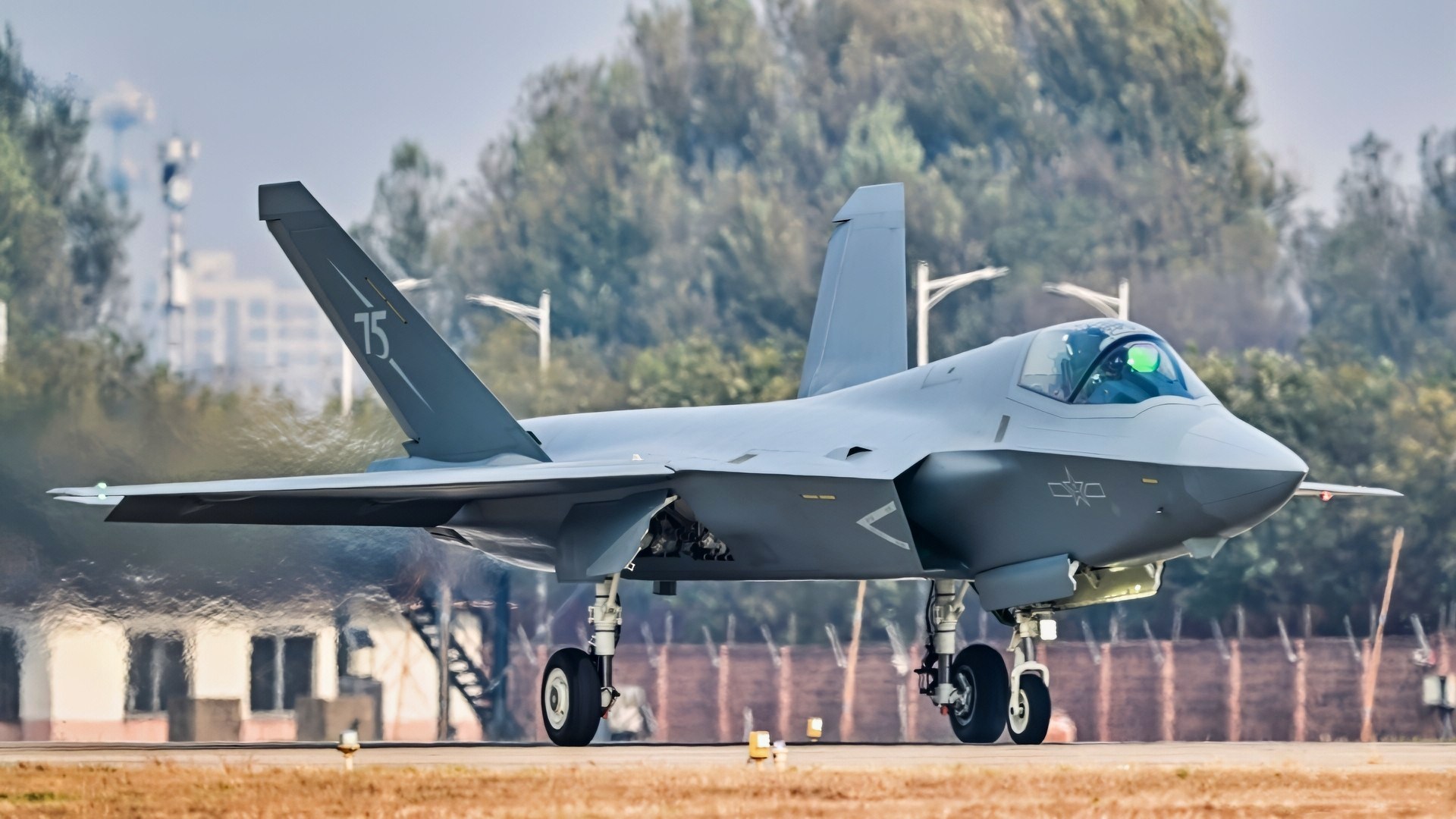
China may soon operate its J-35 stealth fighter from all three of its aircraft carriers — a significant upgrade to the PLA Navy. Only the new carrier Fujian, with its electromagnetic catapult, can launch the J-35 today, but China is reportedly modifying the older ski-jump carriers Liaoning and Shandong to match it. A carrier-based counterpart to the J-20, the J-35 is China’s answer to the U.S. F-35. Even so, analysts say America’s carriers still hold a decisive edge.
The J-35 Stealth Fighter Is On the Rise

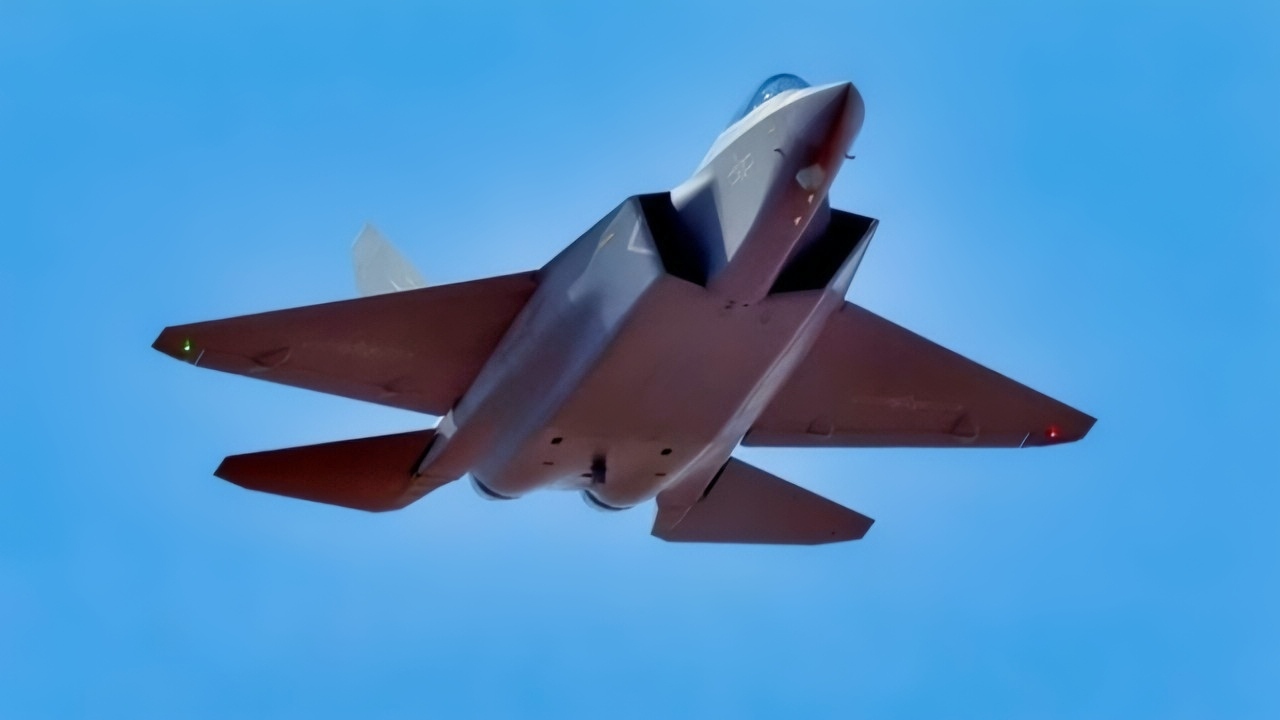
J-35 Fighter from China. Image Credit: PLAAF.

J-35 New Stealth Fighter from China
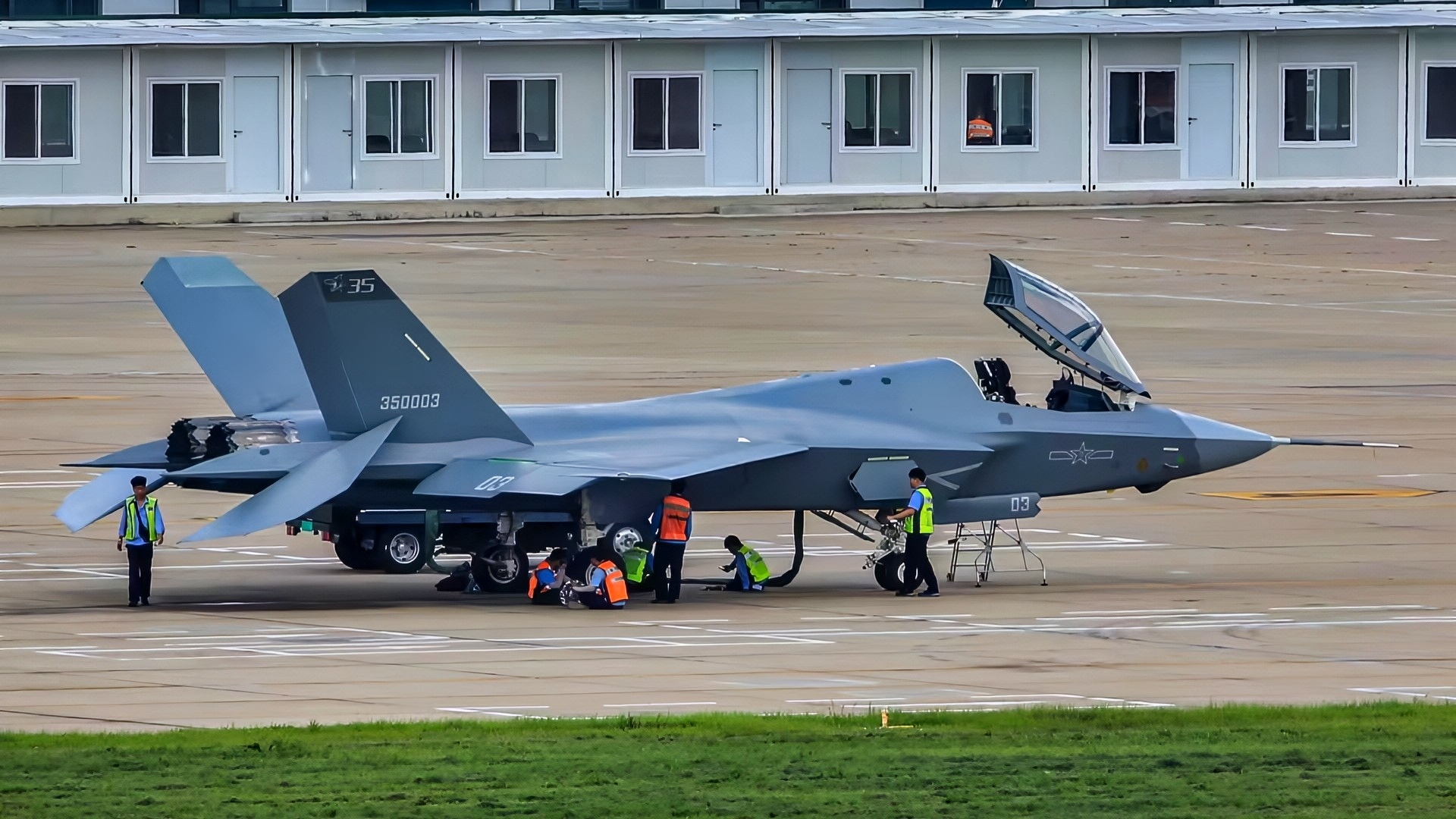
China J-35 Fighter on Runway. Image Credit: PLAAF.
All of China’s aircraft carriers may soon be operating the J-35 stealth fighter. An article in the South China Morning Post stated that all three of China’s aircraft carriers could soon operate the country’s J-35 stealth fighter, which Chinese experts say would “significantly” bolster the PLAN’s combat capabilities.
Currently, only China’s newest carrier, the Fujian, can host the J-35 because it has an electromagnetic catapult (EMALS) for launching the fifth-generation fighter.
The Liaoning and Shandong carriers, former Soviet carriers, launch J-15 fighters from a “ski-jump” deck. China, however, is reportedly upgrading the two older vessels in order to launch the J-35.
“The Liaoning is training in the western Pacific; could the J-35 be on board?” the military channel of Chinese state broadcaster CCTV said in a social media post on Wednesday. This question got plenty of coverage on social media.
China does not usually announce military developments while they are still in progress, but it sometimes uses state media to imply or tease new developments.
Can a J-35 take off from a ski jump carrier?
A fully-loaded J-35 weighs 28,000 kgs or 61,700 pounds, which is a lot of weight. Obviously, when aircraft take off from a ski-jump-type carrier, they are much lighter, using less fuel and fewer weapons.
However, it would require significant work on the carrier and/or the aircraft itself to make it work.
“Even if CCTV did not make that implication, I think electromagnetic-launched aircraft could totally use a ski-jump,” Chinese military analyst Fu Qianshao said to The South China Morning Post (SCMP). “There is no technical difficulty for electromagnetic-launched fighters to ski-jump off Liaoning and Shandong,” he added.
“This means the carrier strike groups’ combat capability has improved significantly, both in terms of battlefield situational awareness and long-range attack capabilities,” Fu said.
China Modifying Its Two Older Carriers
Jane’s Defense Weekly reported that a US firm, Vantor, released images of construction work being undertaken on the deck of the carrier Shandong.
“The stern arresting gear is designed to allow aircraft to enter a safe taxiing or stationary position within a short distance during landing, so modifications to this device may aim to increase the arresting gear’s reliability,” a PLA instructor, Song Zhongping, said to the SCMP.
“The bow brake wheel chocks are designed to allow aircraft to obtain maximum thrust before take-off; modifications to this device may be to adjust the thrust and safety of catapult-launched aircraft,” he added.
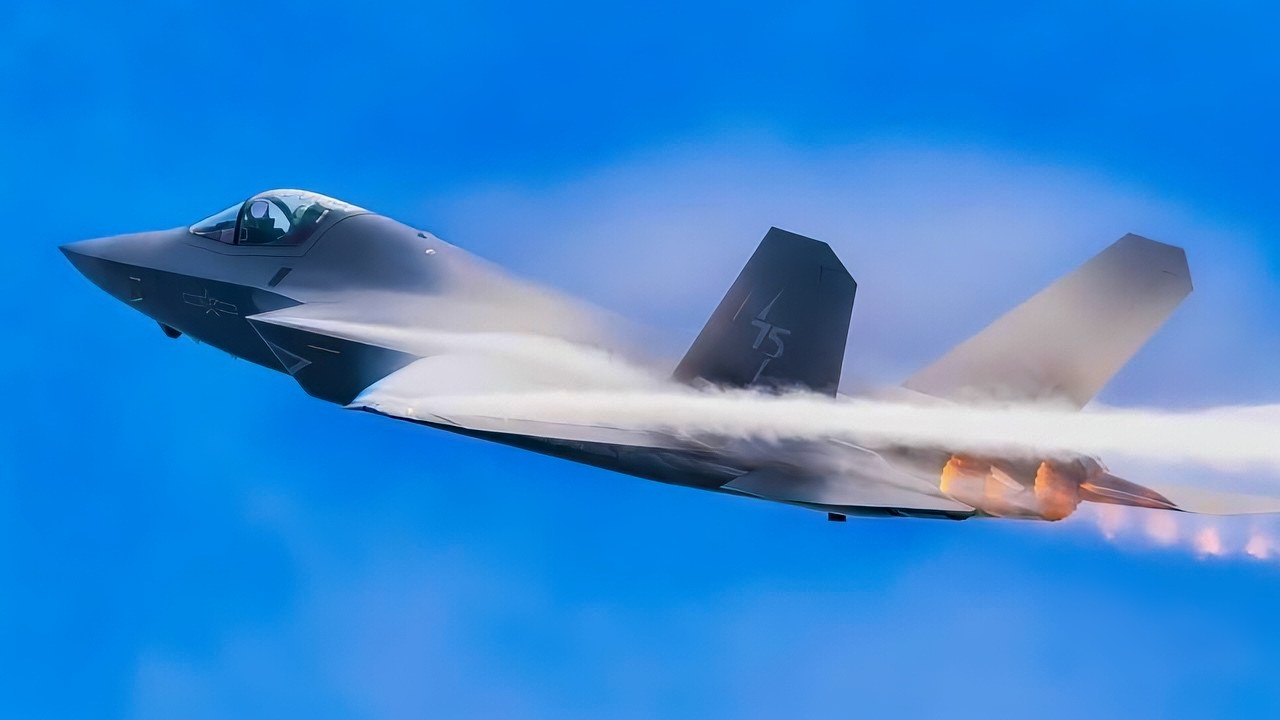
J-35A Fighter in the Clouds. Image Credit: Chinese Weibo.

J-35 China Weibo Screenshot.

China’s New J-35 Stealth Fighter

China New J-35 Fighter on Aircraft Carrier. Image Credit: Chinese Weibo.
China Arms reported that the J-35 is currently undergoing deployment tests aboard the Liaoning, and similar tests will also be conducted aboard the Shandong.
Background On China’s J-35 Fifth-Generation Stealth Fighter
China’s J-35 is a carrier-based fighter built to fly off China’s aircraft carriers.
The J-35 traces its roots back to the Shenyang Aircraft Corporation’s FC-31, a prototype aircraft with some stealth features that first flew in 2012. A land variant of the J-35 is called the J-35A.
The FC-31 was initially conceived as an export stealth fighter but evolved into the J-35, a test and research platform for a carrier-based fighter.
Around a decade later, the first iteration of the J-35 took flight. It featured folding wings and robust landing gear for tight storage and hard landings on aircraft carriers. China recently made its first-ever catapult takeoffs from its new carrier.
The Chinese Government-backed Global Times says the J-35 is quite different from its predecessor, the J-20, in its discussion of the J-35’s arrival. The Chinese paper compares the J-20 to its J-35 and says its newer J-35 stealth fighter is lighter and faster, similar to the F-35, and engineered for “strong surface attack capabilities.”
“The J-35A has a different design than China’s first stealth fighter jet, the J-20. The J-20, with a canard wing configuration, is a heavy fighter jet with a focus on air superiority missions comparable with the US’ F-22, while the medium-sized J-35A uses a tailplane wing configuration similar with the US’ F-35 that also has strong surface attack capabilities,” The Global Times says.
The China Daily reported that Wang Yongqing, chief researcher at the Aviation Industry Corp of China’s Shenyang Aircraft Design and Research Institute, said the J-35A provides what he described as “systems coordination” or “multi-domain coordination” in combat.
“It [the J-35A] can lock on the targets, share the targets’ position with other weapon systems, such as surface-to-air missiles, and even use its own radar to guide other weapons to bring the targets down,” he told the state-run newspaper in an interview published on May 13.
The J-35 Has “First Detection, First Strike” Capabilities
“Our adversaries will definitely use their stealth aircraft or low-observable cruise missiles to penetrate our air defense networks,” Yongqing Wang explained, without naming any specific countries. The U.S. and its allies operate over 1,320 F-35 stealth fighter jets, including those operated by Japan.
Lockheed Martin, the manufacturer of the F-35, has claimed that the aircraft, described as a “force multiplier,” has demonstrated its ability to link with missile defense systems to detect, track, and destroy threats “sooner and safer” by providing sensor data in a network.

U.S. Air Force Maj. Melanie “Mach” Kluesner, the pilot for the F-35A Demonstration Team, performs aerial maneuvers in a USAF F-35A Lightning II during the first day of the airshow at Jacksonville Naval Air Station, Florida, on 18 October, 2024. The Demo Team performs at various airshows across the globe to display the power, agility, and lethality of America’s 5th generation fighter jet. (U.S. Air Force photo by Senior Airman Nicholas Rupiper)

Capt. Kristin “BEO” Wolfe, F-35A Lightning II Demonstration Team pilot and commander, flies during an airshow demonstration practice Mar. 5, 2020, at Hill Air Force Base, Utah. The team will make its first of 20 appearances at the Yuma Air Show, Mar. 13-14, 2020, at Marine Corps Air Station, Yuma, Ariz. (U.S. Air Force photo by Cynthia Griggs)
“The J-35A has significant advantages in terms of first detection, first strike, and securing operational advantages,” Wang said. He added that in combat against previous generations of aircraft, “the J-35A can remain outside the effective detection range of the enemy, achieving one-way transparency of the battlefield situation and possessing overwhelming advantages that disrupt traditional air combat patterns,” the Global Times states.
However, the only information on J-35 variants is what China has released. We don’t yet know the aircraft’s capabilities, especially its stealth properties, but they are supposedly selling 40 J-35As to Pakistan.
Regardless, if the Chinese can launch J-35s from the Shandong and Liaoning, it will immediately upgrade China’s carrier strike group’s power. Equipping the entire fleet with the J-35 stealth fighter provides China’s carriers with flexible deployment options and vastly improved sensor, networking, and stealth capabilities.
This will change those small carriers from nothing more than cannon fodder to legitimately being able to take on American carriers, although they’d still be outgunned, even if they operated together.
About the Author: Steve Balestrieri
Steve Balestrieri is a National Security Columnist. He served as a US Army Special Forces NCO and Warrant Officer. In addition to writing on defense, he covers the NFL for PatsFans.com and is a member of the Pro Football Writers of America (PFWA). His work was regularly featured in many military publications.


