

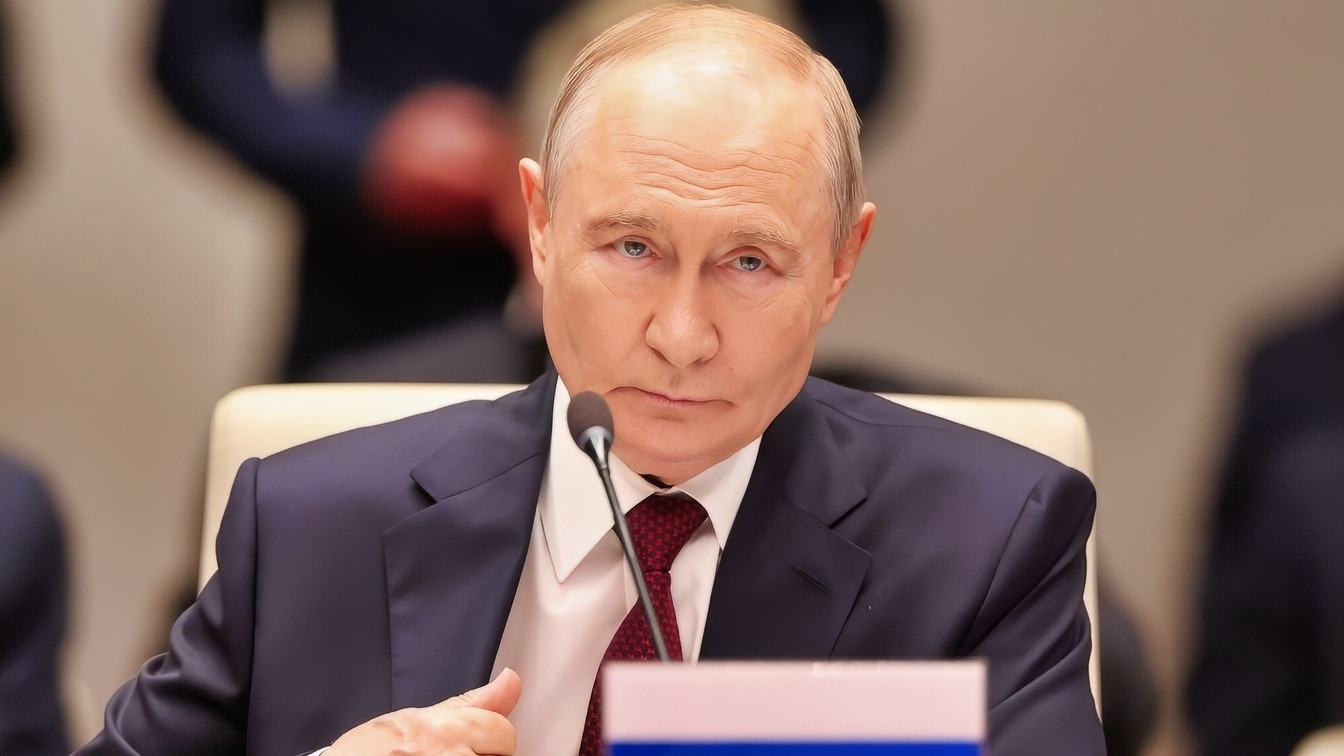
Zelenskyy: Putin Told His Commanders the Rules of War No Longer Apply – “He said there are no rules now.” That’s how Ukrainian President Volodymyr Zelenskyy described the order he says Vladimir Putin gave his military leadership in September. That strategy should put all of Europe on notice.
Speaking to the Financial Times from the bomb shelter of a Kyiv school that had just been hit, Zelenskyy said Ukrainian intelligence intercepted communications between Kremlin officials showing Putin lifted the remaining restrictions on air strikes against civilian targets, according to the Kyiv Post.

T-14 Armata. Image Credit: Creative Commons.

Main battle tank T-14 object 148 on heavy unified tracked platform Armata. Image Credit: Creative Commons.
Schools. Hospitals. Data centers. Bridges. All of it is now fair game, if Zelenskyy is right.
However, it’s important to note what we know and what we don’t. The intercepts haven’t been made public, and the claim can’t be independently verified.
The Kremlin, as expected, denies it all. Spokesman Dmitry Peskov insisted that “Russian forces do not strike schools or hospitals.”
Official Russian officials categorically deny intentionally targeting schools, hospitals, and civilian infrastructure, consistently maintaining that their military strikes only target military infrastructure or critical logistics networks.
Despite these official denials, independent international bodies, humanitarian organizations, and intelligence agencies have extensively documented thousands of direct strikes on civilian facilities.
According to documentation compiled by the World Health Organization (WHO), there have been more than 3,000 verified attacks affecting healthcare facilities in Ukraine since the full-scale invasion began. At the same time, Ukraine’s Ministry of Education and Science has cataloged damage or destruction to over 4,700 educational institutions.
Why Now? Look At The Donbas
Zelenskyy ties the order directly to Russia’s battlefield failures. After the Kremlin’s offensive in the Donbas stalled, he argues, Moscow went looking for another way to break Ukraine.
“They couldn’t organize occupation, and that’s why they do now the same massive attack, massive killing,” he said, as quoted by Türkiye Today.
That tracks with how this war has been fought from the beginning. When Russian ground forces can’t take a city, Russian missiles and drones try to make it unlivable. It’s the Grozny playbook. It’s the Aleppo playbook. Mariupol was the first chapter in Ukraine.
This mirrors Russia’s prior actions during its military intervention in Syria. When accused by Turkey and the United Nations of bombing hospitals and schools in rebel-held areas, Kremlin spokesperson Dmitry Peskov repeatedly rejected the claims, stating that accusers were “unable to prove their allegations in any way.”
According to 112 Ukraine, the shift is toward mass bombardment and intimidation, leaning on overwhelming firepower rather than maneuver. Out of options on the ground, the Kremlin is turning to the air.
The Evidence Is In The Rubble
One recent school strike in Kyiv tells the story better than any intercept. When it was hit, 104 students and 60 teachers were sheltering underground. The 50-kilogram warhead failed to detonate. Luck, nothing more.
The Financial Times reviewed footage of the attack on that school in Kyiv’s Solomianskyi district and examined recovered drone parts carrying Russian manufacturer markings, handwritten Russian text, and production dates from late July, according to B92. So much for Peskov’s denial.
The target list has grown well past power plants and military sites. B92 reports strikes on hospitals, data centers, warehouses, shopping centers, office complexes, and civilian bridges, including Kyiv’s Southern Bridge on October 1.
Ukraine’s Education Ministry has documented more than 4,700 attacks on schools during the war, and the World Health Organization has verified over 3,000 attacks on health care, per the Kyiv Post.
Then there’s the volume. Russia launched roughly 500 drones in a single day this week, about half of them jet-powered. That matters. Ukraine knocks down 85 to 90 percent of the older, propeller-driven Shaheds. Against the jet-powered versions, that number drops to about 57 percent. Russia increased its use of jet drones eightfold between June and August.
And winter is coming. Ukrainian intelligence says it intercepted Russian plans to knock out 15 gigawatts of generating capacity and isolate Kyiv, Kharkiv, Odesa, and Lviv, reports LIGA.net. The point is to freeze civilians in the dark.
The Rules Of War Exist For A Reason
Every American soldier sits through International Humanitarian Law classes. Distinction, proportionality, military necessity. They aren’t suggestions. Article 52 of Additional Protocol I to the Geneva Conventions is blunt: civilian objects “shall not be the object of attack.”
Hospitals get specific protection under the Fourth Geneva Convention. Russia signed both, but has been blatantly ignoring those protections.
So what does it mean when a head of state allegedly tells his commanders to throw that out?
From the situation on the ground, it is clear that it means two things. First, it confirms what the targeting already suggested. Russia isn’t hitting civilian sites by accident or because its munitions are sloppy.
It’s doing it because terror is the strategy. Second, it’s an admission of its military weakness. Armies that are winning on the battlefield don’t need to bomb schools full of kids. Armies that can’t take ground do.
The practical answer for Ukraine’s partners is air defense, and lots of it. Interceptors that can handle jet-powered drones. Generators and transformers before the first hard freeze. None of that is glamorous. All of it saves lives.
Putin may have told his generals there are no rules. The rules didn’t go anywhere. He just decided they don’t apply to him. History has a way of disagreeing.
The International Criminal Court (ICC) has already formally found reasonable grounds to hold Russian President Vladimir Putin legally liable for war crimes in Ukraine, resulting in an active arrest warrant from 2023.
About the Author: Steve Balestrieri
Steve Balestrieri is a National Security Columnist. He served as a US Army Special Forces NCO and Warrant Officer. In addition to writing on defense, he covers the NFL for PatsFans.com and is a member of the Pro Football Writers of America (PFWA). His work was regularly featured in many military publications.


