


Russia bombarded Ukraine yet again on Wednesday, launching one of the largest aerial attacks against the country in months and targeting civilian infrastructure around the country. It is part of Moscow’s effort, ahead of Ukraine’s bitterly cold winter months, to break civilian infrastructure, particularly heating, electricity, and water services in Kyiv and elsewhere.
“Russia has launched massive strikes on energy infrastructure,” Ukrainian Prime Minister Serhii Koretskyi wrote on his Telegram channel Wednesday.
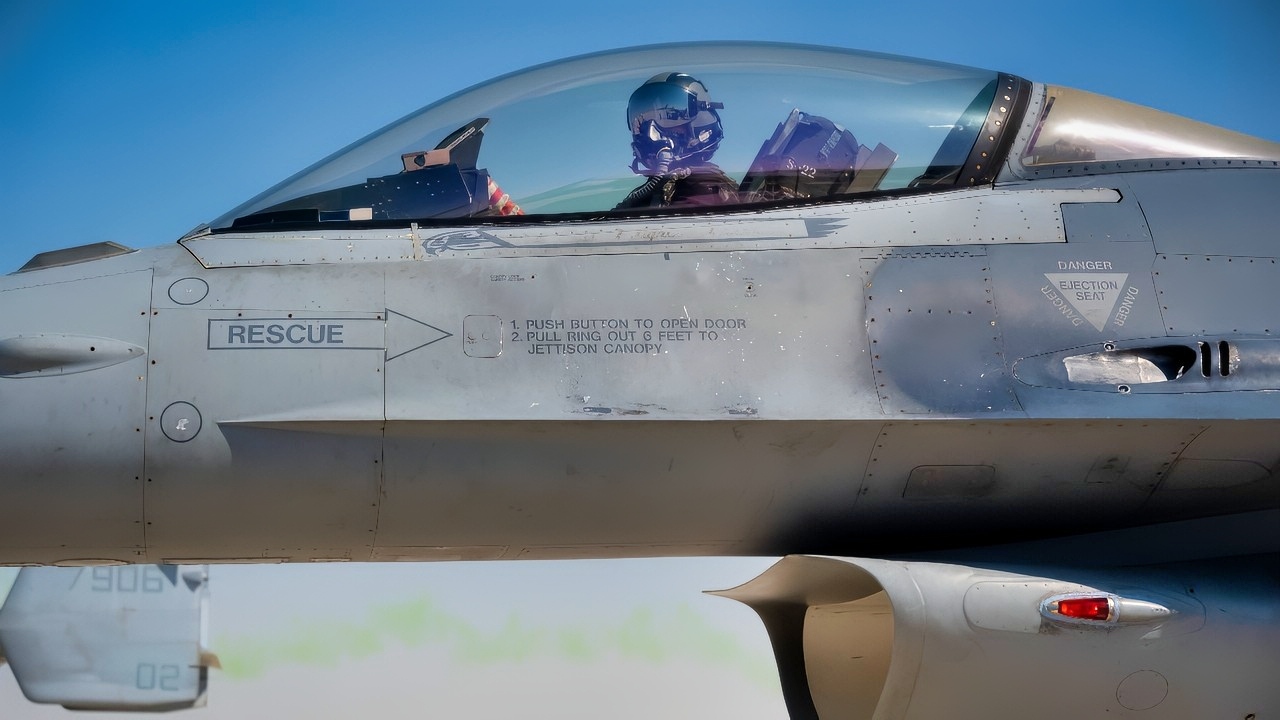
U.S. Air Force Maj. Josiah “Sirius” Gaffney, Pacific Air Forces Demonstration Team commander, prepares to fly a practice sortie before the Dubai Airshow in Dubai, United Arab Emirates, Nov. 11, 2021. In addition to the PACAF F-16 Demonstration Team routine, the air show will highlight a variety of U.S. Air Force, Navy and Marine Corps aircraft showcasing the range of U.S. military airpower capabilities. (U.S. Air Force photo by Staff Sgt. Matthew Kakaris)

Bohdan, a drone pilot from the Unmanned Systems Battalion of Ukraine’s 110th Separate Mechanized Brigade, pilots an FPV drone in Donetsk Oblast during active battle operations. Photo: David Kirichenko
“Since the summer, there has been practically no day when the enemy has not attacked energy infrastructure. But such a massive and combined attack has occurred for the first time since the end of the last heating season,” the prime minister added.
Energy Attacks
Earlier this summer and into the fall, Ukraine had launched an enormous and surprisingly successful air campaign against Russian energy infrastructure within Russia itself. Using increasingly long-range, explosive-laden drones as well as a growing crop of cruise missiles, Ukraine struck oil and gas refineries and storage facilities around the country.
Taking to X, formerly Twitter, Ukrainian President Volodymyr Zelensky pulled back the curtain on a new Ukrainian missile. “Ukrainian tactical ballistic missile. FP-7. First combat use,” the president wrote. “Thank you for the result. Next up: production. Glory to Ukraine!”
While American President Donald Trump announced last month that both Russia and Ukraine had agreed to suspend attacks on each other’s energy infrastructure, both Kyiv and Moscow denied that such an agreement existed, opening the door to repeated attacks on infrastructure important to both countries.
Winter Rapidly Approaching — and Waning Air Defenses
Although the recent Russian attack on Ukraine was not entirely unexpected — Ukrainian officials have been warning that Russia would do so — the attacks come at a particularly perilous time for Ukraine.
Pinched by the war in the Middle East against Iran, the world’s supply of Patriot air defense interceptors is in extremely high demand. While the American-designed and made munitions are considered some of the best, if not the best, in the world at taking down a variety of munitions, they are expensive, slow to manufacture, and take 24 to 30 months to build from order placement to final delivery.
The munitions’ many subcomponents must be tested and validated at multiple points in production to ensure their high reliability—a necessary and immensely important part of production, but one that drastically slows it.
More Russian Threats
Kaliningrad, Russia’s exclave on the Baltic Sea, has become the Kremlin’s latest rhetorical flashpoint. In a letter the Kremlin sent to NATO headquarters in Belgium through diplomatic channels, Russia declared that any move by the defensive alliance against Kaliningrad would be met with a nuclear response.
According to the letter, seen by Reuters, a wire service, Russia considers NATO’s moves both “dangerous and reckless” and that if the course were not changed, there would be “high risks of the outbreak of a direct armed conflict.”
Kaliningrad is a Russian exclave squeezed between Poland and Lithuania. Formerly part of East Prussia before and during the Second World War, the Soviet Union annexed the area after hostilities ended.
Today, the small landmass, roughly the size of Connecticut, gives Russia direct access to the Baltic Sea, one of NATO’s soft underbellies, a commercial route, and a site of substantial underwater infrastructure, including communications and energy. But Kaliningrad’s separation from the rest of Russia proper is also a potential weak spot for the Kremlin, which could struggle to hold the landmass in a war with NATO.
In addition, the letter specified that Russia would not eschew “Russian strikes against decision-making centers in the alliance’s member states right from the outset” of a war between NATO and Russia.
“Russia will be ready to use the entire arsenal of forces and capabilities at its disposal, including nuclear weapons, in order to defend its territory should NATO countries undertake any attempt aimed at isolating the Kaliningrad Region from the rest of the country,” the letter reportedly stated.
What Does NATO Think?
The rhetoric emanating from the Kremlin, however, did not seem to fluster the NATO alliance much, if at all. In an interview with Euronews, a European television news broadcaster, NATO Secretary-General Mark Rutte said NATO is not particularly worried about the gravity of the threat from the Kremlin or the prospects of the war in Ukraine expanding westward and engulfing the alliance.
“Everybody knows that he [Russian President Vladimir Putin] can never win against NATO. I don’t take this seriously. But of course, we have to reply and make clear that NATO is a defensive alliance, as I said, and stop the war in Ukraine and stop the nuclear threats,” Rutte said.
About the Author: Caleb Larson
Caleb Larson is an American multiformat journalist based in Berlin, Germany. His work covers the intersection of conflict and society, focusing on American foreign policy and European security. He has reported from Germany, Russia, and the United States. Most recently, he covered the war in Ukraine, reporting extensively on the shifting battle lines in Donbas and writing about its civilian and humanitarian toll. Previously, he worked as a Defense Reporter for POLITICO Europe. You can follow his latest work on X.


