

PUBLISHED on August 7, 2025, 12:55 PM EDT – Key Points and Summary – The F-117 Nighthawk, the world’s first operational stealth aircraft, was a subsonic precision bomber that prioritized stealth over speed.
-Despite its slow Mach 0.9 top speed, it had a stellar combat record, destroying over 1,500 high-value targets in the Gulf War without a single loss.

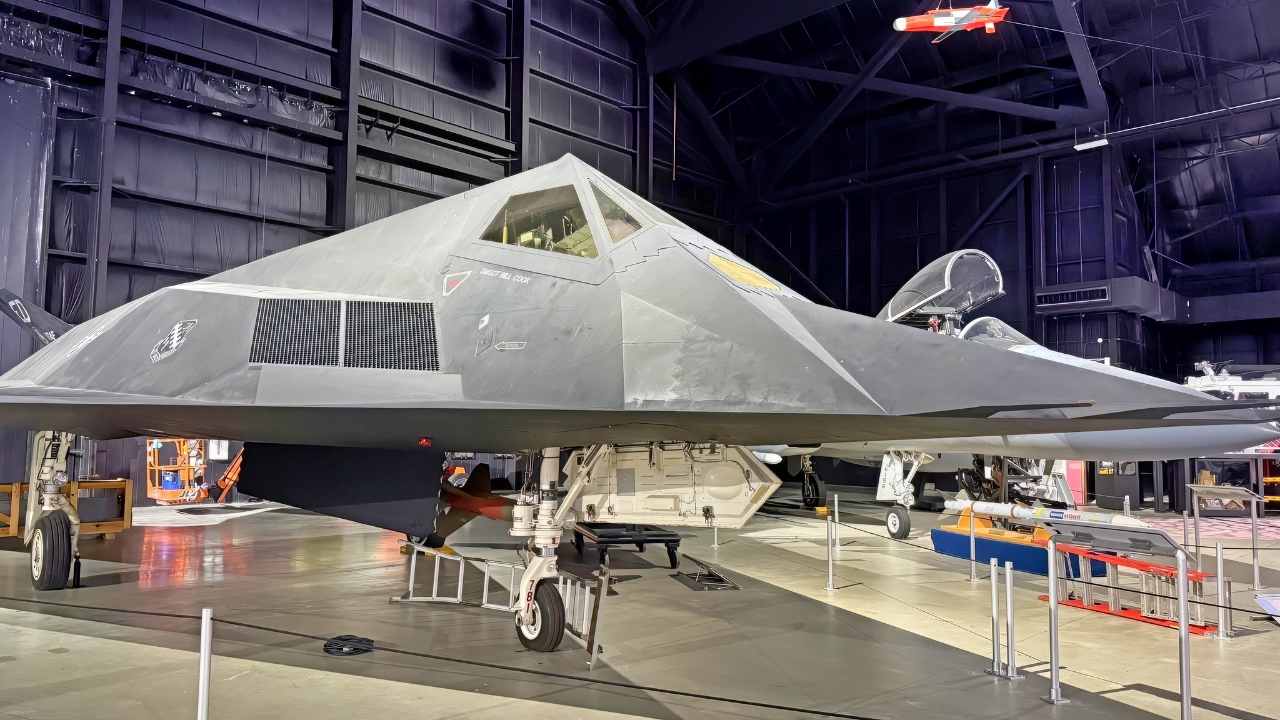
U.S. Air Force Museum Display of F-117 Nighthawk. Image Credit: National Security Journal.
-Its famous “F for fighter” designation was a deliberate deception. With no air-to-air capability, it was purely an attack aircraft; the “F” was used as an internal recruitment tool to attract the Air Force’s top “fighter-jock” pilots to the top-secret program.
The F-117 Nighthawk Wasn’t Built For Speed, But for Stealth
The Lockheed F-117 Nighthawk was the world’s first operational stealth fighter, designed to penetrate high-threat airspace and deliver precision strikes.
It entered service in 1983 and was officially retired from service in 2008, after paving the way for modern stealth technology in other aircraft.
However, the US F-117 wasn’t a fighter at all despite the “F” designation. She wasn’t built for speed but stealth. Its unique, faceted shape and radar-absorbent materials were crucial for penetrating enemy airspace undetected, rather than achieving high speeds.
While it was not a pretty supersonic aircraft, its primary mission was to deliver precision strikes against heavily defended targets, which required stealth capabilities over raw speed.
How Fast Was The F-117 Nighthawk?
The Nighthawk was no speed demon; her top speed was O.9 mach or 684 mph. But that wasn’t what the aircraft was designed for. She was designed for, and proved to be, a very successful stealth aircraft that delivered precision bombing.
Designed by the famous Lockheed Skunk Works, the F-117 was designed, built, and operated under the strictest veil of secrecy. So secretive was the aircraft that the Air Force was flying combat missions for seven entire years before it was formally unveiled to the public. Now that is stealth.
Very Successful Combat Record
During the Gulf War, F-117s destroyed more than 1,500 high-value targets in just 43 nights without suffering one loss. The Nighthawk was deployed to Panama, the desert during the Gulf War, and in Kosovo during the war against the Serbian military.
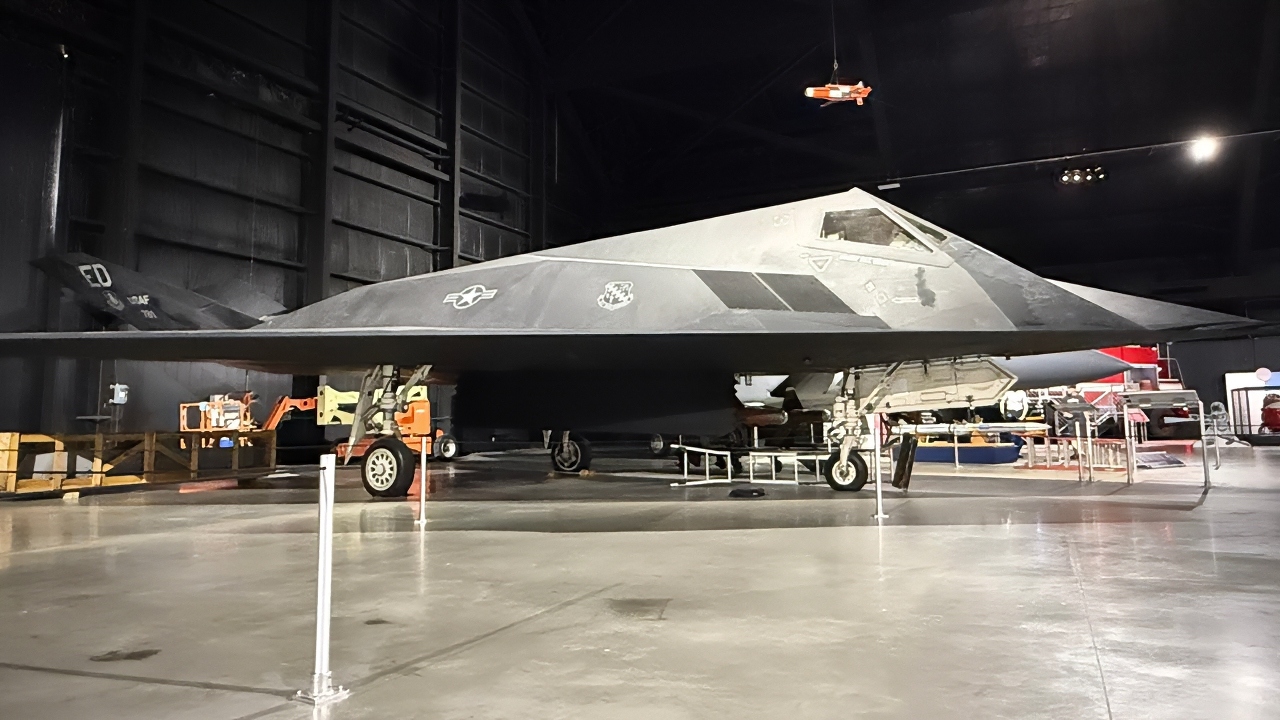
F-117 Nighthawk in the Air Force Museum. Image Credit: National Security Journal.
Only one F-117 was ever shot down, in Serbia. And in that instance, several circumstances were working against the Americans. First, the Serbs had broken NATO communications in Italy. So, they knew that the F-117s were flying a mission that day, unsupported, as the EA-6B Prowlers, the electronic warfare aircraft, were grounded by bad weather that day.
And in an overconfident move, the Air Force planned on flying the F-117s into Serbia by the same route they had several times already. The Serbs got a big break when they scanned for the F-117s a second time; it just so happened to be when the pilot opened his bomb bay doors.
Not a Fighter At All, So Why Call It One?
The F-117 Nighthawk, commonly referred to as the “Stealth Fighter,” wasn’t a fighter at all, but you can’t blame the public. Even the Air Force seemed to give this unusual aircraft the wrong designation–and according to some records, that was intentional.
The F-117 Nighthawk became operational in 1983, meaning the platform was already flying some missions in the early 1980s. By 1988, the US Air Force still hadn’t admitted that it even had a stealth aircraft that could defeat enemy radar, opting instead to keep the advanced capabilities of the F-117 a secret.
The F-117 was an attack aircraft and should have carried the “A” designation like the A-10, AC-130 gunship, so the correct designation should have been the A-117 Nighthawk.
Since 1962, the services have been uniform in their aircraft designations. Alex Hollings wrote about the simplicity of the aircraft’s uniformity.
A – For attack aircraft like the A-10 Thunderbolt II
B – For bombers like the B-52 Stratofortress, or B-2 Spirit
C – For cargo aircraft like the C-130 Hercules or C-17 Globemaster
F – For fighter aircraft like the F-15 Eagle or F-35 Joint Strike Fighter
“To be classified as a fighter aircraft and carry that F prefix, a plane usually needs to be explicitly designed to be capable of engaging other aircraft in the battle space.
“The F-117, however, was built specifically for engaging ground targets under a shroud of secrecy. The F-117 carried no guns and offered a maximum payload capacity of only two 2,000-pound bombs, making it all but defenseless against enemy fighters in most circumstances.”
So, Where Did The “F” Designation Come From?
The mystery behind the Air Force’s choice of name for the aircraft, the F-117, rather than the A-117, lies in its intended purpose: to deceive both our adversaries and, more importantly, our own pilots.
According to Gen. Robert J. Dixon, who served at Tactical Air Command at the time, the reasoning was simple: The Air Force wanted to court the best and most capable pilots for the new stealth program. They knew a “stealth fighter” would be more enticing to fighter-jock pilots than a new “attack” aircraft would be.
The old ‘bait and switch’ game. Even when it comes to classified programs, perception matters.
About the Author:
Steve Balestrieri is a National Security Columnist. He served as a US Army Special Forces NCO and Warrant Officer. In addition to writing on defense, he covers the NFL for PatsFans.com and is a member of the Pro Football Writers of America (PFWA). His work was regularly featured in many military publications.
Military Problems
No F/A-XX Fighter? Say Goodbye to the Aircraft Carrier


