

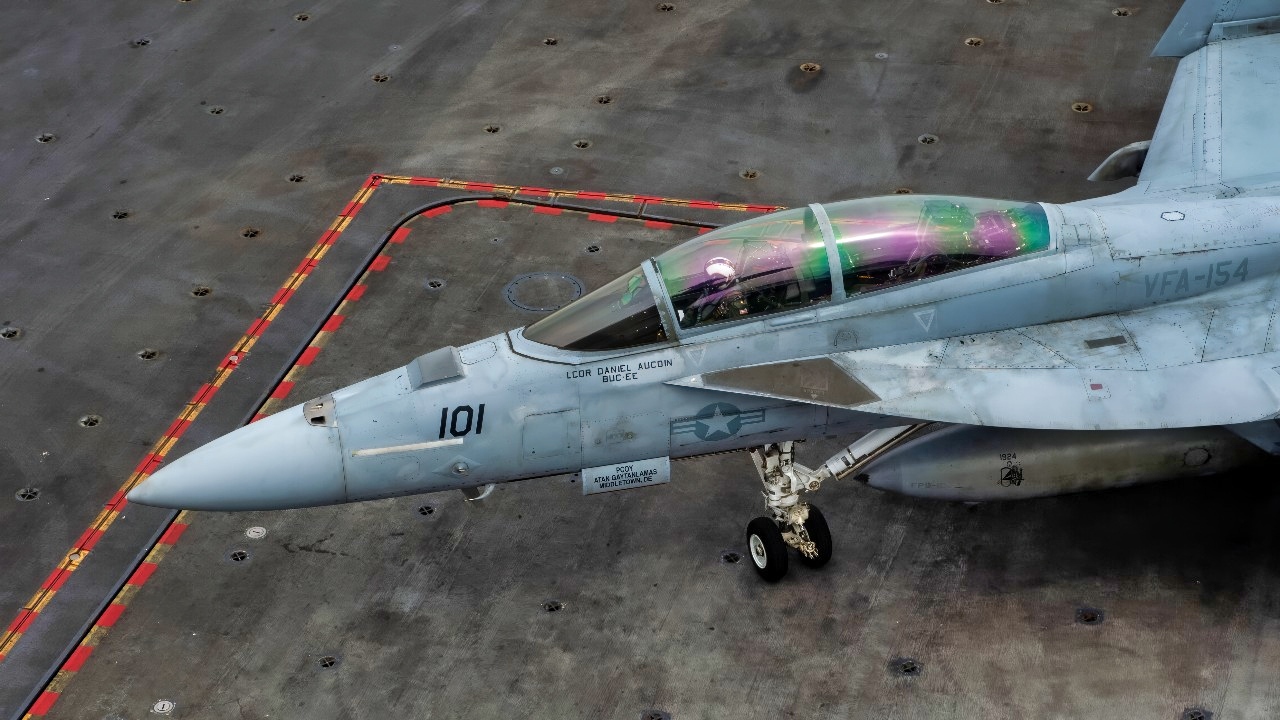
Key Points and Summary on F/A-XX Program – The U.S. Navy and the Pentagon are locked in a public struggle over the F/A-XX sixth-generation fighter, a program the DoD moved to defund in favor of the Air Force’s F-47.
-The Navy argues the F/A-XX is essential to overcome the critical range limitations of its current F/A-18 and F-35 air wing, keeping its aircraft carriers viable against long-range Chinese “carrier killer” missiles.

F/A-XX U.S. Navy Fighter. Image Credit: Creative Commons.
-The Pentagon’s move, however, may reflect more profound skepticism about the future of carriers and concerns about the industrial base’s ability to build two next-generation fighters simultaneously.
Why the Navy Carriers Want F/A-XX—And the Defense Department Doesn’t
The US Navy and the Department of Defense are locked in an unusually public struggle over funding priorities.
At stake: the fate of F/A-XX, the Navy’s planned sixth-generation stealth fighter intended to replace fourth-generation F/A-18E and F Super Hornet jets on Navy carriers.
Rival F/A-XX designs by Boeing and Northrop Grumman, still veiled in secrecy, are up for consideration, awaiting the Navy’s go-ahead. But then the Department of Defense’s proposed budget slashed F/A-XX R&D funding to $74 million and redirected $500 million F/A-XX dollars to the Air Force’s F-47.
The Navy objected vociferously and placed F/A-XX in its annual list to Congress of “unfunded priorities”. The Senate Armed Services Committee proved receptive and is now counter-proposing $1.4 billion in funding for F/A-XX. Time will tell whether that survives forthcoming rounds of budgetary wrangling.
Kicking off in 2012, F/A-XX always existed in the shadow of the Air Force’s parallel sixth-generation NGAD program. In a topsy-turvy series of events, in 2024, Air Force leadership abruptly expressed doubts that NGAD was cost-efficient. Then, following test wargames and a change of administration, this March, the Air Force announced it was going full speed ahead with NGAD, selecting Boeing’s F-47 design.
While an F/A-XX selection was rumored to follow, the DoD’s proposed budget unveiled in July effectively showed it had been put on ice, with the administration arguing the US industrial base couldn’t handle development of two sixth-generation fighters simultaneously.
Both the Navy and the defense industry have disputed this claim. Historically, many of the US’s fighters were developed concurrently, and the Pentagon has incorporated industrial considerations in past procurements.

Members of the US Navy F/A-18F Super Hornet Demo Team performs a maneuver at the Wings Over South Texas Air Show. This year’s air show marks the first return of Wings Over South Texas to Naval Air Station Corpus Christi since 2019.
It seems more likely the DoD doesn’t want to fund two sixth-generation fighters concurrently, and lacks faith that F/A-XX would deliver adequate bang-for-buck. Indeed, it may reflect skepticism that aircraft carriers themselves will remain viable.
Problems with the Aircraft Carrier Air Wing
Currently, Navy carrier air wings are primarily composed of F/A-18E and F Super Hornet jets (AKA ‘Rhinos’), a smaller number of similar EA-18G Growlers specialized in electronic anti-radar warfare, and 12 to 14 F-35C stealth fighters.
Super Hornets have served capably, but a 2023 report found their airframes were wearing out faster than expected, with readiness rates declining below those of their predecessors. Ordering more factory-fresh Super Hornets is also not ideal, as these non-stealth jets are vulnerable to China’s growing fleet of stealth aircraft and the proliferation of long-distance anti-aircraft missiles, such as the Chinese-built PL-15Es, which were used effectively in an India-Pakistan air battle this May.
Lastly, the Super Hornet is short-ranged with a combat radius of 370 miles whilst carrying a strike payload. Even factoring in air-to-air refueling, this compels carriers to approach dangerously close to enemy anti-ship capabilities (see below).
F-35Cs, meanwhile, are stealthy, have robust sensors, and have greater range—but the 600 nautical mile combat radius is still considered to fall short of operational needs. Furthermore, its weapons bay doesn’t support internal carriage of longer-range weapons like the LRASM anti-ship missile.
What Does the F/A-XX Bring to the Table?
The Navy has kept its cards close to the chest regarding F/A-XX, but the few confirmed details give the impression of an evolutionary design.
That includes a reported range boost of 25% compared to existing carrier-based fighters (presumably using the F-35C as a benchmark). That detail led to grumbling among defense commentators because it falls well short of being a ‘game-changer’.
However, F/A-XX may also feature a larger weapons bay accommodating longer-distance weapons, which might extend effective range somewhat.
Furthermore, F/A-XX will incorporate key fifth and sixth-generation technologies—stealthy radar cross-section minimization, networked sensors, and capability to simultaneously control four drones, starting with new MQ-25 Stingrays entering service for mid-flight refueling (and likely other roles in time) and future carrier-based Loyal Wingmen drones armed with missiles or radars for combat tasks.
One lingering question is whether the Navy wants F/A-XX to improve upon its predecessors’ kinematic performance, perhaps leveraging the adaptive-cycle engine technology intended to boost the F-47’s supersonic performance. An interceptor-style F/A-XX with supersonic cruising capability might help rapidly intercept bombers and missiles further away from carriers. However, the Navy seems to have eschewed that design path, trusting that a combination of stealth, subsonic cruising combined with afterburner sprints, and long-range missiles will suffice.
Of course, F/A-XX will also feature folding wings for more compact stowage, an arrestor hook, and ruggedized landing gear for carrier landings, lift-optimized wings to aid takeoff, and resilience to seawater exposure. Such features are the price of doing business on the short deck of a carrier. F/A-XX also likely has twin engines, a configuration long preferred by the Navy due to the better recovery odds of having a second engine should one fail.
Big Aircraft Carriers and Manned Fighters—Obsolete?
To some extent, F/A-XX’s defunding may reflect a desire by Hegseth’s DoD to move the US Navy away from its carrier-centric model gradually. Admittedly, the case against carriers is hardly new and runs as follows: new long-range missiles—epitomized by China’s land-based DF-21D ‘carrier killer’ ballistic missile with 1000+ miles range—make it possible to assail carriers over great distances at reduced or no risk—the limited range of current carrier-based aircraft compounds this problem. So carriers might not be able to approach close enough to desired targets without incurring unacceptably large volumes of enemy fire. From the carrier critic’s perspective, F/A-XX might seem an incremental fix for an obsolete platform.
But while the survivability argument is compelling, it requires nuance and verification. In over a year of combat operations in the Red Sea, dozens of anti-ship ballistic missiles (ASBMs), cruise missiles, and drones launched by Houthi rebels failed to hit even one warship thanks to the US Navy’s superior (though very expensive) air defenses, though there was a close call. Still, that’s impressive given the confined waters of the Red Sea make it difficult to hide.

The aircraft carrier USS Nimitz (CVN 68) steams in the Pacific Ocean, Oct. 5, 2024. Nimitz is underway in 3rd Fleet conducting routine training operations. (U.S. Navy photo by Mass Communication Specialist Second Class Carson Croom)
China has superior anti-ship weapons, but would also face greater challenges locating and tracking carriers across the vast Pacific Ocean—and ensuring that the moving carrier remains within the narrow target-acquisition arc of the missile’s seeker after many minutes traversing hundreds of intervening miles.
So it’s not confirmed that new threats to carriers will consistently overwhelm their defenses and nullify their effectiveness. After all, China’s Navy sure seems to think carriers are useful, judging by the pace of construction. Thus, carrier advocates argue it is nonsensical to allow carrier air wings to atrophy by killing programs like F/A-XX—not until there’s more substantial proof.
Drones? Yes, and…
Technophiles have also argued that drones render manned warplanes like F/A-XX obsolete and that it’s a folly to invest in them. The former is likely true in the long term, but the “move fast, break things” spirit carelessly gambles that still immature technologies will be ready on schedule and prove effective.
Notably, while small, slow tactical drones have disrupted ground warfare, there are no drones in operational service combining core characteristics of modern jet fighters (speed, range, weapons payload, and service ceiling). That will soon change—there are lots of prototypes under testing—but early ‘fighter drones’ will remain tethered to human controllers, necessitating a vulnerable communications chain.
Many anticipate that AI-powered autonomy will solve communication challenges. But full mission autonomy for a complex jet fighter—not just an AI trained to solve narrowly defined tasks like winning a dogfight using only guns in a controlled environment—doesn’t exist yet! Both it and the supporting command-and-control structures and doctrine will require years of iterative development and testing.
Until then, fighters like the F-47 and F-35 (and maybe F/A-XX) will shepherd drone fighters and Stingrays, extending their command-and-control range, allowing pilots or distant operators to make key high-level decisions. Undoubtedly, future carrier-based drones have great potential to re-extend the strike range of carrier air wings and permit larger wings at lower cost and smaller size. But the near-term solutions will be based on cooperating with accompanying manned fighters, rather than replacing them.
While F/A-XX may not offer a panacea to the challenges facing carriers, it could help carrier air wings keep pace with advancing adversary capabilities, ameliorate survivability margins, and facilitate command-and-control of Stingrays and future drone fighters.
Thus, the Navy’s objections to F/A-XX’s defunding reflect its institutional preference to invest in keeping carriers viable.
About the Author: Defense Expert Sebastian Roblin
Sebastien Roblin writes on the technical, historical, and political aspects of international security and conflict for publications including The National Interest, NBC News, Forbes.com, and War is Boring. He holds a Master’s degree from Georgetown University and served with the Peace Corps in China. Roblin is also a National Security Journal Contributing Editor.
More Military
Su-57 vs. J-20 Fighter: Who Wins?


bobb
August 5, 2025 at 11:07 am
Aircraft carriers piddling around in a small shallow sea are like tanks roiling around in the muddy raputitsa.
They will be hit by drones and missiles and bombs and more bombs, drones and missiles.
In the end, what aircraft they carry aboard doesn’t matter.
A carrier piddling around in a shallow sea is like a fish getting stuck in a shrinking paddy field pond during a spell of dry weather.
Pingback: Israel Might 'Conquer' All of Gaza - National Security Journal
George Taylor
August 8, 2025 at 8:26 pm
There are many Billy Mitchell types telling us the obvious. In 2025 and beyond, aircraft carriers are big fat targets. Are potential peer adversaries anti-ship missiles are coming with long range, higher speeds and due to manufacturing capabilities that we no longer possess, there making thousands of them.
DkWin
September 21, 2025 at 9:43 pm
This post raises some compelling points about the future of aircraft carriers amidst evolving military technologies. The F/A-XX fighter could be a game changer, but the question remains: can carriers adapt quickly enough to remain relevant? It’ll be interesting to see how the Navy balances tradition with innovation in the coming years.
d06
October 11, 2025 at 11:43 pm
This post raises some compelling points about the future of aircraft carriers in modern combat. While the F/A-XX fighter program seems promising, I wonder how it will adapt to the evolving landscape of naval warfare, especially with increasing threats from advanced missile technologies and cyber capabilities. The role of carriers might be changing, but I think they could still play a crucial role in power projection and deterrence if they’re integrated with emerging technologies effectively. Excited to see how this unfolds!
Java burn
May 26, 2026 at 1:37 pm
This article raises some thought-provoking points about the future of naval power. While the F/A-XX fighter could enhance the capabilities of the U.S. Navy, I wonder if relying too heavily on aircraft carriers could ultimately be their downfall. With advancements in missile technology and drone warfare, it seems crucial for the Navy to adapt its strategies rather than just upgrade existing assets. Looking forward to seeing how this debate develops!