

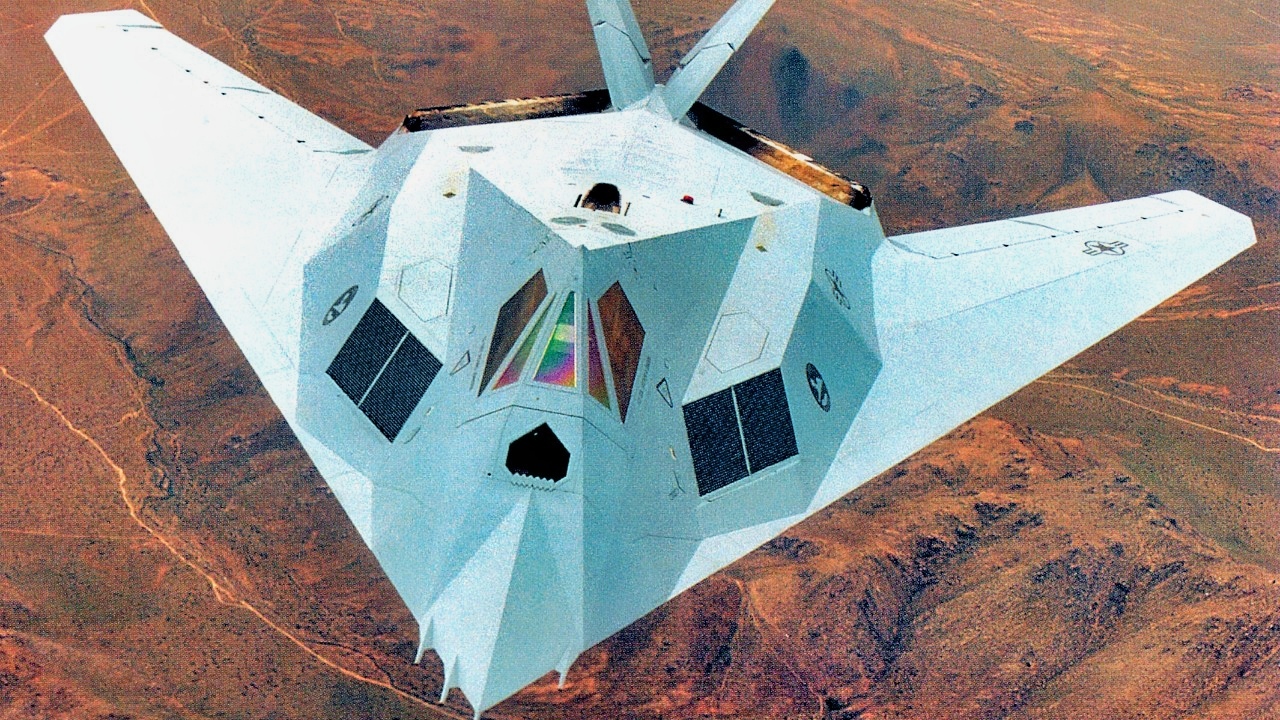
Today, stealth aircraft form a substantial part of the United States’ Air Force; however, back in the 70s and 80s, stealth technology was thought to be a thing of science fiction.
Everything changed when the F-117 Nighthawk entered service. As the first stealth fighter adopted by any air force in the world, the F-117 shocked the world with its unorthodox design and stealth capabilities.
Today, the Nighthawk is retired, but it was a pioneer in stealth technology that paved the way for future aircraft, such as the F-22 Raptor and B-2 Spirit.
F-117 Nighthawk – America’s First Stealth Fighter
Development of the F-117 Nighthawk began in the 1970s, when the U.S. Department of Defense began exploring ways to reduce an aircraft’s radar cross-section. This initiative led to the “Have Blue” program, a classified research effort managed by the Defense Advanced Research Projects Agency (DARPA) and executed by Lockheed Martin’s Skunk Works division.
Under the leadership of Ben Rich, the Skunk Works team applied the theoretical work of Soviet physicist Pyotr Ufimtsev, who had developed mathematical models for predicting how electromagnetic waves reflect off surfaces. By using these principles, engineers designed an aircraft with flat, angular surfaces that could deflect radar waves away from their source, effectively rendering the aircraft invisible to radar.
The Have Blue prototypes were the first aircraft built with stealth as the primary design consideration. These early models demonstrated that it was possible to create a plane that could evade radar detection, even if it meant sacrificing aerodynamic efficiency. Building on this success, Lockheed developed the F-117, which first flew in 1981.
The aircraft entered service in 1983, though it remained a closely guarded secret until it was publicly acknowledged in 1988. Only 64 F-117s were built, including five prototypes, making it a relatively small fleet by military standards.
Design and Specs
The design of the F-117 was unlike anything seen before. Its faceted, diamond-like shape was dictated entirely by the need to minimize radar visibility. This unconventional appearance made the aircraft aerodynamically unstable, requiring a sophisticated fly-by-wire system to maintain control. The aircraft was coated in radar-absorbent material, and its engines were buried deep within the fuselage to reduce both radar and infrared signatures. The exhaust nozzles were flattened and shielded to minimize heat emissions, further enhancing its stealth capabilities.
Internally, the F-117 carried its weapons in a central bay to avoid radar reflections from external stores. It was powered by two General Electric F404 turbofan engines, which provided enough thrust for subsonic flight. The aircraft had a top speed of around Mach 0.92 and a combat radius of approximately 600 nautical miles. Despite its “F” designation, which typically denotes a fighter aircraft, the F-117 was not designed for air-to-air combat. It was a precision strike platform, optimized for attacking high-value targets in heavily defended areas.
The Nighthawks Combat History
The F-117’s combat debut occurred during Operation Just Cause in Panama in 1989, but it was during the Gulf War in 1991 that the aircraft truly proved its worth. In Operation Desert Storm, F-117s flew only a small fraction of the total sorties but were responsible for striking a significant portion of Iraq’s strategic targets. These included command and control centers, communication hubs, and air defense installations. The aircraft’s ability to operate undetected in the heavily defended airspace over Baghdad demonstrated the effectiveness of stealth technology and changed the way air campaigns were conducted.
The F-117 continued to serve in subsequent conflicts, including Operation Allied Force in Kosovo in 1999, where it conducted precision strikes against Serbian targets. It also participated in the early stages of Operation Enduring Freedom in Afghanistan and Operation Iraqi Freedom in 2003. However, the aircraft was not invulnerable. On March 27, 1999, during the Kosovo conflict, an F-117 was shot down by a Serbian surface-to-air missile. The pilot ejected safely, but the incident marked the first and only time an F-117 was lost to enemy fire. Serbian forces partially recovered the wreckage and reportedly shared it with other nations, raising concerns about the potential compromise of stealth technology.
The Pioneer of Stealth Technology
The F-117 was officially retired in 2008, as more advanced stealth aircraft like the F-22 Raptor and F-35 Lightning II entered service. However, in the years following its retirement, sightings of F-117s in flight suggested that some aircraft remained in use for testing and training purposes. These aircraft have been seen flying in the western United States, often serving as adversary aircraft in military exercises to simulate enemy stealth capabilities.
The Nighthawk left an enduring legacy even well after its retirement. It was the first aircraft to demonstrate that stealth technology could be successfully applied in combat, and it paved the way for a new generation of low-observable platforms. Its influence can be seen in the design of the B-2 Spirit stealth bomber, the F-22 Raptor, the F-35 Lightning II, and the upcoming B-21 Raider.
The F-117 also highlighted the importance of precision-guided munitions and the integration of intelligence, surveillance, and reconnaissance assets in modern warfare.
Beyond its technical achievements, the F-117 captured the public imagination. Before its declassification, it was the subject of numerous conspiracy theories and UFO sightings, particularly around Area 51, where it was tested. Its angular, alien-like appearance only fueled these rumors. After its public unveiling, the aircraft became a symbol of American technological prowess and was featured in countless documentaries, video games, and films.
About the Author:
Isaac Seitz, a Defense Columnist, graduated from Patrick Henry College’s Strategic Intelligence and National Security program. He has also studied Russian at Middlebury Language Schools and has worked as an intelligence Analyst in the private sector.
More Fighters
China’s J-20 Stealth Fighter Looks Like a Powerhouse
China’s White Emperor Space Fighter Looks Fake
China’s Aircraft Carriers Have Arrived (Just Not Nuclear Carriers)


