

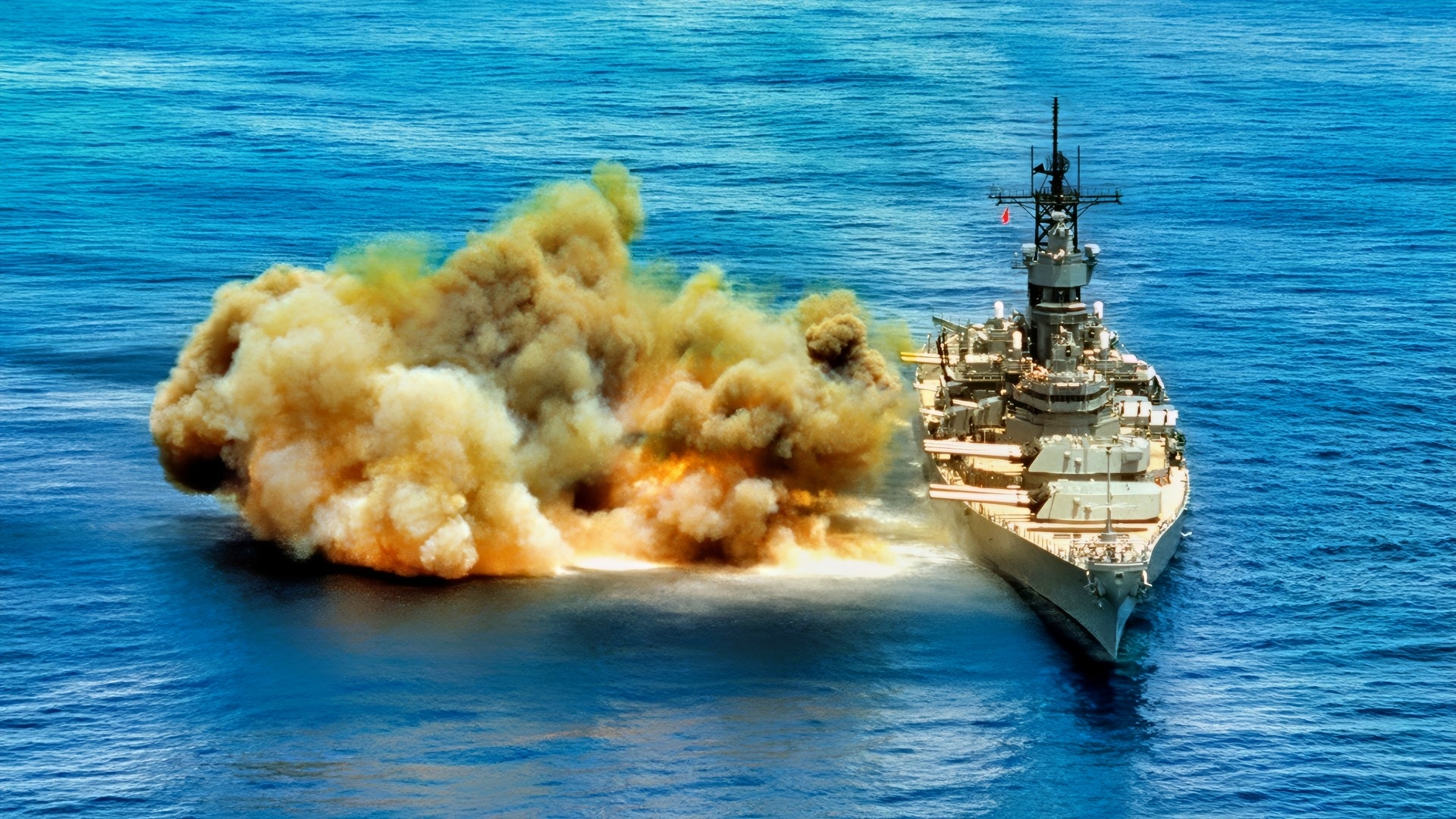
Key Points and Summary – USS Wisconsin (BB-64) served across three eras: screening carriers and bombarding shores in WWII, smashing rail hubs and batteries in Korea, then returning in the 1980s as a missile-armed strike ship.
-Modernized with Tomahawk, Harpoon, Phalanx, upgraded radars, C2 spaces, and UAV spotting, she offered rapid deep-strike and overwhelming naval gunfire—useful combat power and potent signaling.
-In Desert Storm she coordinated and fired TLAMs and used drone-spotted 16-inch salvos to batter Iraqi positions.
-Costly manpower and the rise of distributed VLS ships ended her run, but as a museum in Norfolk she preserves the lesson that a great hull can absorb new missions for decades.
USS Wisconsin (BB-64): A Working Battleship’s War-To-War Life
When USS Wisconsin joined the fleet in 1944, the United States already held the initiative in the Pacific. What it still needed was a way to sustain that pressure—every day, in any weather—against an enemy that mixed shore defenses, air attacks, and a still-dangerous fleet.
Fast battleships of the Iowa-class answered that requirement. They could keep pace with fast carriers, anchor anti-air screens, and deliver brutal shore bombardment when Marines and soldiers needed steel on target.
Wisconsin arrived as that concept reached maturity. She would spend the next half-century proving a deceptively simple point: a ship built to move, shoot, and survive can keep finding new jobs if you keep feeding it new sensors and weapons.
The Pacific War: Carrier Escort, Shore Bombardment, And The Long Grind
From late 1944 through 1945, USS Wisconsin fought as part of the fast carrier task forces that battered Japan’s defensive rings from the Philippines to Okinawa, and finally the home islands. Her daily work combined three missions that defined the late-war battleship:
Anti-Air Guard For The Flattops. The Iowas threw dense curtains of fire from 5-inch/38s and an ever-expanding forest of Bofors and Oerlikons while their radars and directors stitched the air picture together. Wisconsin shot down and drove off attackers while providing stable, high-speed maneuvering space for carriers launching and recovering strikes.
Shore Bombardment. Ahead of major landings, she hosed down beach approaches, gun positions, airfields, and supply hubs. The 16-inch/50 guns’ reach and destructive power suppressed defenses that would otherwise chew up landing craft and tanks.
Counter-Surface Presence. By 1945 the Imperial Japanese Navy seldom risked major sorties, but Wisconsin and her sisters remained the backstop: if something big came out, the Iowas were ready to end the conversation quickly.
Those months at war hardened not only steel but also procedures—magazine handling, underway replenishment, damage control, and radar-directed gunnery—that Wisconsin would carry into the next conflict.
A Between-Wars Upgrade Mindset
Even before Korea, USS Wisconsin benefited from a pattern that would define her career: when the ship returned to the yard, the Navy did more than fix wear and tear. It refreshed radars, modernized fire control, re-wired where needed, and adjusted the anti-air suite to match new threats. The result was an air-defense and bombardment platform that behaved like a reliable machine even as the tech around her changed. That culture of “never bring her back the same” is why the hull remained militarily relevant long after most navies gave up on battleships.
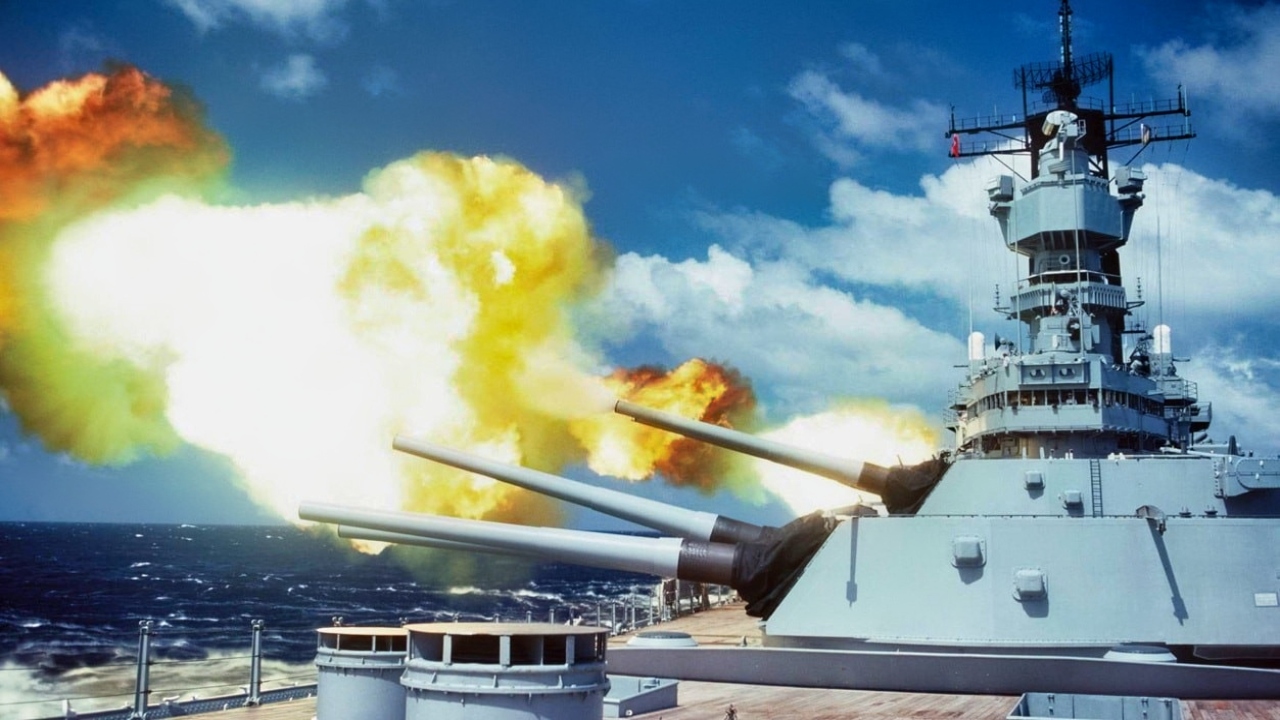
Iowa-Class Battleship. Image Credit: Creative Commons.
Korea: Big Guns In A Limited War
When North Korea’s invasion drew the United States and its allies into war on the peninsula, Wisconsin returned to service as a floating artillery brigade with the stamina to stay on station for weeks. Off Korea’s coasts she:
Shelled Rail Hubs, Bridges, And Batteries. With spotters ashore and in the air, Wisconsin’s 16-inch guns broke logistics arteries, collapsed tunnels, and silenced coastal artillery that menaced UN shipping.
Worked The Siege Line. In places like Wonsan, battleships and cruisers kept pressure on enemy positions day after day; Wisconsin’s large magazines and accurate secondary battery made her a constant, unwelcome presence.
Served As Flagship And Deterrent. Commanders used the Iowa-class not just for firepower but for command spaces and communications—they were stable, roomy flag platforms that shrugged off heavy weather.
Korea also pushed another wave of electronics updates: better air search, height-finding radars, and improved gunnery computers to keep pace with jet aircraft and more complex firing solutions.
The 1950s: Peacetime, A Collision, And A New Bow
Post-Korea, USS Wisconsin continued as a front-line capital ship—training, exercising with allies, and reminding the world that the United States could surge heavy combatants quickly. In 1956 she collided with the destroyer USS Eaton off the Virginia Capes, losing much of her bow. The repair became legend: shipfitters grafted on a pre-fabricated bow section originally intended for the canceled battleship BB-66 Kentucky.
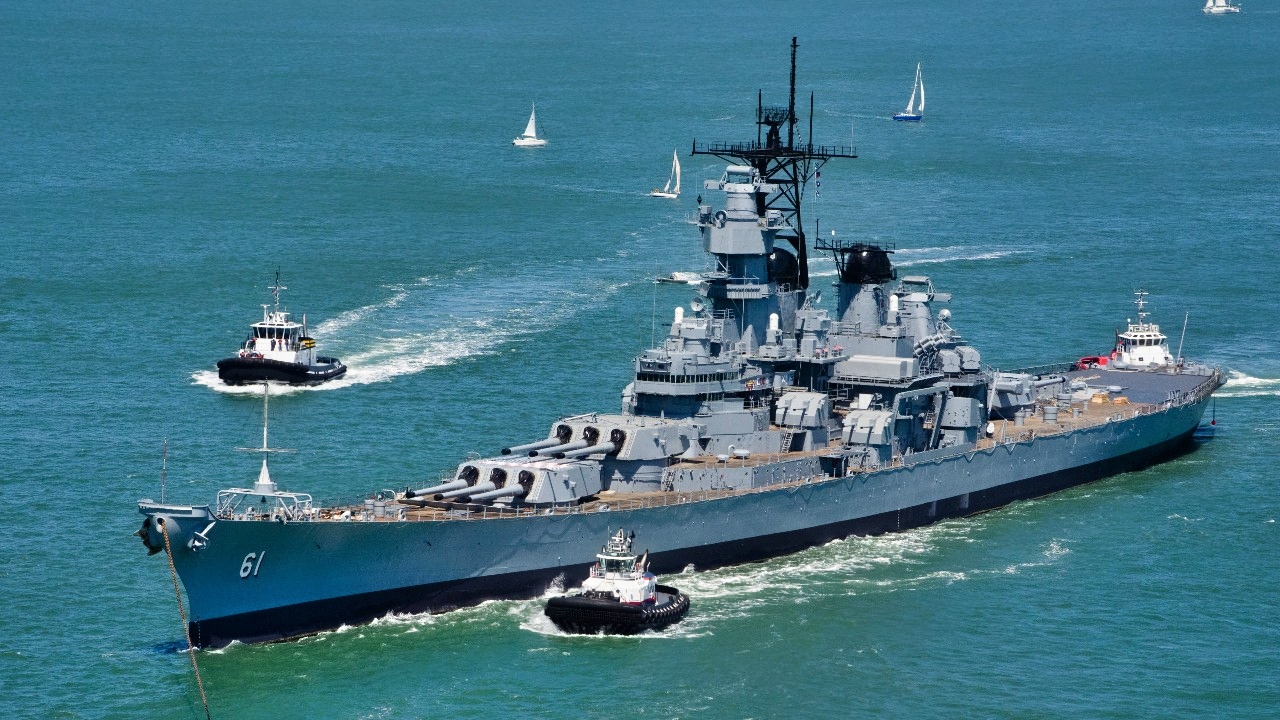
Iowa-Class Battleship USS Iowa. Image Credit: Creative Commons.
The speed and precision of that rebuild said as much about American industrial depth as it did about Wisconsin. Shortly thereafter, as missiles and carriers eclipsed gun battleships, she was decommissioned to the reserve fleet. But the Navy didn’t forget what an Iowa-class hull could do.
The 1980s: Why Revive A Battleship?
By the early 1980s, Cold War competition at sea took a new turn. The U.S. Navy’s Maritime Strategy envisioned pushing to the Soviet periphery, keeping pressure on submarine bastions, and threatening strikes against shore targets—while also re-arming the fleet after a 1970s dip. The 600-ship Navy plan sought hulls that could join that fight now, not a decade from now.
Reactivating the Iowas, including Wisconsin, solved several problems at once:
Instant Strike Capacity. Fitting Tomahawk Land-Attack Missiles (TLAM) in armored box launchers gave a single ship the ability to hurl dozens of precision strikes deep inland on day one of a crisis—without needing a carrier’s air wing to be in range or weather-permissive.
Sea Control And Deterrence. Adding Harpoon anti-ship missiles and Phalanx CIWS made the ship more lethal in the surface fight and harder to kill at close range.
Naval Gunfire Support. No other U.S. platform could deliver the volume, shock, and intimidation of nine 16-inch guns. Against coastal defenses, fixed sites, and troop concentrations near shore, that mattered.

Iowa-Class 16-Inch Shell Menu. Image Credit: National Security Journal.
Cost And Time. Refurbishing a stored battleship was faster and cheaper in the near term than designing and building new large combatants—especially when budgets were rising but still finite.
There was also theater. A battleship’s silhouette communicates power in a way few ships do. The Navy understood the value of a platform that could both fight and signal to allies and adversaries—from a port visit that drew crowds to an unmistakable radar return off a contested coast. Was Wisconsin a symbol? Absolutely. But she was a symbol that could fire Tomahawks at a thousand miles and level a square mile of coastline before lunch.
USS Wisconsin: What The 1980s Modernization Actually Changed
The 1980s refit did not turn Wisconsin into a museum piece with missiles; it turned her into a hybrid—part classic battleship, part modern strike ship:
Missile Armament.
32 Tomahawk in Armored Box Launchers (ABLs) aligned along the weather decks.
16 Harpoon in four quad canisters for anti-ship strikes.

Missile Box on USS Iowa. Image Credit: National Security Journal.
Point Defense And EW.
Phalanx CIWS mounts ringed the ship to swat sea-skimming missiles and fast boats.
A modern electronic-warfare suite jammed, decoyed, and detected threats the 1940s crew could not have imagined.
Sensors And C2.
New air-search radars, navigation systems, and communications pulled Wisconsin into the fleet’s digital nervous system.
Expanded command spaces let her serve as a strike planning and coordination hub.
Aviation And Spotting.
The ship partnered with RQ-2 Pioneer UAVs for over-the-horizon spotting—a revolutionary twist: drones cueing 16-inch salvos and helping battle damage assessment in near real time.
Guns And Secondaries.
The nine 16-inch/50 Mark 7 rifles remained the soul of the ship.
The 5-inch/38 dual-purpose battery, revamped and integrated with modern directors, still put accurate medium-caliber fire on surface and shore targets.
The only thing the refit couldn’t modernize was manpower: Wisconsin needed a big crew, and she would always burn more fuel and labor per effect than a missile destroyer. The Navy accepted that trade for the shock and reach she brought to a crisis.
Desert Storm: The Old Giant Throws The First Punch
In 1991, Wisconsin deployed to the Persian Gulf and northern Arabian Sea for Operation Desert Storm. She made her case on two fronts:
Tomahawk Strikes. On opening nights, USS Wisconsin launched volleys of TLAMs against Iraqi command, control, and air-defense nodes, punching corridors for coalition airpower and degrading Baghdad’s nervous system. A single ship, sitting far from coastal SAM belts, could do that reliably, repeatedly, and in all weather.
Big-Gun Firepower With A Drone Cursor. Off Kuwait, Wisconsin’s 16-inch guns—spotted by Pioneer UAVs—hammered artillery sites, trenches, and facilities. The psychological effect was as real as the physics: several Iraqi units attempted to surrender to the drone spotting for Wisconsin, a bizarre and telling first in naval history.
She also served as a strike warfare commander, coordinating TLAM missions for other platforms. In a war that showcased stealth aircraft and precision bombs, a 1940s battleship proved that old steel plus new brains could still dominate a littoral fight and contribute to deep-strike campaigns.
Symbol Versus Steel: What Did The Navy Really Buy?
It’s fair to ask whether Wisconsin’s 1980s-90s service was about image more than impact. The honest answer is both—and the balance shifted with the mission.
As A Symbol: Port visits drew crowds; adversaries noticed when a battleship anchored offshore; allies loved the optics. In peacetime signaling, Wisconsin could do in one hull what might take a squadron of smaller ships to achieve.
As Real Power: In the Gulf, she saved sorties that would otherwise have gone to carriers, delivered effects no destroyer or cruiser could match in volume at very short notice near shore, and provided redundant strike capacity the Navy could call on instantly.
As A Budget Play: Reactivation filled near-term capability gaps while new classes matured. But her manpower and operating costs were high, and missiles placed on battleship decks were missiles not on more numerous VLS-equipped escorts. In the long run, the fleet chose distributed VLS capacity over concentrated ABLs, and carriers and submarines carried the deep-strike burden.
So yes, Wisconsin was a theater of deterrence—but she was also a workhorse whose TLAM salvos and 16-inch fire ended arguments ashore. The two roles fed each other: a symbol enemies believed because they knew the guns and missiles were not just for show.
Life Aboard: A City That Could Fight A War
One reason USS Wisconsin stayed credible across decades was the human system built into her design. The Iowas had spacious machinery flats, redundant systems, and stream-lined ammunition trains that let crews work fast and repair battle damage. In the 1980s the Navy layered on safety and automation, but the ethos remained hands-on: sailors sweating in magazines, ordnance crews driving projectiles the size of small cars, electricians nursing ancient circuits alongside modern fiber runs.
That culture—equal parts tradition and adaptation—made the ship resilient in ways that never show on a line-item chart. When things got hot, Wisconsin could take the punch, fix herself, and keep going.
Why She Stood Down After Desert Storm
The same structural strengths that made Wisconsin valuable also made her expensive in a post-Cold War drawdown. With the Soviet Union gone, the Navy faced force-structure choices:
Distributed Strike. Vertical Launching System (VLS) ships—cruisers and destroyers—could carry more Tomahawks across more hulls, complicating an enemy’s targeting problem and lowering operational risk.
Manpower And Maintenance. A battleship’s crew and yard bills dwarfed those of modern escorts. In an era focused on cost per effect, Wisconsin was a pricey hammer.
Mission Fit. Precision airpower, submarines, and VLS ships covered most of the strike missions Wisconsin had shouldered in the Gulf. The unique niche—massive near-shore bombardment—was real but infrequently needed.
Accordingly, Wisconsin decommissioned again in the early 1990s. She remained maintained in reserve for years as the Navy debated whether to keep battleship gunfire as a retained option. Eventually, with guided-rocket artillery and long-range missiles filling the gap, the service closed the book.
The Museum Ship: A Final Mission In Norfolk
Today USS Wisconsin rests beside the Nauticus maritime campus on the Elizabeth River in Norfolk, Virginia. The placement is perfect: visitors step from modern exhibits onto a ship that compresses three distinct American eras into one welded narrative—World War II’s industrial surge, Korea’s grinding limited war, and the Cold War’s late-century technological leap.
As a museum, she does work no active ship can do: she lets the public touch the scale of naval power—to feel a breech door, to stand under a turret that weighs more than a destroyer, to walk the missile decks where Tomahawk canisters sat among 1940s capstans and chocks. She is also a living classroom for damage control, engineering, and logistics—the unphotogenic skills that decide whether ships come home.
USS Wisconsin Upgrades Over A Lifetime: What Changed, What Didn’t
To understand Wisconsin’s arc, it helps to see the layer cake of her capability:
1940s Core.
Guns: Nine 16-inch/50, twenty 5-inch/38 in ten twin mounts.
Air Defense: Dozens of 40 mm and 20 mm guns, radar directors, early air search.
Combat Systems: Mechanical-electrical fire control that was cutting-edge for the time.
1950s Refresh.
Radars: Newer air-search and height-finding sets; improved gunnery radars.
AA Suite Changes: As jets replaced prop attackers, the light AA forest thinned; emphasis moved to directed medium-caliber fire and fighter cover.
C2 Fit: Better communications and plotting spaces for a modern flagship.
1980s Reinvention.
Missiles: Tomahawk ABLs and Harpoon canisters added strategic and tactical reach.
Point Defense & EW: Phalanx and modern jammer/decoy suites acknowledged the missile age.
Sensors & Networks: New radars and data links knitted the old hull into a digital fleet.
UAV Spotting: Pairing drones with 16-inch guns turned a WWII weapon into a precision tool.
What never changed was the hull and the guns—a stable, fast, survivable platform that could accept new payloads again and again. That is the enduring design lesson.
The Balance Sheet: What Wisconsin Proved
A Good Hull Is A Strategy. Build margin into power, cooling, and deck space and you can keep bolting on the future.
Presence Is Power—When Backed By Power. Wisconsin’s symbolism worked because anyone watching knew she could reach out with both TLAM and 16-inch steel.
Cost Curves Win Eventually. For all her strengths, the Navy ultimately chose many VLS cells on many small ships over a few giant icons. That was the right peacetime move. In a different world, with a different war, the calculus could tilt back toward big guns near shore.
Final Assessment: A Fighting Ship With Three Lives
USS Wisconsin is often remembered for spectacle—the vast turrets, the shockwave of a full broadside, the oddity of a battleship launching precision missiles. Look longer, and a more interesting picture appears. She was, above all, useful—to carrier admirals in 1945 who needed an indestructible screen and bombardment hammer; to Korean commanders who needed a sustained siege gun at sea; to Cold War planners who needed instant strike capacity and a platform that turned heads; and to coalition leaders in 1991 who needed results on night zero.
Her final duty—as a museum in Norfolk—is not retirement so much as a new kind of service. She continues to project power of a different sort: the memory and method of a navy that adapts. In steel and teak, Wisconsin reminds visitors that technology changes, missions evolve, and budgets ebb and flow—but a well-designed warship, kept current and sailed hard, can matter across generations.
About the Author: Harry J. Kazianis
Harry J. Kazianis (@Grecianformula) is Editor-In-Chief and President of National Security Journal. He was the former Senior Director of National Security Affairs at the Center for the National Interest (CFTNI), a foreign policy think tank founded by Richard Nixon based in Washington, DC. Harry has over a decade of experience in think tanks and national security publishing. His ideas have been published in the NY Times, The Washington Post, The Wall Street Journal, CNN, and many other outlets worldwide. He has held positions at CSIS, the Heritage Foundation, the University of Nottingham, and several other institutions related to national security research and studies. He is the former Executive Editor of the National Interest and the Diplomat. He holds a Master’s degree focusing on international affairs from Harvard University.
More Military
‘Apex Predator’: The Royal Navy’s New Astute-Class Submarine Is Quiet as ‘Baby Dolphin’
Aircraft Carrier USS Carl Vinson Has a Message for the U.S. Navy
Europe’s Future Combat Air System (FCAS) 6th-Generation Fighter Is Officially in Trouble
The Royal Navy’s Dreadnought-Class SSBNs have a Message for Russia
Goodbye, Admiral Kuznetsov: Why Russia Doesn’t Need Aircraft Carriers


