

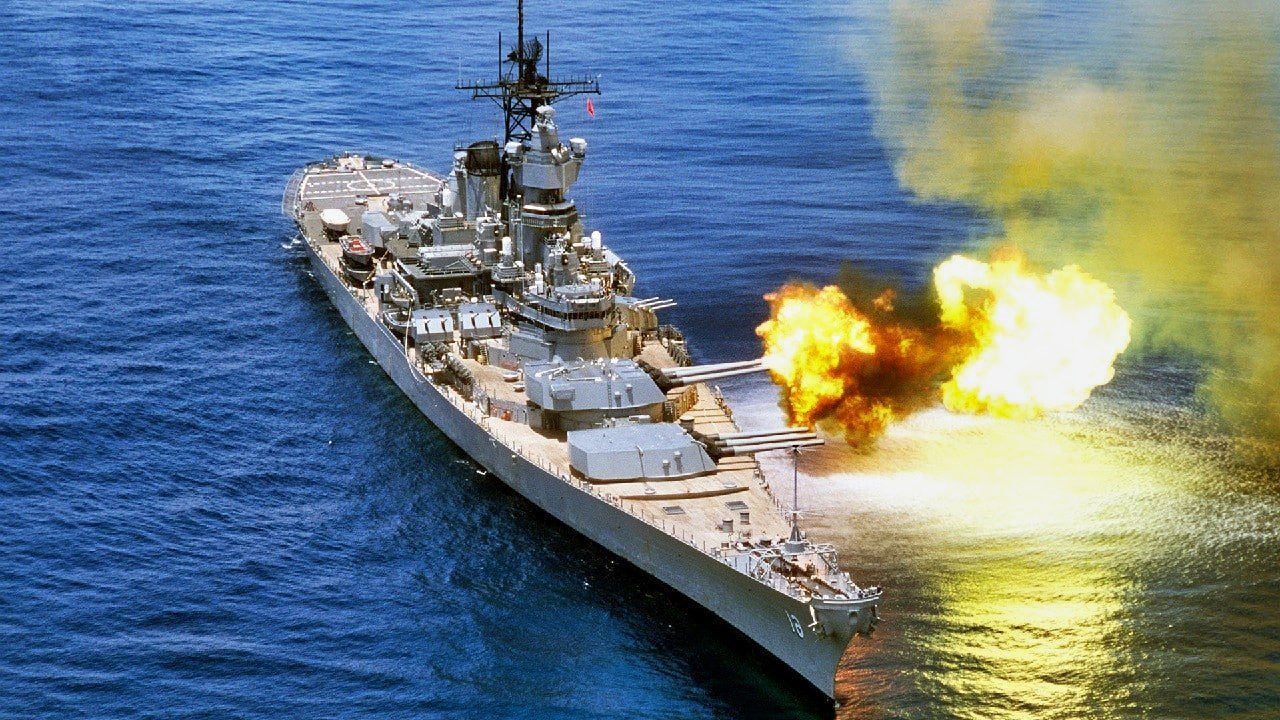
Key Points and Summary – The Iowa-class battleships—Iowa, New Jersey, Missouri, and Wisconsin—were built as fast battleships to escort carrier task forces and overmatch enemy capital ships.
-Drawing on lessons from North Carolina and South Dakota, they combined 33-knot speed with heavy armor, the 16-inch/50 main battery, and formidable anti-aircraft suites.
-They screened carriers and bombarded shores in World War II, returned for Korea, and New Jersey came back again for Vietnam. In the 1980s, all four were modernized with Tomahawk, Harpoon, new radars, and Phalanx—serving through Desert Storm before permanent retirement.
-Today, each serves as a museum ship, preserving the last American battleships and their lessons.
BONUS: Most of the pictures and videos presented in this article were collected by National Security Journal during a visit to the USS Iowa, docked in Long Beach Port outside of Los Angeles as well as a recent visit to the USS New Jersey.
Iowa-Class Battleships: Speed, Firepower, And The Long Goodbye
By the late 1930s the U.S. Navy faced a simple reality: carriers were ascendant, but surface gunnery still mattered—and fast enemy forces could threaten American task groups. The Navy wanted a battleship that could keep up with the fleet carriers, outgun enemy cruisers and battleships, and deliver decisive shore bombardment when fleets closed with land. That meant speed without surrendering armor, and a main battery that could reach and wreck anything it met.

Iowa-Class 5-Inch Guns. Image by Harry J. Kazianis/National Security Journal.
The Iowa-class program answered that requirement with a class of fast battleships—ships that were not just floating artillery, but fleet companions built to maneuver alongside the fast carriers that would dominate the Pacific war.
The Design Lineage: What Came Before
The Iowas were not a leap into the unknown. They refined ideas proven on the North Carolina and South Dakota classes—treaty-era designs that squeezed protection, firepower, and speed into tight displacement caps. Those ships validated the “all-or-nothing” armor scheme, modern fire-control, and the shift to high-velocity 16-inch guns. They also revealed the limits of treaty compromises when asked to make carrier speed for long stretches.

USS New Jersey Big Guns National Security Journal Photo Taken on 8/2/2025.

USS New Jersey National Security Journal Photo by Stephen Silver.
With treaty shackles loosening and war clouds building, designers could finally pursue the combination they wanted all along: a long, fine hull for sustained 33-knot running, 16-inch/50-caliber Mark 7 guns for reach and hitting power, and a layered defensive suite that grew with wartime experience. In short, the Iowa class took the best of its predecessors and removed the governor.
What Made The Iowas Different
Three elements defined the class:
Speed As A Tactic. A long hull and powerful machinery made the Iowas genuine fleet sprinters—fast enough to screen carriers, reposition quickly for shore fire support, and dictate range against surface opponents.
Guns With Reach. Nine 16-inch/50 guns in three triple turrets fired heavy shells over the horizon—armor-piercing for ships, high-capacity for shore targets—guided by increasingly refined radar fire-control.
Protection Without Excess. The armor scheme wrapped magazines and machinery in an internal citadel, matched to the expected threat angles of surface duels while keeping weight under control. Wartime refits then piled on anti-aircraft guns and sensors as kamikazes and mass air attacks became the primary danger.
The net result was a battleship that could fight and keep up, a rare pairing that made the class useful long after other battleships went to reserve.
World War II: From Atlantic Escort To Pacific Hammer
When the Iowas joined the fleet in 1943–44, the carrier war was already raging. Their first tasks were escorting fast carriers and knocking down aircraft—jobs they excelled at thanks to speed, radar, and a forest of AA guns that grew each month.

USS New Jersey Full Profile Battleship. Image Credit: National Security Journal.

USS New Jersey July 2025. Image Credit: National Security Journal.
As the island-hopping campaign tightened the noose, the Iowas turned their main batteries on shore. Pre-invasion bombardments ripped gun emplacements, fuel dumps, and transport hubs ahead of landings in the Marianas, Philippines, Iwo Jima, and Okinawa. They also participated in surface sweeps and legacy capital-ship roles when targets presented themselves, but the war’s logic was clear: the battleship’s greatest value was now AA shield and shore battering ram for the carriers’ airpower.
In September 1945, USS Missouri hosted the Japanese surrender in Tokyo Bay, an indelible image that welded the class to the war’s end and to American memory.
Brief Peace, Brief Retirement
With victory secured, the Navy demobilized fast. Jet aircraft, radar pickets, and nuclear weapons were changing budgets and doctrine. The Iowas cycled to reserve, maintained by caretaker crews while the fleet wrestled with what “postwar” meant for big-gun ships. The answer came quickly: Korea.
Korea: The First Comeback
When North Korea crossed the 38th parallel, the Navy needed floating artillery that could loiter in contested waters and deliver sustained, accurate fire. The Iowas returned to service in rotation. Off both coasts of the peninsula they pounded rail lines, bridges, troop concentrations, and coastal guns, often under return fire. Their combination of endurance, survivability, and magazine depth made them ideal siege partners for United Nations forces ashore.

Iowa-Class 16-Inch Shell Menu. Image Credit: National Security Journal.

USS Iowa 16-Inch Guns National Security Journal Photo. Taken August 15, 2025 By Harry J. Kazianis.
At the same time, they continued to serve as carrier escorts, reminding air planners that a ship which can both sprint with the carriers and dig enemies out of hills has a place in modern war.
Between Conflicts: Reserve, Experiments, And Relevance
After Korea, the Iowa-class ships again shifted to reduced status. The Navy tested new communications, refined naval gunfire doctrines, and debated big-gun utility in a missile age. The Iowas were too valuable to discard outright and too manpower-intensive to keep fully active. Their sheer flexibility—gunfire support, presence, and escort—kept them in the conversation, setting the stage for a one-ship revival when Washington needed shore fire in Southeast Asia.
Vietnam: New Jersey’s Solo Tour
In 1968, USS New Jersey returned to service for a single intense combat deployment. From the South China Sea she delivered heavy bombardment against North Vietnamese logistics, coastal batteries, and troop positions. Spotters praised the immediacy and psychological impact of 16-inch salvos; enemy gunners learned to stop shooting once the first ranging rounds landed.
But jets, missiles, and budget pressures again closed the window. The Navy decommissioned New Jersey in 1969. The lesson wasn’t that big guns were obsolete; it was that operating costs and manpower had to be weighed against a war effort dominated by air power and riverine craft.
The 1980s Modernization: Missiles Meet Big Guns
Reagan’s 600-ship Navy resurrected all four Iowas with a clear proposition: keep the 16-inch battery for shore dominance, add modern missiles for deep strike and sea denial, and update the ship to survive in a missile-saturated world.
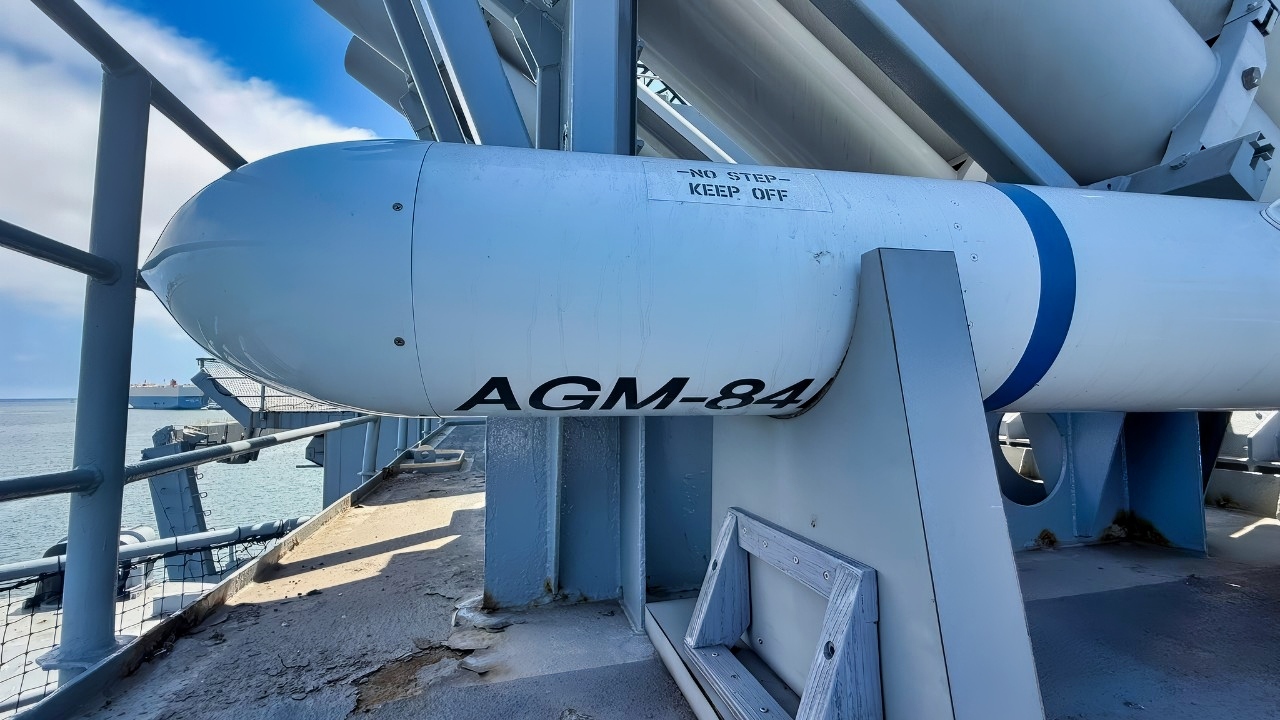
Harpoon Missile Onboard USS Iowa. Image Credit: National Security Journal.
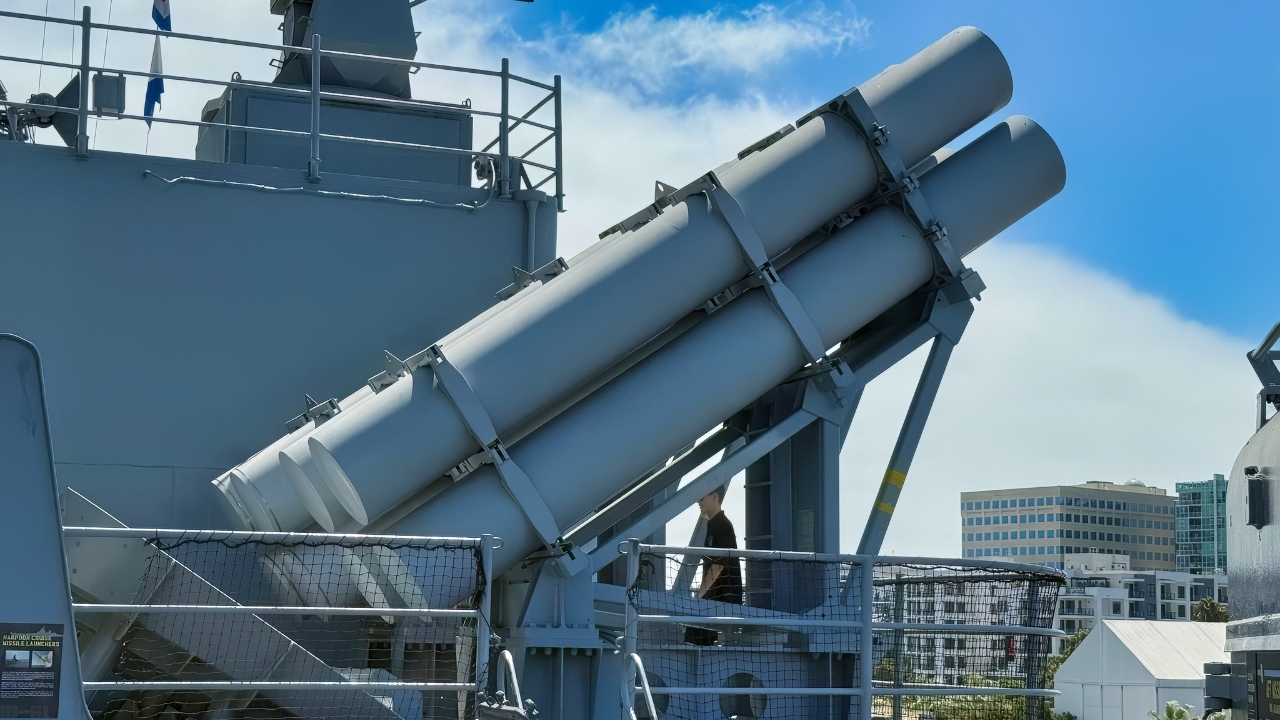
USS Iowa Harpoon Canister. Image Credit: Harry J. Kazianis/National Security Journal.

Missile Box on USS Iowa. Image Credit: National Security Journal.
The Iowa-Class makeover added:
Tomahawk cruise missiles in armored box launchers (land-attack precision at long range).
Harpoon anti-ship missiles for sea fights beyond gun range.
Phalanx CIWS mounts for close-in defense against sea-skimming threats.
New radars, EW suites, communications, and navigation gear to plug the ships into modern battle networks.
Helicopter/VTUAV facilities and improved gunfire-spotting methods—the class famously used Pioneer UAVs as aerial spotters, a pioneering operational concept for the era.
The result was a hybrid: part arsenal ship, part siege gun, part flagship, with a presence value out of all proportion to cost.
Lebanon And Presence Patrols
In the early 1980s, USS New Jersey shelled hostile positions in Lebanon, delivering politically calibrated pressure with heavy guns while standing in as deterrent theater presence. The other battleships conducted high-visibility cruises, exercises with allies, and deployments that telegraphed American resolve. Even when they never fired a shot, the ships’ silhouette did work—steel as messaging.
Desert Storm: The Last Shots In Anger
In 1991, USS Missouri and USS Wisconsin sailed to the Persian Gulf. Both launched Tomahawk salvos during the air campaign and turned 16-inch guns on Iraqi coastal targets. Wisconsin served as a Tomahawk strike coordinator, evidence that a World War II deck could host modern command roles. Pioneer UAVs again spotted for naval gunfire, marking one of the last times heavy battleship shells spoke in combat.

USS Iowa Logo National Security Journal Photo. Taken August 15, 2025.
These missions proved the modernization logic: precision missiles for deep targets, big guns for immediate, sustained effect near the shore.
The Final Retirement
After the Cold War, the Navy downsized, and that meant trouble for the Iowa-class. Keeping four crews and the specialized logistics for massive steam-driven ships no longer penciled. By 1990–1992 the Iowas were decommissioned again. For a time the Navy kept them in a status that allowed recall if naval gunfire support needs spiked; eventually, each ship was donated as a museum, closing the era of the American battleship while preserving it in steel.
Today you can walk their decks at Pearl Harbor (Missouri), Camden, NJ (New Jersey), Norfolk, VA (Wisconsin), and San Pedro/Los Angeles (Iowa)—each a city-sized classroom for sailors, students, and history buffs.
Influences That Shaped The Design—And Their Payoff
Looking back from their museum piers, the Iowas embody the culmination of interwar thinking:
All-Or-Nothing Protection. Focus armor where it counts, accept damage elsewhere, and keep magazines alive—validated in war and accepted ever since in warship design as a principle of risk budgeting.
Fire-Control And Radar Integration. The class grew with the radar revolution, proving that a gunnery platform can out-think as well as out-shoot rivals. That fusion of sensors and weapons foretold today’s combat-system mindset.
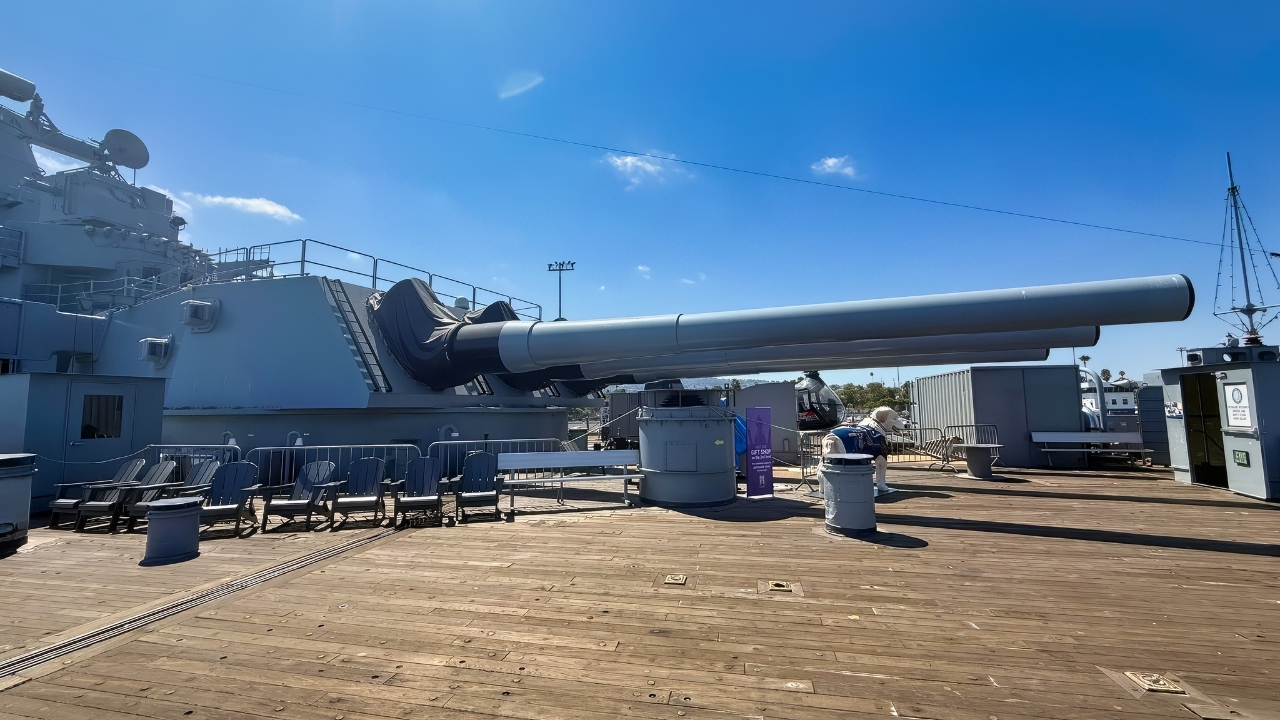
Long View of USS Iowa Guns. Image Credit: National Security Journal.
Speed As Survivability. The Iowas survived because they could be where the fight was—and leave when the carriers needed airspace and sea room. Speed wasn’t glamour; it was strategy.
Why They Faded—And Why They Endure
Missiles and aircraft made it increasingly risky and inefficient to bring a battleship within gunnery range of defended coasts. Precision-guided munitions let destroyers and submarines land blows from far away, with far fewer sailors. In that world, the Iowas’ operating costs and crewing requirements were hard to justify.
Yet they endure for reasons beyond romance. Their museums teach seamanship, engineering, leadership, and the gritty reality of war at sea. Their service histories map the Navy’s journey from gunnery dominance to air and missile warfare, and their 1980s retrofit foreshadowed the arsenal ship idea: large hulls packed with missiles and battle management.
The Iowa-Class In Perspective
It would be easy to call the Iowas anachronisms after 1945. That misses the point. They were built for a world that still valued the decisive surface duel, then adapted—twice—to serve in worlds that prized shore bombardment, presence, and missile warfare. In every era they entered, they found a job worth doing because their speed, protection, and volume gave commanders options.
Their final retirement acknowledges a truth: technology moved on. But their legacy lays down a marker for naval designers—build in margin, respect human factors, and expect your ship to meet missions no one can yet name. The Iowas did that, which is why they kept coming back.
The Museum Years: Living Lessons In Steel for Iowa-Class
Stand under a 16-inch turret and you feel the scale of industrial war. Step into a plotting room and you see analog computing at its peak. Look at the Tomahawk launchers and CIWS mounts and you see the Navy’s hybrid century—old and new welded into capability. The exhibits on each ship are not props; they are systems, preserved and explained by veterans who turned them in anger and in peace.
That is the best final chapter any warship can have: not scrap, not myth, but teaching—to future sailors, engineers, and citizens—what sea power costs and what it can do.
About the Author: Harry J. Kazianis
Harry J. Kazianis (@Grecianformula) is Editor-In-Chief and President of National Security Journal. He was the former Senior Director of National Security Affairs at the Center for the National Interest (CFTNI), a foreign policy think tank founded by Richard Nixon based in Washington, DC. Harry has over a decade of experience in think tanks and national security publishing. His ideas have been published in the NY Times, The Washington Post, The Wall Street Journal, CNN, and many other outlets worldwide. He has held positions at CSIS, the Heritage Foundation, the University of Nottingham, and several other institutions related to national security research and studies. He is the former Executive Editor of the National Interest and the Diplomat. He holds a Master’s degree focusing on international affairs from Harvard University.
More Military
The Air Force’s Big FB-22 Raptor Stealth Bomber Mistake Still Stings
The Navy’s F-117 Nighthawk Stealth Fighter Mistake Still Stings
SR-71 Blackbird: We Got Right Up Close to the Mach 3 Legend
‘Cost Crisis’: $141,000,000,000 For America’s New LGM-35A Sentinel ICBM


Ghost_Tomahawk
September 22, 2025 at 5:31 pm
The solution?
The Navy still needs a vessel that serves the role the Iowas provided.
30 knot speed
Missiles to destroy modern navy vessels
Shore battery
Anti aircraft anti missile defense
Sounds like a new battleship needs to be built with automation on a Cruiser hull. A ship with about 250-400 sailors and officers. Don’t go nuts on extras. It’s these ships to replace Aegis Cruisers to allow destroyers to fulfill their roles as attack vessels.
Stephen Livingston
September 24, 2025 at 12:58 pm
Everyone forgets about the USS Alabama
Tobias Levene
September 25, 2025 at 12:23 am
The USS Iowa is at the port of Los Angeles in San Pedro not Long Beach
Pingback: The Iowa-Class Battleships Have A Message for the U.S. Navy – LivelyCity – Switzerland