

Iran is going after the big ships. Oil is moving on the smaller ones. That’s the short version of a Bloomberg report published Wednesday by Weilun Soon, which found that crude is increasingly leaving the Persian Gulf aboard Suezmax and Aframax tankers, the mid-sized workhorses of the fleet, as Iranian attacks thin out the supertankers that have carried most of the wartime shuttle trade.
According to Vortexa data cited by Bloomberg, the volume moved through the strait by those two classes climbed over the past two months, hitting a wartime high of more than 2 million barrels a day in October.

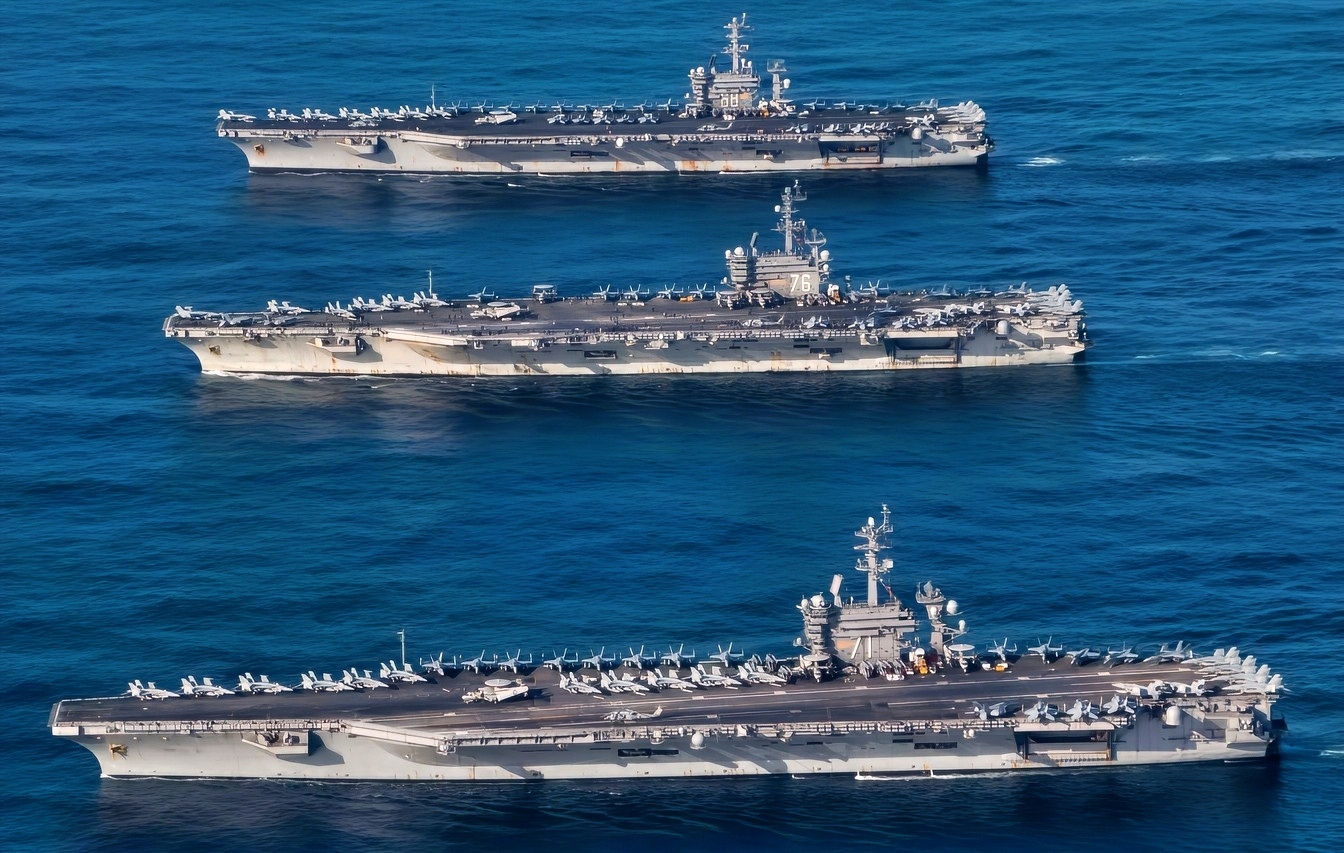
USS John C. Stennis Aircraft Carrier. Image Credit: Creative Commons.
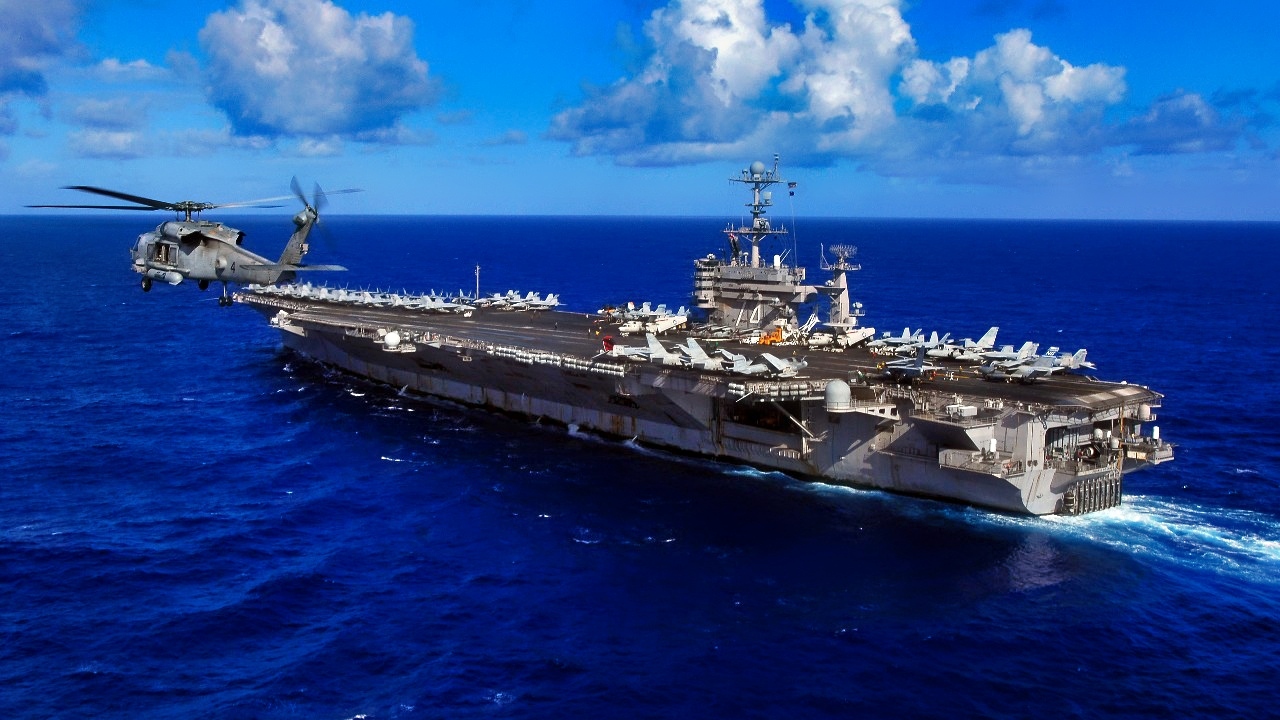
An HH-60H Seahawk, from the “Eightballers” of Helicopter Anti-Submarine Squadron (HS) 8, flies past Nimitz-class aircraft carrier USS John C. Stennis (CVN 74) during flight operations. Stennis is on a scheduled deployment to promote peace, regional cooperation and stability.
That helped push total daily exports through Hormuz to 11.4 million barrels, the highest figure since the conflict began in late February.
Out of a strait Iran insists it controls.
The Supertanker Problem
To understand why this matters, you have to look at how the shuttle trade has worked since the shooting started. Very large crude carriers, or VLCCs, can haul up to 2 million barrels apiece.
According to BRS Shipbrokers, they make up 72 percent of the vessels transiting Hormuz.
They run crude out of the Gulf to waters off Sohar, Oman, and Fujairah in the UAE, where it gets pumped across to waiting tankers whose owners won’t risk the strait themselves.
That model is efficient.
It’s also a bullseye.
Tehran figured out early that every VLCC it damages or scares off takes a massive chunk of lift out of the system.
October made that plain. Al Jazeera, citing Kpler data, reported that 10 tankers were struck in the strait between Sept. 28 and Oct. 4, with UKMTO logging another 15 attacks between Oct. 6 and 14.
Iran’s security chief, Mohsen Rezaei, claimed his forces were hitting five or six vessels in the U.S.-backed shuttle system every night.
Take that number with a large grain of salt.
However, the trend was real enough that the Joint Maritime Information Center rated the threat to shipping “severe,” its second-highest level.
Iran has tried the paperwork route, too.
In August, its new Persian Gulf Strait Authority blocked 45 tankers and threatened action against any vessel that transferred cargo with them.
Breakwave Advisors noted that the targeting focused on VLCCs, with the 12 supertankers named at the time accounting for roughly 900,000 barrels per day, about 16 percent of all crude liftings from inside the Gulf since early July.
The list has since grown. One analysis put it at 77 ships and found none of them had been deterred.
Enter The Suezmax
A Suezmax carries about a million barrels.
An Aframax carries less—both haul less than half of what a VLCC does. In peacetime, that’s a disadvantage. In a shooting gallery, it starts to look like an asset.
Bloomberg’s reporting shows these mid-sized ships have mostly been loading cargoes from Iraq, Kuwait and Qatar.
Once through the strait, they either transfer their crude to other ships in the Gulf of Oman or sail straight to port, often in India.
The Lucia A is a good example.
The Suezmax, owned by a Marshall Islands-based company, was one of the first of its class into the trade.
Since June, it has picked up at least four Iraqi cargoes and delivered them either to ships waiting in the Gulf of Oman or to Ain Sukhna, Egypt’s Red Sea port.
Earlier this month, it loaded its fifth.
Another Suezmax, the Ture, collected its third Iraqi cargo last week. Before this, it was hauling Russian crude from western ports to India under the G7 price cap.
Supertanker rates have climbed much faster than rates for smaller ships since the conflict began. Shipbrokers told Bloomberg that a Suezmax from the Persian Gulf to China runs roughly a third to just under half of the published VLCC benchmark on the same route.
For a charterer staring down war-risk premiums, that’s a real number.
The Military Logic Of Going Small
One lesson holds up everywhere.
You don’t put everything in one basket when someone is shooting at the basket. This is dispersion, plain and simple.
Militaries do it with aircraft on austere airfields, with supply points, with command posts.
Spread the load across more, smaller platforms, and the enemy has to find, fix,x and hit more targets to achieve the same effect.
A VLCC knocked out of service removes up to 2 million barrels of oil.
A Suezmax removes about half that. Iran’s targeting cells now need roughly twice the hits to do the same damage, and every one of those strikes exposes the people firing them.
That’s the most important takeaway from the Bloomberg piece.
The Gulf producers and the shipowners willing to run this gauntlet are adapting faster than Tehran’s pressure campaign.
There’s an American piece to this as well.
The U.S. Navy has reportedly opened a route to let Gulf states keep exporting despite Iran’s closure, and CENTCOM said U.S. forces helped Gulf partners move more than 19 million barrels of crude on a single day, Oct. 12.
Rezaei, for his part, accused CENTCOM and the UAE military of using smaller vessels to transfer oil to larger tankers. Whether Washington is steering the shift to Suezmaxes or simply riding it, the effect on the water is the same.
The Smaller Tankers, However, Means More Targets
None of this is free. More smaller ships means more transits, more crew exposure, and more ship-to-ship transfers in crowded waters off Oman.
Each one is another chance for a mine, a drone, or a collision.
Seatrade Maritime’s look at the shuttle trade shows how much choreography those transfers take even on a quiet day.
The supply picture is still fragile.
The EIA has long called Hormuz the world’s most important oil chokepoint, and before the war it averaged about 17.1 million barrels a day.
Gulf flows outside Iran had climbed back above 81 percent of prewar levels in September, then crashed again when Iran stepped up its attacks.
On Oct. 11, only 2.9 million barrels made it through.
Tehran isn’t signaling any retreat, either. Parliament Speaker Mohammad Bagher Ghalibaf, Iran’s top negotiator, said last week that navigation through Hormuz won’t return to prewar conditions and argued that the UN Convention on the Law of the Sea doesn’t apply to the strait.
So what does all this mean for the war and for what you pay at the pump?
In the short term, the smaller tankers are a pressure valve. Every extra barrel that clears the strait helps keep a lid on crude prices. However, they’re a workaround. The underlying problem is that a hostile power sitting on one of the world’s most important chokepoints hasn’t changed one bit. Iran built its strategy around hitting the biggest ships it could find. The oil found smaller ones. Now comes the inevitable adaptation.
About the Author: Steve Balestrieri
Steve Balestrieri is a National Security Columnist. He served as a US Army Special Forces NCO and Warrant Officer. In addition to writing on defense, he covers the NFL for PatsFans.com and is a member of the Pro Football Writers of America (PFWA). His work was regularly featured in many military publications.


