
Negotiations between the United States and Iran continue, and traffic through the Strait of Hormuz appears to be gradually increasing.
Shipping companies are finally expressing greater confidence in their ability to safely pass through the waterway following ceasefire agreements between the U.S., Israel, Hezbollah, and Iran – but there’s still a long way to go.
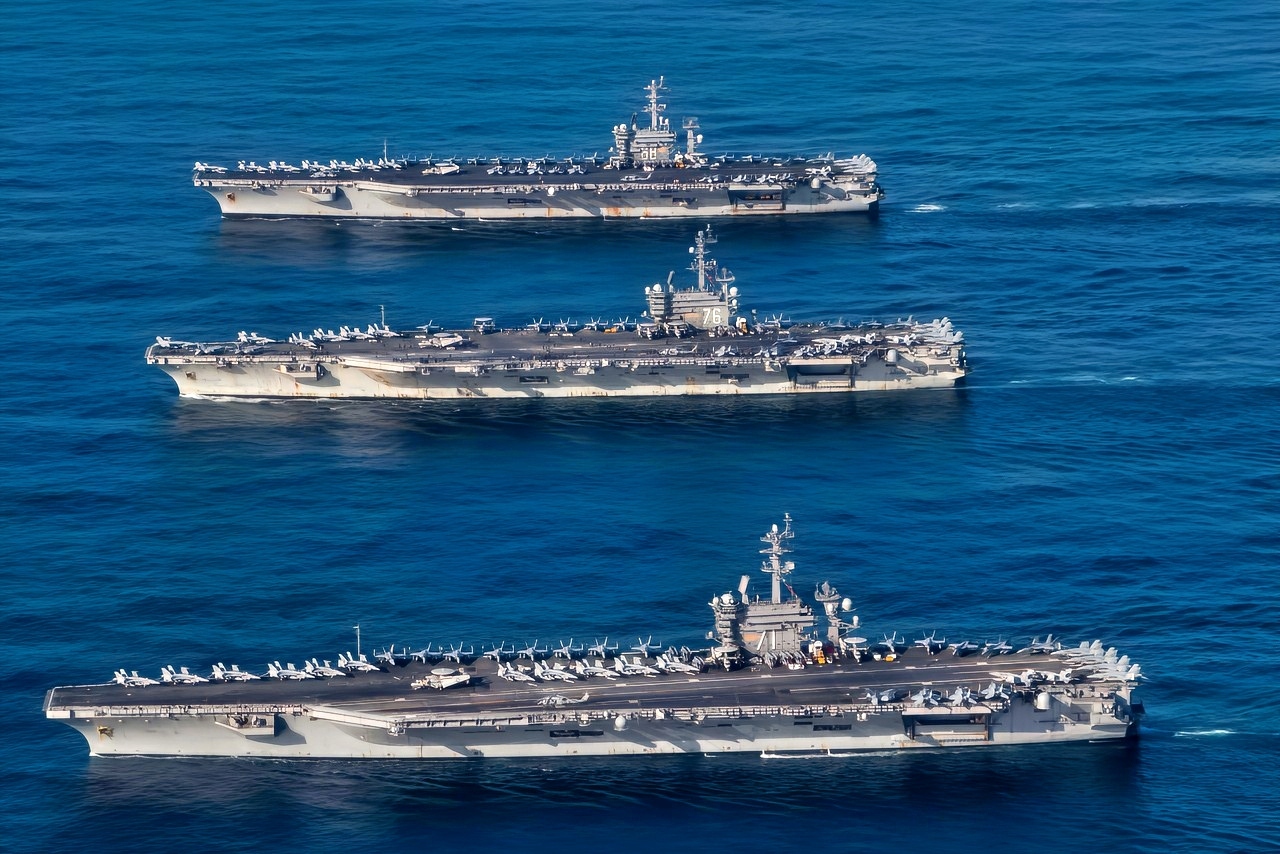
The U.S. Navy aircraft carriers USS Nimitz (CVN-68), USS Theodore Roosevelt (CVN-71) and USS Ronald Reagan (CVN-76) underway in the Western Pacific on 12 November 2017. The strike groups were underway and conducting operations in international waters as part of a three-carrier strike force exercise. This was the first time since August 2007 that three U.S. Navy carriers operated together. In 2007, USS Kitty Hawk (CV-63), USS Nimitz (CVN-68) and USS John C. Stennis (CVN-74) participated in exercise “Valiant Shield”.
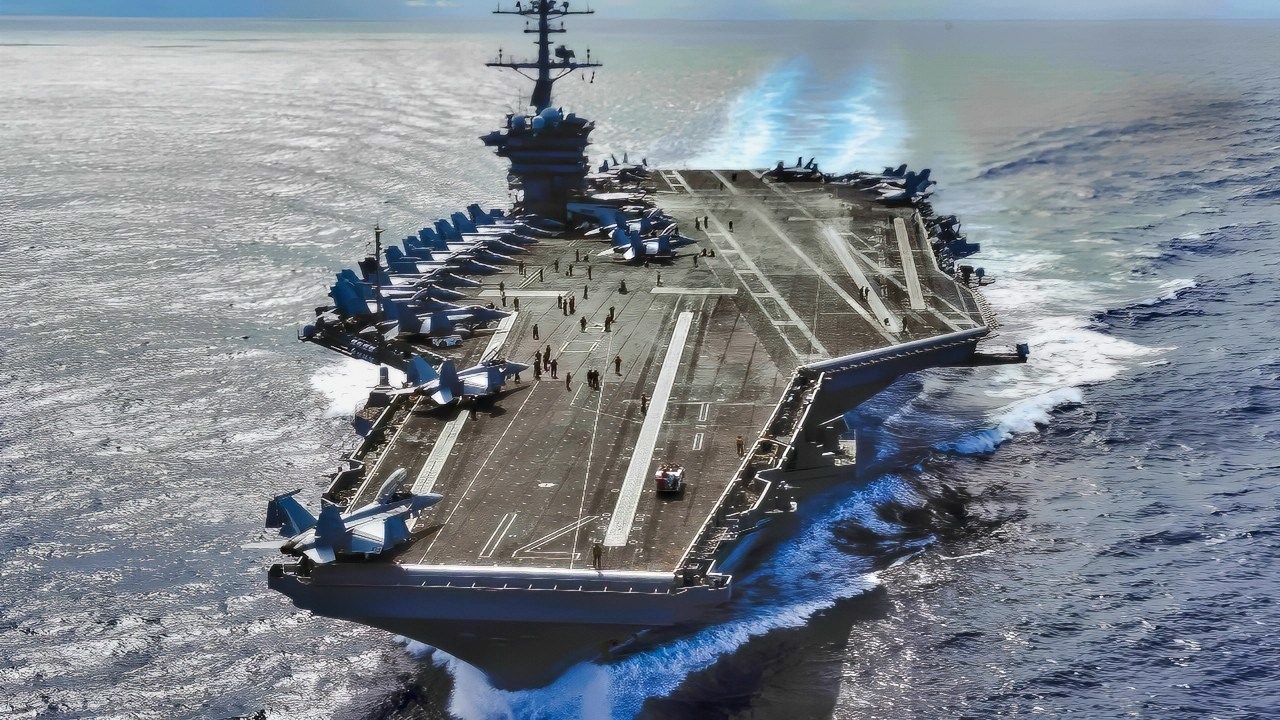
PHILIPPINE SEA (Sept. 24, 2024) The Nimitz-class aircraft carrier USS Theodore Roosevelt (CVN 71) transits the Philippine Sea, Sept. 24, 2024. Theodore Roosevelt, flagship of Carrier Strike Group 9, is underway conducting routine operations in the U.S. 7th Fleet area of operations. U.S. 7th Fleet is the U.S. Navy’s largest forward-deployed numbered fleet, and routinely interacts and operates with allies and partners in preserving a free and open Indo-Pacific region. (U.S. Navy photo by Mass Communication Specialist 3rd Class Adina Phebus)
Traffic seems to be moving through the strait, and Vice President JD Vance said significant progress had been made in negotiations on Monday – but given that the Strait of Hormuz was “closed” again by Iran only days after the Memorandum of Understanding was signed, it’s hard to know what comes next.
Traffic Trends Up
Reuters reported that three stranded supertankers passed through the Strait of Hormuz on Tuesday, and an additional seven empty liquefied natural gas tankers have entered in recent weeks.
A day earlier, ship broker Clarksons confirmed in a note that daily transits are still below the 125 crossings seen daily before the conflict began, but added that “the trend is positive.”
On Sunday, five vessels passed through the Strait, down from 26 ships a day earlier.
A general increase in traffic is good news for the world, but significant challenges remain, with thousands of seafarers still awaiting evacuation after becoming stranded during the conflict.
Maritime authorities, meanwhile, are still looking for ways to secure the Strait and minimize the impact of temporary clashes that may still arise during the negotiating process.
Evacuations Begin
While the long-term future of the Strait of Hormuz remains uncertain, the International Maritime Organization announced on Tuesday that seafarers stuck in the Persian Gulf will begin to be evacuated as part of a large-scale plan backed by both the United States and Iran.
According to IMO Secretary-General Arsenio Dominguez, necessary “safety guarantees” have been obtained and the conditions for safe navigation have been confirmed to support the effort.
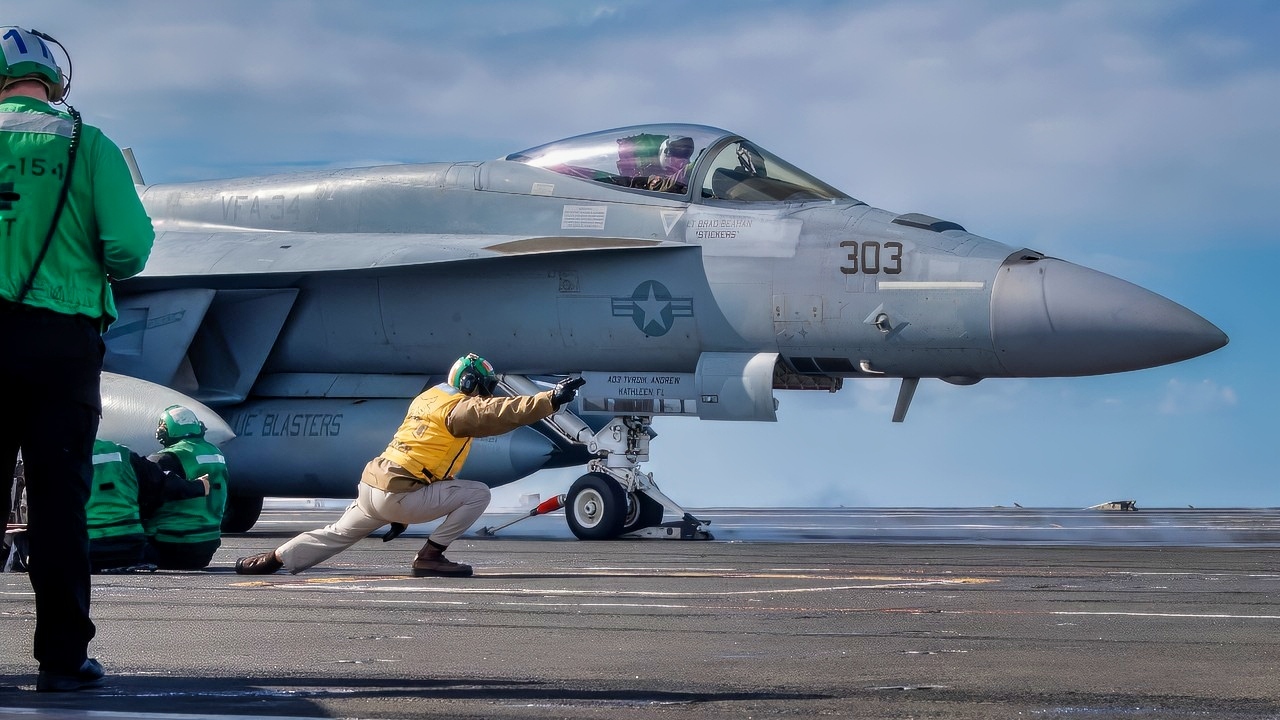
U.S. Navy Lt. Andrew Bentley signals an F/A-18E Super Hornet, assigned to the “Blue Blasters” of Strike Fighter Squadron (VFA) 34, to launch from the flight deck of the Nimitz-class aircraft carrier USS Theodore Roosevelt (CVN 71), Nov. 30, 2023. Theodore Roosevelt, the flagship of Carrier Strike Group Nine (CSG 9), is conducting integrated training exercises in the U.S. 3rd Fleet area of operations. (U.S. Navy photo by Mass Communication Specialist 3rd Class Adina Phebus)
Dominguez described “months of hardship and distress” for as many as 11,000 innocent seafarers stranded in the region who will now be allowed to return home.
“After months of hardship and distress for thousands of innocent seafarers, and a negative impact for the whole world, I welcome with deep satisfaction the peace agreement concluded between the United States and Iran, marking a decisive step towards restoring maritime security and bringing to an end the unacceptable attacks against civilian shipping,” Dominguez said.
“We will begin the implementation of the evacuation plan for over 11,000 seafarers still stranded in the region. This large-scale operation will be carried out in close cooperation with Iran, Oman, all other coastal States in the region, the United States, and the maritime industry,” the statement continued.
Denmark Makes Announcement
On Tuesday, June 23, Denmark announced that it would begin working with France and Britain to fully reopen the Strait of Hormuz in an international maritime mission that could help prevent a global oil supply shock.
In a statement, Danish Defense Minister Jepp Bruus said they would begin working with drone operators, interpreters, and officers to launch an initiative to ensure safe freedom of passage through the Strait.
“This will involve a contribution including a group of interpreters, drone capabilities, staff officers, as well as the possibility of mobilizing expertise in the cyber domain,” Bruus said.
A bill passed in the Danish parliament said that the effort is designed to “strengthen maritime security and guarantee freedom of navigation in and around the Strait of Hormuz and the Red Sea.”
Britain and France Lead the Way
The initiative established by Britain and France is not new. Britain, France, and Denmark have all played substantial roles in maritime security operations in the Persian Gulf since a number of tanker attacks occurred in the region in 2019.
Britain and France were among the first supporters of a mission known as European Maritime Awareness in the Strait of Hormuz (EMASoH), intended to monitor shipping lanes and reassure commercial vessels transiting one of the world’s most important waterways.
That mission gives all parties involved crucial experience that could help open the Strait of Hormuz.
The latest mission builds on that old framework and will attempt to secure the Strait while the United States and Iran continue to negotiate details of a potential peace deal.
European governments have been hesitant to assist in military strikes against Iran but have since worked alongside the United States to secure the Strait in the wake of the war – a move driven by Europe’s dependence on Liquefied Natural Gas (LNG) shipments from the Gulf, and its exposure to skyrocketing oil prices globally.
For now, negotiations continue, and the Strait of Hormuz – despite comments over the last week from officials in Tehran – remains open to commercial traffic.
But there is no telling when the Strait could close again, as recent events show that a single strike in Lebanon or a threat from the U.S. president could unravel any progress made so far.
About the author: Jack Buckby
Jack Buckby is a British researcher and analyst specializing in defense and national security, based in New York. His work focuses on military capability, procurement, and strategic competition, producing and editing analysis for policy and defense audiences. He brings extensive editorial experience, with a career output spanning over 1,000 articles at 19FortyFive and National Security Journal, and has previously authored books and papers on extremism and deradicalization.


Hujjathullah M.H.B. Sahib
June 24, 2026 at 3:37 am
While the mediated relief to the thousands of seafarers trapped around the Straits of Hormuz must be welcomed it must also be realised that their graduated freedom of movement is still pegged to and held hostage by the ground realities within Labanon. Even with security imputs from the U.K. France and Denmark kicking in, the functional repatriation of the seafarers would be stretched over the 60 days period and beyond because of the propensity of the U.S. and Israel to flout the pledges. The geopolitical Sword of Democles would continue to hang over the Hormuz for the near future at least.