


Is The Sea Mine Threat Returning to the Strait of Hormuz? – The Iranian use of sea mines in the Strait of Hormuz has been well documented. They are effective as a strategic deterrent: cheap, relatively easy to deploy, and capable of slowing maritime traffic in the area.
The Iranians have claimed that three tankers that were set on fire in the Strait were the victims of sea mines.
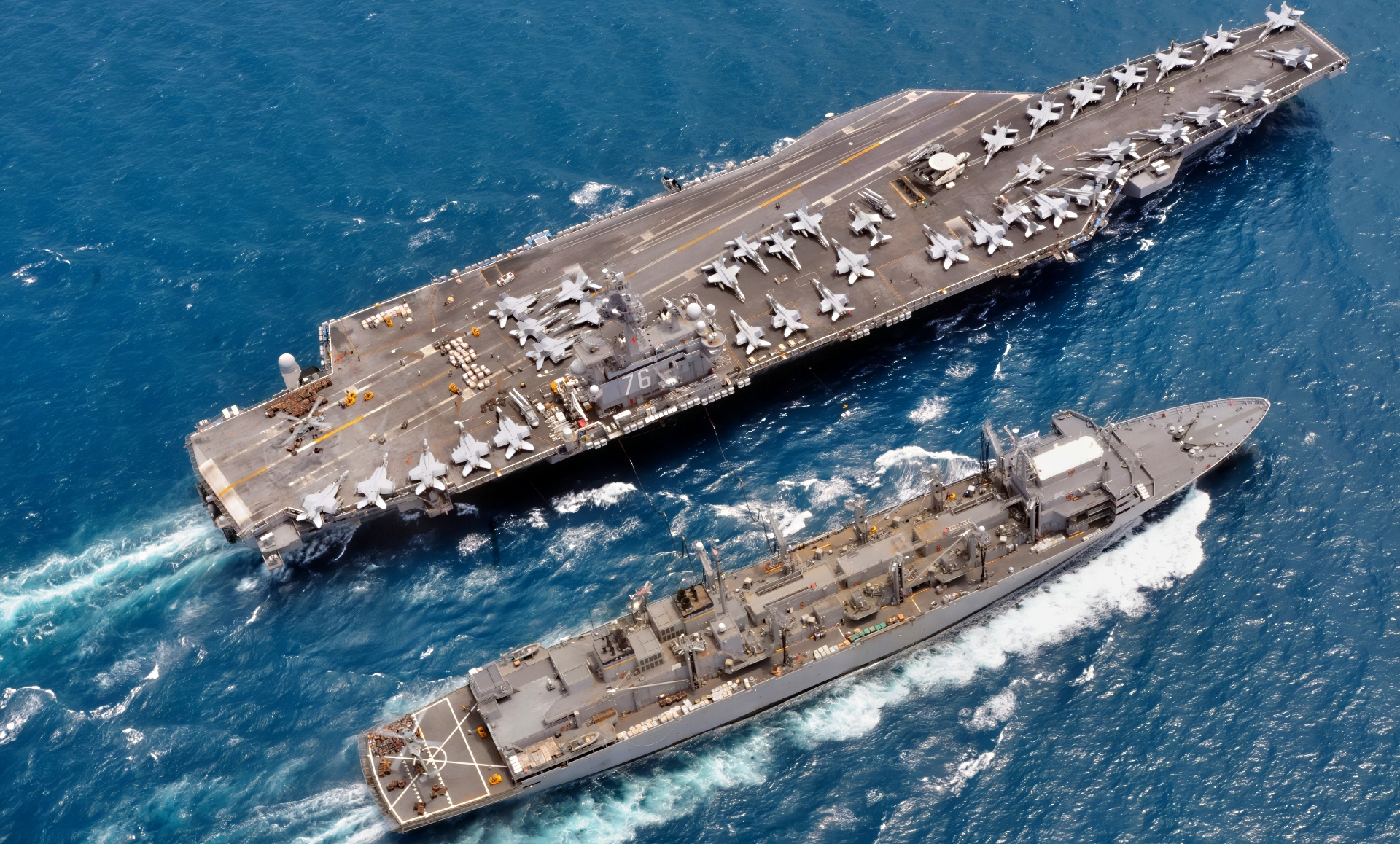
(August 15, 2008) With SH-60 helicopters moving pallets of supplies both USS Ronald Reagan (CVN 76) and USNS Bridge (T-AOE 10) work together during a replenishment at sea or RAS. With Reagan’s six galleys and approximately 4,100 Sailors it takes a lot of produce to feed that many folks and the Nimitz-class aircraft carrier got what it needed from USNS Bridge to do so.
The Ronald Reagan Carrier Strike Group is on a routine deployment in the 7th Fleet area of responsibility. Operating in the Western Pacific and Indian Ocean, the U.S. 7th Fleet is the largest of the forward-deployed U.S. fleets covering 52 million square miles, with approximately 50 ships, 120 aircraft and 20,000 Sailors and Marines assigned at any given time.
U.S. Navy photo by Senior Chief Mass Communication Specialist (SW/NAC) Spike Call

At sea (Mar. 1, 2007) – Capt. Craig “Animal” Williams (front) in a F/A 18C Hornet (front) and Capt. Richard “Rhett” Butler (back) in an F/A 18C Hornet look up for a photo as they fly over USS Ronald Reagan (CVN 76). Capt. Williams, a 22-year Naval Aviator who graduated from the United States Naval Academy, was relieved as Commander, Carrier Air Wing Fourteen (CVW-14) by 21-year Naval Aviator, Capt. Butler, a graduate of the University of Kentucky during an aerial change of command ceremony. The Ronald Reagan Carrier Strike Group is currently underway in the Pacific Ocean on a surge deployment in support of U.S. military operations in the Western Pacific. Official U.S. Navy photo by Lt. Cmdr. Tam Pham
(RELEASED)
The U.S. Central Command (CENTCOM) claimed that they had cleared the Strait of Hormuz’s international shipping lanes of Iranian mines more than two months ago. However, the threat is possibly back. Fox News reported this week that the world’s top maritime official says the waterway is far from safe.
Iran’s IRGC naval forces claimed on Oct. 17 that two large oil tankers caught fire after striking naval mines in the strait.
According to Reuters, Iran’s state news agency IRNA said both ships had switched off their positioning and radar systems, as most tankers do, and were using the southern route to avoid Iranian missiles.
One of the tankers was left dead in the water. On Tuesday, the Guards claimed that a third tanker was hit, stating it exploded after hitting a mine south of the strait.
The Use Of Spotters In The Strait Is Leading To Fresh Attacks
Although tankers and container ships have switched off their transponders to avoid being targeted, a separate Reuters report said the IRGC has used new tactics to target shipping.
The IRGC is using unarmed spotters in small dhows to relay information on tankers’ locations. The IRGC has adapted to this tactic to save its last remaining fast boats.
In one incident, the US caught the dhow relaying information and forced the crew off before sinking it. Because of these repeated attacks, the US Navy-led Joint Maritime Information Center (JMIC) said the threat to merchant shipping in the Strait of Hormuz remained at its second-highest level: “severe.”
“IRGC attacks, attempted attacks, and/or harassment activity persisted, including UAV overflight, targeted surveillance of merchant shipping, and occasional VHF hailing,” the JMIC said.
The IMO Won’t Vouch For The Lanes
Arsenio Dominguez, Secretary-General of the International Maritime Organization, told Fox News Digital that despite CENTCOM’s denials, the IMO’s information indicates mines remain a significant threat to shipping in the Strait.
“The traffic separation scheme, the information that we have is that they still have mines. And of course, whilst the conflict is ongoing, it’s very difficult for us to use third parties to verify that it is clear of these hazards,” he said.
The IMO-approved traffic separation scheme, adopted in 1968, is the only route mariners actually use on the charter. The IMO states that any arrangement with the Gulf littoral states will “guarantee the non-discriminatory and unimpeded right of transit passage of all ships.”
However, due to Iran’s actions, Dominguez said that the strait is “not open for business in the way that it was before the conflict started.”
Iran insists that shipping use the northern route within its territorial waters, with the IRGC collecting tolls and safety fees. Washington and the IMO both reject it as a violation of international maritime law.
Dominguez added that Tehran notified the IMO of its temporary route but never submitted it for approval.
CENTCOM Insists That Mines Aren’t To Blame
However, CENTCOM and the UK Maritime Trade Operations (UKMTO) have disputed the mine story. The JMIC issued an advisory on Oct. 18 stating there is “no substantiation” to the IRGC’s claims, gCaptain reported.
CENTCOM has gone further, calling Iran’s announcements disinformation meant to scare commercial shipping off. The command told Al Jazeera reporters that projectiles are hitting the ships.
Whether mines or projectiles hit these vessels, shipping is being impeded at great cost both inside and outside the Strait.
But just the threat of mine warfare is giving shippers and insurers pause, influencing the cost of using the Strait. That’s been Iran’s goal from the outset. The JMIC still rates the threat level as Severe.
How This Current Situation Unfolded
In late August, CENTCOM commander Adm. Brad Cooper explained how U.S. forces cleared the Traffic Separation Scheme over several months, using Navy divers, SEALs, and air power from all four services.
He described the conditions as “challenging and dangerous to say the least, but we got the job done.” Per U.S. officials cited by Axios, crews ran down more than 200 mine-like objects in the main lane. Only 11 were actual mines. It is a painstakingly slow process.
In another shortsighted move by the Pentagon, the Navy had retired its four Bahrain-based mine sweepers the year before, while their unmanned replacements were still being fielded.
Defense analyst Bryan Clark described the Navy’s minesweeping capacity at the time as being at a nadir. Gutting the Navy’s minesweeper force so early was a mistake.
The Navy has been down this road before. In April 1988, the frigate USS Samuel B. Roberts struck an Iranian M-08 mine in the central Gulf, a weapon built on a design older than World War I. It nearly broke her keel. The repair bill ran about $90 million. The mine cost at most a few thousand dollars.
IRGC Navy commander Rear Adm. Ali Azmaei has also warned that any vessel that switches off its navigation systems will be treated as hostile.
Mines Are One of Tehran’s Bargaining Chips
The timing is no accident. Iranian Foreign Minister Abbas Araghchi says Tehran submitted a proposal through Qatar that would reopen the strait and restore normal traffic within seven days. But the US will not agree to the conditions that Tehran has insisted on for that to happen.
U.S.-Iran talks opened Sunday in Switzerland, with a fight already brewing over frozen Iranian assets. Iran’s economy is in freefall, with inflation surging to nearly 90 percent (about 73.6 percent annually), driven by a severe currency collapse, the ongoing conflict and U.S. maritime blockades, and soaring food and energy costs, according to the Statistical Center of Iran.
Tehran is using the suggestion of a mine threat to remind Washington, and every oil importer on the planet, that it still can influence prices elsewhere through its targeting of shipping in the Strait.
The U.S. cleared the lanes once. It may have to prove they’re clear again, and again after that. As mentioned above, that’s a slow process.
About the Author: Steve Balestrieri
Steve Balestrieri is a National Security Columnist. He served as a US Army Special Forces NCO and Warrant Officer. In addition to writing on defense, he covers the NFL for PatsFans.com and is a member of the Pro Football Writers of America (PFWA). His work was regularly featured in many military publications.


