


Iran isn’t just blockading the Strait of Hormuz anymore — it’s monetizing it. A new law creates a dedicated agency, backed by the Revolutionary Guard, that turns the world’s most important oil chokepoint into a tollbooth: pay up, or your tanker doesn’t pass. Tehran believes it can squeeze tens of billions of dollars a year out of the scheme — and it’s betting the rest of the world will have little choice but to go along.
The Iran Strait of Hormuz Crisis Looks Clear: Tehran Wants Money
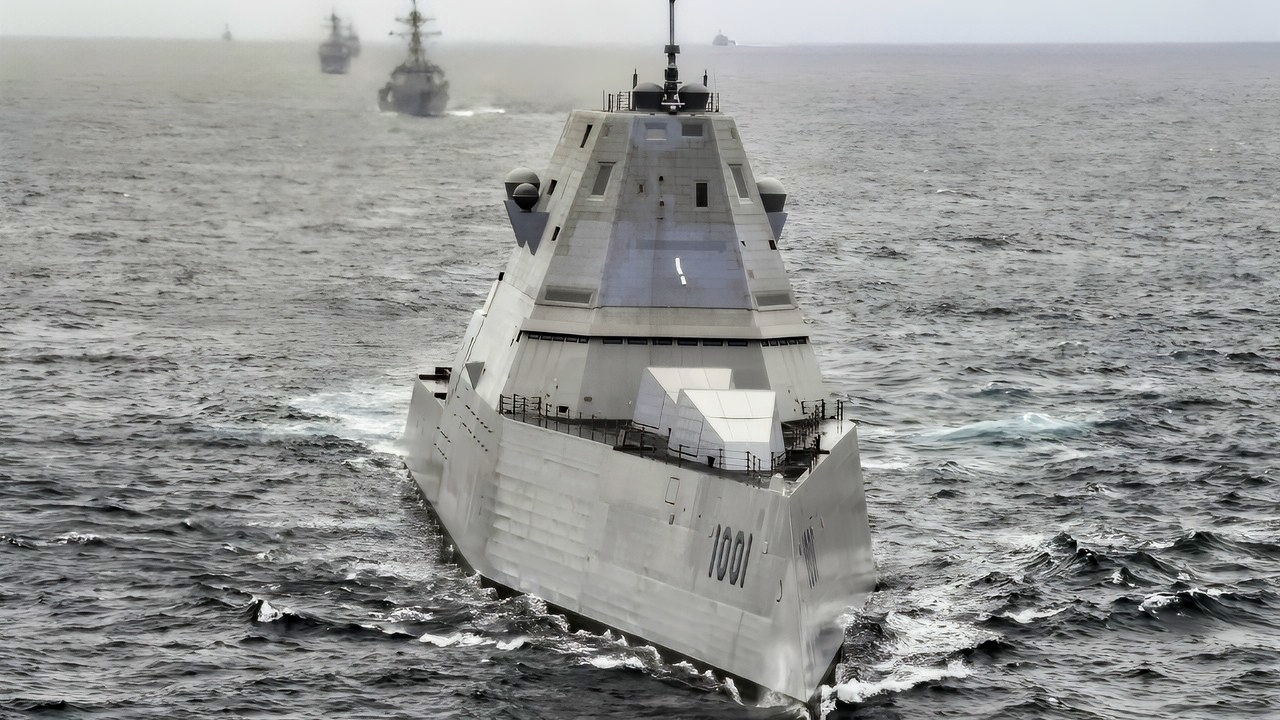
(April 21, 2021) The Zumwalt-class guided-missile destroyer USS Michael Monsoor (DDG 1001) leads a formation including the Arleigh Burke-class guided missile destroyers USS Fitzgerald (DDG 62), USS Spruance (DDG 111), USS Pinckney (91), and USS Kidd (DDG 100), and the Independence-variant littoral combat ship USS Coronado (LCS 4) during U.S. Pacific Fleet’s Unmanned Systems Integrated Battle Problem (UxS IBP) 21, April 21. UxS IBP 21 integrates manned and unmanned capabilities into challenging operational scenarios to generate warfighting advantages. (U.S. Navy photo by Chief Mass Communication Specialist Shannon Renfroe)

Littoral Combat Ship. Image Credit: Creative Commons.
Iran is never going to give up the Strait of Hormuz willingly. A recent law passed by the Iranian parliament underscores this painful reality. Per the new law, the Islamic Republic has created an entirely new bureaucracy for managing the flow of shipping traffic through the Strait of Hormuz.
Known as the Persian Gulf Strait Authority, Iran will establish a regulatory mechanism, backed by the Islamic Revolutionary Guard Corps (IRGC) Navy, that requires vessels transiting the Strait to obtain transit permits before entering the Strait.
Since the US and Israel initiated their abortive regime change war against the Islamic Republic of Iran, Tehran has blockaded the Strait of Hormuz, cutting off nearly 20 percent of the world’s oil flow, 18 percent of the world’s natural gas flows, and one-third of the world’s agricultural products (notably fertilizer). Tehran has allowed a smattering of civilian ships to pass through–so long as those ships paid a transit fee, submitted to inspections, and paid the fee in either Chinese Yuan or bitcoin.
Iran has already earned money from this informal toll system. With the new law, they’ve formalized the system and intend to charge $2 million per vessel. Tehran claims that it will charge “friendly” nations only $1 million. Meanwhile, Iran projects it could earn between $70 billion and $100 billion annually from this proposed system.
A Financial Lifeline for Tehran
Meanwhile, Washington continues to delude itself that the Iranians will simply give up their plans for a tolling system because, well, no one can quite explain why. President Donald Trump, the man who was the inspiration for The Art of the Deal, should know better than most that “money talks and excrement walks.”
Before the war started, Iran was, other than North Korea, probably the most heavily sanctioned nation on the planet, going back decades. While there is some argument over the exact size and severity of the protests that gripped Iran late last year and early this year, one thing most experts agree upon is the cause.
It was Iran’s abysmal economy that caused those protests.

Littoral Combat Ship USS Cooperstown NSJ Photo Taken On October 14, 2025.
The Islamic Republic has long blamed the US sanctions as being the cause of its economic woes. In turn, those sanctions have created unrest among the struggling Iranian people who, during those aforementioned protests, turned their ire for a time at their own regime. Since the Americans and Israelis initiated the war, though, that has changed.
Popular sentiment appears to have shifted back to the regime, because it is no longer the Islamic Republic killing and terrorizing its own people (of course, the regime still does that). But, Iranians are now primarily threatened by the bombs being dropped upon them by US and Israeli warplanes.
So, circumstances have changed that today favor the Iranian regime for a while longer. Recognizing the advantage that the US-Israeli war has offered Tehran, the Iranian regime has decided to exploit this situation for maximum gain. The Iranian toll system will bring in staggering amounts of money for barely any work.
Iran will use this money for its flailing economy. Plus, Iran is already a top global energy producer. While sales of those energy sources have slowed due to the war and blockades, Iranians are still moving their products.
What’s more, if the war does end without regime change in Iran (it is likely to end that way), then the government in Tehran can stabilize and grow its economy–while empowering its war machine as never before–thereby ensuring the government remains in power.
Trump’s Dilemma: Accept Reality or Escalate
The real question is whether the Americans, specifically America’s chief egoist, President Donald J. Trump, could live with the endless humiliation of the way in which the Iranians have flipped the script on his purported strategy in Iran.

Amphibious assault ship USS Makin Island (LHD 8) and aircraft carrier USS Nimitz (CVN 68) perform expeditionary strike force (ESF) operations, Feb. 15, 2023 in the South China Sea. Nimitz Carrier Strike Group (NIMCSG) and amphibious assault ship USS Makin Island (LHD 8) with embarked 13th Marine Expeditionary Unit are conducting joint ESF operations, representing unique high-end war fighting capabilities, maritime superiority, and power projection, demonstrating the U.S. commitment to our allies and partners in the Indo-Pacific region. (U.S. Navy photo by Mass Communication Specialist 3rd Class Kendra Helmbrecht)
Writing in Al Jazeera, Yashraj Sharma outlined how it was mathematically cheaper for companies and countries to simply pay Iran’s $2 million-per-ship transit fee. Sharma interviewed an Iranian-American economist, Nader Habibi, who explained that shipping companies are “under pressure from the US sanctions” and do not want to run afoul of the US government (or a vengeful American president humiliated by Iran).
The War Produced the Opposite Result
If the Americans were smart, though, they’d recognize the hitherto unbelievable way in which their war destabilized the region and had the opposite intended effect for Iran. Rather than triggering a mass popular uprising against the Islamic Republic, the US-Israeli war ended up empowering the regime as never before and enhancing its popularity among the very people it has spent the last 47 years repressing.
Iran’s leaders are maximizing their gains by building the infrastructure to ensure permanent control over the Strait of Hormuz.
Should the Americans refuse to acknowledge this reality, they will likely continue the blockade with the hopes that it will inevitably crash Iran’s economy, as Iranian energy sources cannot get out to the wider world at the volume that they did before February 28.
But as noted above, Iran continues to move its energy supplies (albeit in drastically reduced volumes), especially via Chinese-controlled railroads and the Caspian Sea.
The Global Economy Faces a Choice
It is the Americans and the rest of the world, though, who will buckle if the blockade doesn’t desist.
The US blockade will ensure the global economy collapses as shortages intensify. Yes, Iran will feel the pinch, too. But not at the level that the rest of the world will remember, Iran has existed for nearly 50 years under severe sanctions and isolation. Tehran is accustomed to living meagerly as a result of those sanctions.
Neither the Americans nor much of the rest of the world can accept such a painful reality.
Unless the Trump administration plans to attack Iran with a much larger force, for a longer duration (which is, frankly, not possible under current economic, logistical, and political strains), then the world will have little choice but to accept the painful, albeit cheaper, realities of Iranian control over the Strait of Hormuz.
Because if it doesn’t, the economy will collapse into another depression that will destroy the United States.
About the Author: Brandon J. Weichert
Brandon J. Weichert is Senior National Security Editor. He also manages The Weichert Brief on Substack. Weichert hosts “National Security Talk” on Rumble, too. He is the author of four bestselling national security books, the most recent of which is A Disaster of Our Own Making: How the West Lost Ukraine (Encounter Books). Follow him via Twitter/X @WeTheBrandon.


