
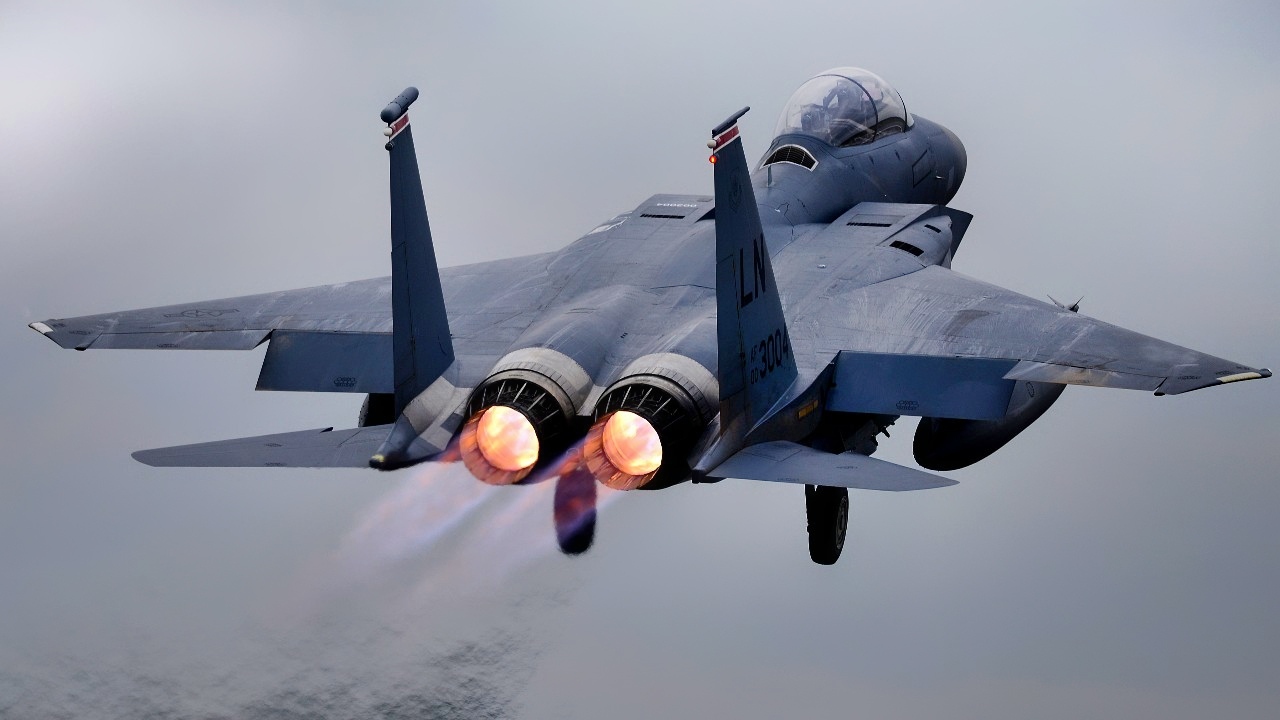
U.S. Expands Iran Strikes As Tehran Lashes Out Across Region: The United States once again expanded its military campaign against Iran overnight into Thursday, July 16, striking military sites around the Strait of Hormuz as well as other sites around Tehran. Iran responded to the attacks with missile and drone strikes targeting six American-linked bases throughout Bahrain, Jordan, and Kuwait.
U.S. Central Command said American forces had carried out two major waves of strikes on Wednesday, July 15, targeting Iranian command centers and air defense systems, missile and drone sites, and coastal surveillance systems. The strikes are intended to degrade Iran militarily and prevent further attacks on ships transiting the Strait of Hormuz. U.S. forces also reportedly disabled a tanker approaching Kharg Island, Iran’s primary crude oil export terminal, following the reimposition of its naval blockade.
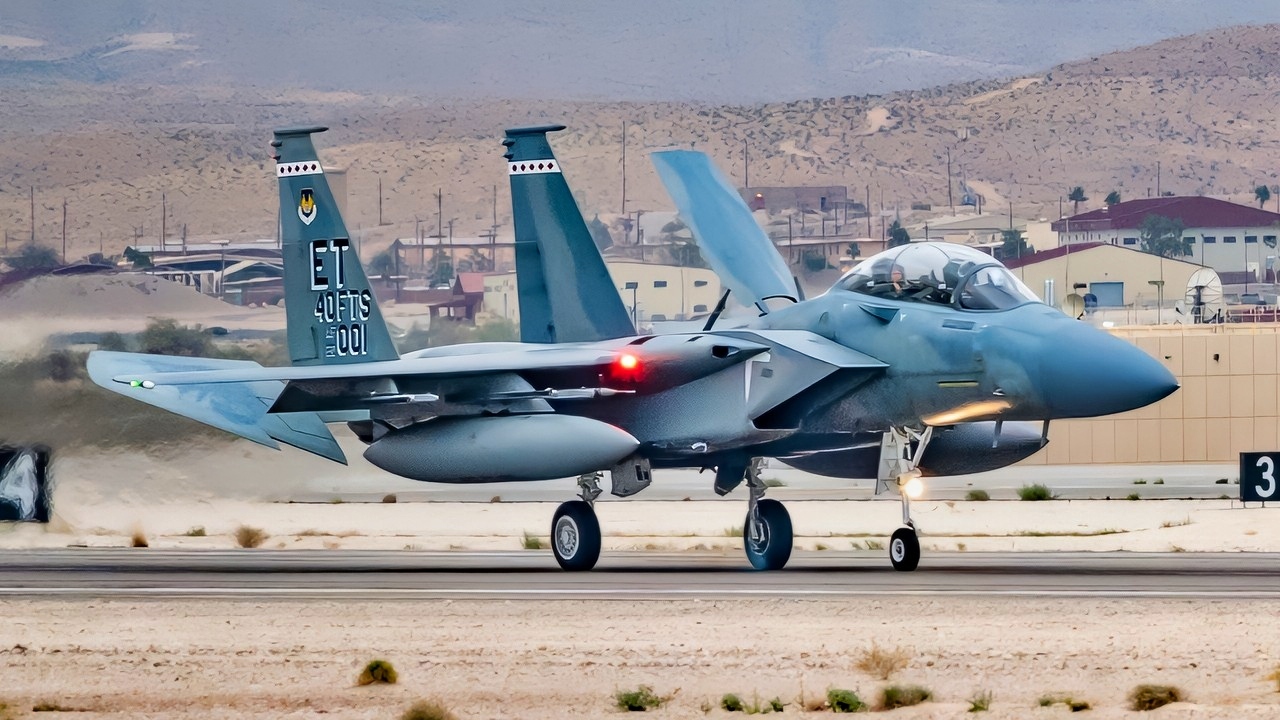
An F-15EX Eagle II lands on the flight line after a training operation at Nellis Air Force Base, Nevada, Nov. 15, 2023. The aircraft is able to fly at a speed of Mach 2.5, constituting it as the world’s fastest fighter jet. (U.S. Air Force photo by Airman 1st Class Elizabeth Tan)

Two U.S. Air Force F-15EX Eagle IIs assigned to the 85th Test and Evaluation Squadron, Eglin Air Force Base, Florida, taxi after landing at Kadena Air Base, Japan, July 16, 2025. Local units conducted integration and familiarization training with the F-15EX. (U.S. Air Force photo by Airman 1st Class Arnet Shayne Tamayo)
U.S. Launches Two Major Waves Of Strikes
The United States carried out two separate waves of airstrikes against Iran on Wednesday, in what became the most extensive series of strikes in the renewed U.S. air campaign since fighting resumed last week. The first operation was announced by U.S. Central Command (CENTCOM) in a statement around 8 am Eastern Time, shortly after U.S. forces completed what was described as a 90-minute wave of strikes.
According to CENTCOM, U.S. aircraft launched strikes against Iranian coastal defense systems and missile storage sites, as well as launch sites on Greater Tunb Island, which lies close to the entrance to the Strait of Hormuz. CENTCOM described the strikes as being intended to further degrade Iran’s ability to threaten commercial shipping through the Strait of Hormuz as Tehran continues to insist it maintains control of the waterway.
Greater Tunb Island occupies a particularly important position west of the Strait of Hormuz. The land has been under Iranian control since 1971, although it is claimed by the United Arab Emirates. Iran has maintained control of the island through a heavy military presence, using coastal defense batteries and missile positions capable of covering the shipping lanes entering and leaving the Persian Gulf.
Later in the evening, CENTCOM announced that American forces had completed a second, larger wave of strikes. The second round of attacks concluded at 9 pm Eastern Time, according to a statement released at 9:25 pm. CENTCOM described how U.S. forces had struck Iranian command centers and air defense sites, including targets around Bandar Abbas, Iran’s main naval port on the Strait of Hormuz.
“U.S. forces struck Iranian command centers, air defense sites, missile and drone capabilities, and coastal surveillance facilities to further degrade Iran’s ability to threaten innocent mariners crewing commercial vessels transiting the Strait of Hormuz. CENTCOM used precision munitions to hit targets in multiple locations, including Bandar Abbas,” the statement reads.
Bandar Abbas is an important site for the Iranians. It is home to Iran’s main naval base on the Persian Gulf and hosts Islamic Revolutionary Guard Corps Navy facilities and batteries, anti-ship missile systems, radar installations, and other maritime command-and-control infrastructure.
Iran Launches New Attacks Across the Gulf
Iran responded during the early hours of Thursday, July 16, with a coordinated series of missile and drone attacks that targeted American-linked military bases and facilities across the Gulf. It was one of the biggest nights yet for the Iranian military and the broadest retaliatory strikes since the fighting resumed.
The IRGC claimed that it had struck six U.S.-linked military facilities across the three countries.
Reports in Iranian state media said that missiles struck Isa Air Base in Bahrain, which is also known as Sheikh Isa Air Base. Tehran claimed to have struck an air surveillance radar and fuel pumping infrastructure, as well as other facilities used to support combat aircraft operations. Bahraini authorities confirmed air raid sirens were activated across the country but did not immediately confirm any significant damage or casualties.
Kuwait’s armed forces also said that their air defenses had intercepted “hostile drones” during the attack. Tehran claimed that the strikes had successfully targeted Ali al-Salem Air Base, one of the country’s main installations hosting U.S. forces.
Iran also launched ballistic missiles at Al Azraq Air Base, also known as Muwaffaq Salti Air Base, in Jordan. According to Iranian media, the attack targeted a fighter aircraft parking area and an American command-and-control center. Jordanian officials said that eight incoming missiles were intercepted before they reached their intended targets.
Iran War Could Spread
Iran issued some of its strongest warnings alongside the strikes, too. Iranian military spokesman Col. Ebrahim Zolfaghari warned that any further attacks by the U.S. against Iranian infrastructure would trigger a much broader regional response.
“All the infrastructure in the region will be crushed under the steel blows of the powerful armed forces of the Islamic Republic of Iran,” he said, adding that “under no circumstances and in no way will we allow America, as a foreign and extra-regional country, to interfere in the strait.”
“This is Iran’s inviolable red line,” he continued.
Iranian Parliament Speaker Mohammad Bagher Ghalibaf also rejected U.S. President Donald Trump’s suggestion this week that Tehran had called Washington and was looking to negotiate, describing the conflict as an “essential and existential war with America.”
About the Author: Jack Buckby
Jack Buckby is a British researcher and analyst specializing in defense and national security, based in New York. His work focuses on military capability, procurement, and strategic competition, producing and editing analysis for policy and defense audiences. He brings extensive editorial experience, with a career output spanning over 1,000 articles at 19FortyFive and National Security Journal, and has previously authored books and papers on extremism and deradicalization.


