

Iran Says The Strait Of Hormuz Is “An Unbreakable Red Line”: The Iranian IRGC warned that the Strait of Hormuz was an “unbreakable red line” after the US escalated air strikes against it.
The IRGC added that it would destroy “all infrastructure throughout the region” if President Trump acted on this threat to attack Iranian bridges and civilian infrastructure.
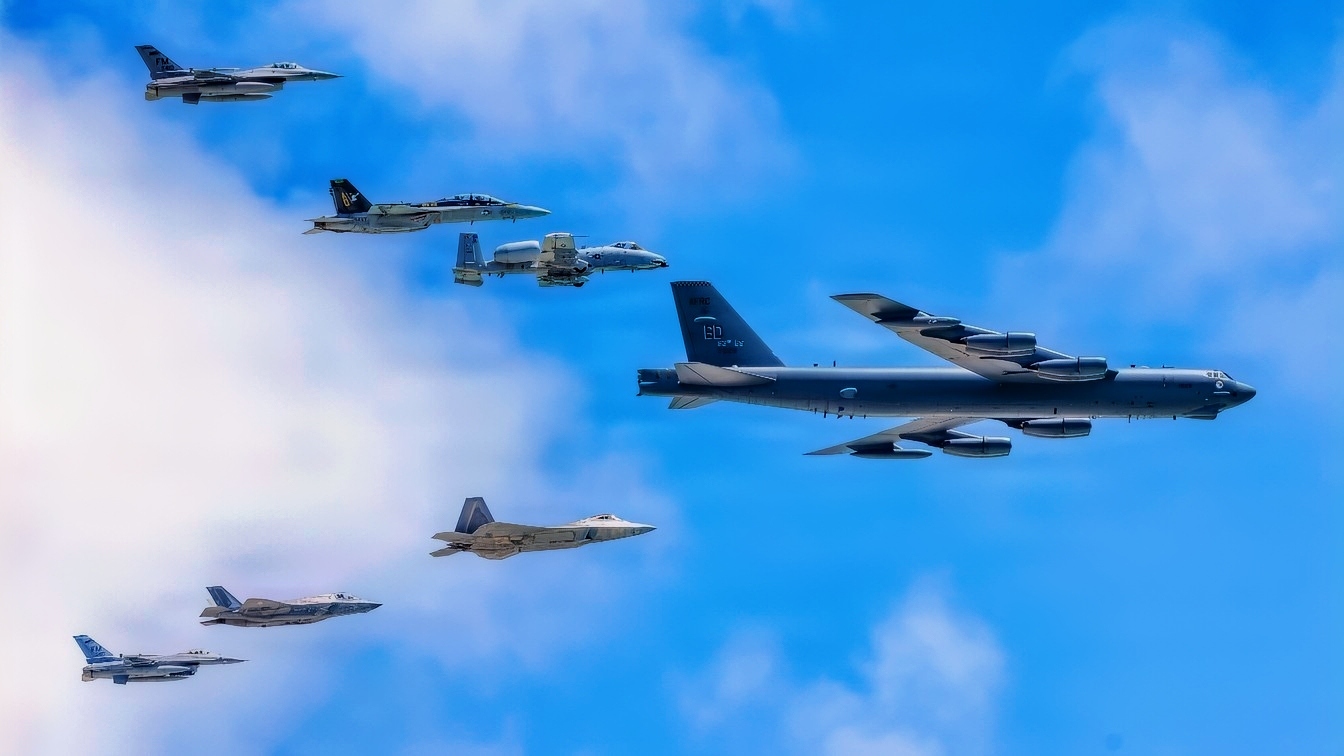
A B-52 Stratofortress leads a formation of a B-1 Lancer, A-10 Warthog, F-16 Fighting Falcon, F-18 Hornet, F-22 Raptor and F-35 Lightning, assigned to Air Combat Command and Global Strike Command, during the Hyundai Air and Sea show at Miami, Florida, May 23, 2026. Each aircraft played a unique role in demonstrating the comprehensive reach of the U.S. Air Force, from legacy bombers to cutting-edge fifth-generation fighters. Known as the Arsenal of Freedom Formation, the event underscored the Air Force’s capability to project force anywhere, anytime, as a key component of national defense. (U.S. Air Force photo by Staff Sgt. Lauren Diaz)

A U.S. Air Force F-35A Lightning II assigned to the 56th Fighter Wing, Luke Air Force Base, Arizona, performs a strafing run during Haboob Havoc, April 24, 2024, over Barry M. Goldwater Range, Arizona. Haboob Havoc is a total force exercise that provides a way for pilots from various bases to demonstrate their skills across a diverse range of aircraft, including F-35 Lightning IIs, F-16 Fighting Falcons, and A-10 Thunderbolt IIs, while also testing their abilities in different mission sets such as dogfighting and gun runs. (U.S. Air Force photo by Airman 1st Class Mason Hargrove)
The American airstrikes were mainly centered in the south along the coastal region, but also conducted deep strikes into Iran. It also fired Hellfire missiles on an empty tanker that was headed for Kharg Island, after it refused repeated warnings.
Iran fired missiles and drones at U.S. military bases in neighboring countries, including a major attack at a recently expanded air base in Jordan.
US Strikes In The South, Iran Dismisses The Threat
For the fifth consecutive day, American airstrikes hit the Bandar Abbas area, where the IRGC has a key naval base, as well as the southern cities of Ahvaz and Chabahar, late Wednesday. Iranian state media reported that explosions were heard in these cities and others.
However, the Iranians dismissed the idea that the airstrikes in the south would cripple their ability to control the strait, stating that their missiles can hit targets from afar.
“The Americans thought that by attacking some of our bases on the southern coasts of the country, they could take control of this strategic strait,” military spokesman Brigadier General Mohammad Akraminia said on Thursday.
Iran can “exert control over the Strait of Hormuz from every single point of its territory,” he added.
“US officials will face new and unexpected challenges from the army of the Islamic Republic of Iran, both in terms of weapons and the geography of the war, that they could never imagine. The United States should expect surprises from the army.” Akraminia said to the Iranian Students’ News Agency (ISNA).
US Conducting “Shaping Operations” With Airstrikes, Officials Say
Three U.S. officials told Reuters that the U.S. strikes could also serve as “shaping operations”, giving the US more options by targeting Iranian military capabilities that the U.S. would want to have destroyed before taking bigger steps in the escalation of attacks against Iran.
“This is helping set the stage, if needed,” one of the officials said.
Shaping operations consist of airstrikes in Iran to degrade its air defenses, coastal radars, and missile capabilities. U.S. Central Command (CENTCOM) strikes are methodically paving the way for broader, more intensive military options amid the ongoing conflict.
The US has attacked Iranian command centers, missile and drone sites, and maritime assets to suppress the regime’s power projection and secure the Strait of Hormuz.
Many analysts believe that the escalation could lead to the seizure of Kharg Island, through which 90 percent of Iran’s oil flows. Seizing it with ground troops, however, would leave them in static positions and subject them to concentrated drone and missile fire. However, the president has left that option open.
“If we degrade them far enough and deep enough back, I would do that,” he said on Fox News in an interview.
Right now, and thankfully so, the president isn’t saying anything concrete.
Imran Bayoumi, a former Pentagon official now with the Atlantic Council, said that many of President Trump’s warnings were an attempt to pressure Iran into returning to negotiations.
“I would separate the noise from the actions,” Bayoumi said. “I would expect the discussions between him and his national security team to look a bit different than what he’s posting online.”
Iran Releases American In “Goodwill Gesture,” Trump Says
An American citizen who has been held in Iran since 2024 has been released, President Trump and her lawyer separately announced Wednesday evening.
“I am delighted and excited to report that my client, U.S. citizen #DenaKarari, who had been trapped in #Iran since December 2024 on bogus charges, is now free,” Jared Genser, a human rights attorney, said on X.
“This would not have happened but for the extraordinary and relentless efforts of President @realDonaldTrump. Dena is now safe and traveling back to the United States.”
“Iran has allowed an American Citizen, who was wrongfully detained in December of 2024 under the ‘presidency’ of Sleepy Joe Biden, to leave the Country. She is now safely outside of Iran and in good condition. The United States of America appreciates this gesture of Goodwill by Iran,” Trump posted on his Truth Social page.
Fight Over Control Of The Strait
Iran insists that all shipping in the Strait coordinate with its recently created Persian Gulf Strait Authority (PGSA) and then use a second northern route that passes along the Iranian coast and is closely monitored and controlled by Iran.
Although the Strait is narrow, it is too wide for Iran to maintain control over both routes without the use, or threatened use, of force. And despite Tehran agreeing to a 60-day window of unfettered access for shipping in the Strait, they have attacked ships for passing through on the Omani side.
These attacks and the US airstrikes are attempts by both sides to gain leverage in any future negotiations. But the recent CENTCOM airstrikes are perhaps setting the stage for further escalations against the Islamic Republic.
About the Author: Steve Balestrieri
Steve Balestrieri is a National Security Columnist. He served as a US Army Special Forces NCO and Warrant Officer. In addition to writing on defense, he covers the NFL for PatsFans.com and is a member of the Pro Football Writers of America (PFWA). His work was regularly featured in many military publications


