
The United States Central Command (CENTCOM) has dismissed a claim by Iran’s Islamic Revolutionary Guard Corps that a Panama-flagged tanker exploded after striking a sea mine in the Strait of Hormuz.
Tehran said the El Gaia tanker exploded after striking a sea mine in the strait over the weekend – a claim rejected by CENTCOM, which said the tanker had been hit twice over the past month.
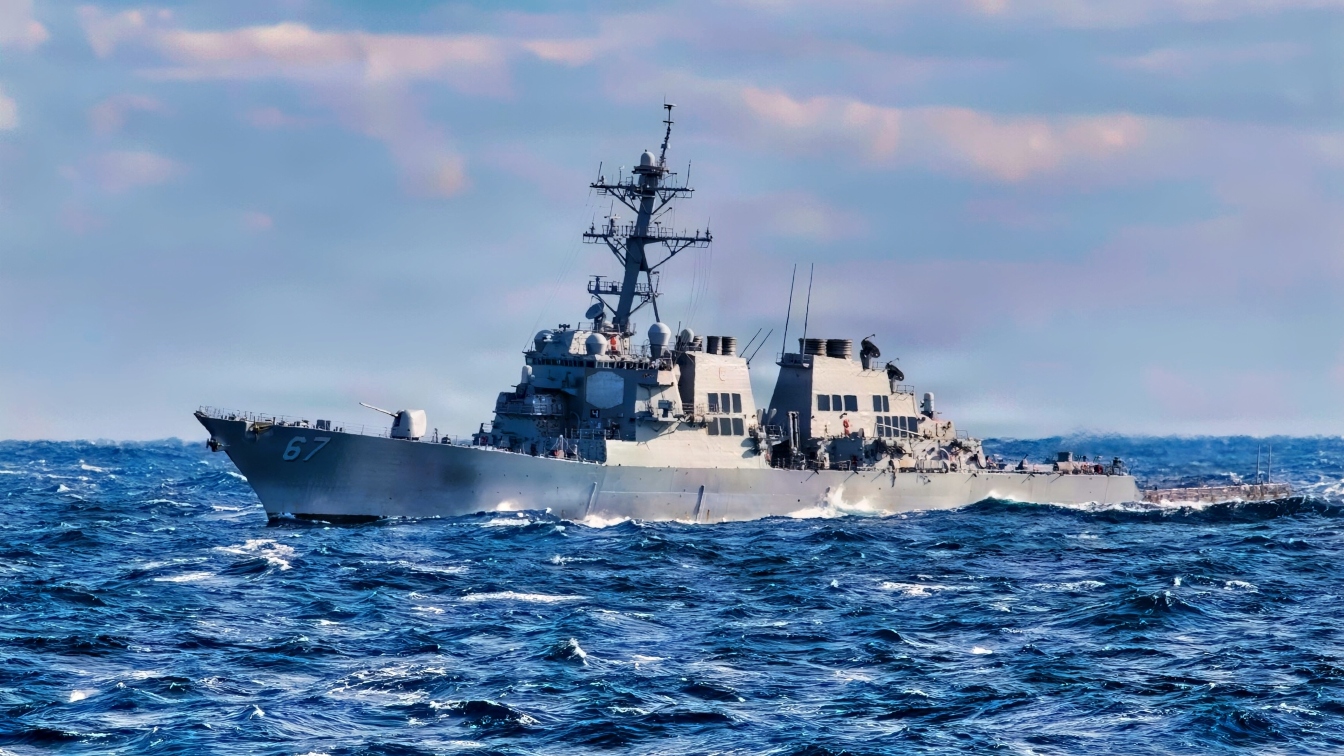
The Arleigh Burke-class guided-missile destroyer USS Cole (DDG 67) operates in the Mediterranean Sea Jan. 9, 2015. Cole, home-ported in Norfolk, is conducting naval operations in the U.S. 6th Fleet area of operations in support of U.S. national security interests in Europe. (U.S. Navy photo by Mass Communication Specialist 3rd Class Jonathan B. Trejo/Released) ( )
Two people were reported missing following the explosion.
The dispute marks the latest incident in the Strait of Hormuz, long a sticking point in the Iran war.
Mind the Mines
Tehran’s claim that the tanker exploded after hitting a sea mine comes weeks after U.S. forces were said to have cleared the Strait of Hormuz in a minesweeping operation.
The tanker had intended to pass “through an area closed to navigation south of the Strait of Hormuz,” according to the IRGC Naval Command.
The vessel reportedly burst into flames following the explosion after colliding with the mine.
CENTCOM disputed Tehran’s “false” claim in a social media post on Monday, 14th September.
“The Panama-flagged oil tanker El Gaia was struck by an Iranian missile last month and rendered inoperable,” CENTCOM said on social media. “This weekend, Iran struck the tanker again with a drone while the ship sat in waters off the coast of Oman.
A regional partner is currently towing the tanker.
The IRGC’s false claim is yet another example of their lies and intimidation attempts while they try to impede commercial vessels in the strait.”
Two Missing
On Tuesday, Oman – which borders the Strait of Hormuz to the south – said two sailors were missing, and 23 others had been rescued after a fire broke out in El Gaia’s engine room.
It was reportedly targeted 1.3 nautical miles north of the Musandam peninsula.
It’s not the first time that Iran has made a disputed claim about its mines in the Strait of Hormuz.
Earlier this month, two sailors were killed in an Iranian attack on a Saudi-owned super tanker, Sidr.
Saudi Arabia said the vessel had been struck by projectiles, despite Iranian claims that it had hit a mine.
A Strait Problem
Ever since the conflict began at the end of February, the Strait of Hormuz has been a key talking point of the war. The waterway is vital for Middle East oil exports, with Gulf states such as Qatar, Kuwait and the United Arab Emirates reliant on its open passage.
Since U.S. and Israeli bombs rained down on Iran, Tehran has used its chokehold on the strait – which is only 24 miles wide at its narrowest point – to limit the flow of commercial shipping traffic through the body of water.
As a result, oil prices have risen, with Brent crude reaching $108 per barrel on Tuesday morning. Battered militarily, Iran has used its leverage to dictate what can (and mostly, what cannot) pass through the Strait of Hormuz, raising costs worldwide and thus limiting support for continued U.S.-Israeli military action in the Middle East.
Oman has led efforts to find a temporary solution, proposing to permit traffic into the Persian Gulf solely via Iranian waters, with outbound vessels traveling partly through Omani territory.
However, a planned meeting was postponed on Monday after Saudi Arabia raised concerns about rising tensions in Yemen.
Why Lie?
Over the past few months, Tehran and Washington have disagreed on whether the Strait of Hormuz is open for business.
The former believes it has the right to control traffic, while U.S. officials have repeatedly said the strait is an international waterway where no country has jurisdiction.
The U.S. claimed to have cleared the strait of Iranian mines in a major operation last month. However, repeated damage to commercial vessels has cast doubt in the minds of shipowners.
If shipowners worry mines may still be present, they are less likely to try to break through Iran’s closure.
Arguably, they may be more tempted to attempt transit if the only threat is an Iranian drone, thereby making the closure harder for Iranian forces to enforce if vessels sail closer to the Omani coast.
Alas, by claiming that recent damage can be attributed to sea mines, Tehran can continue to control the Strait of Hormuz through threats and fears, even if the mines themselves are no longer present.
About the Author: Shay Bottomley
Shay Bottomley is a British journalist. He has written for the Western Standard, Business Insider, Maidenhead Advertiser, Slough Express, Windsor Express, Berkshire Live and Southend Echo.