

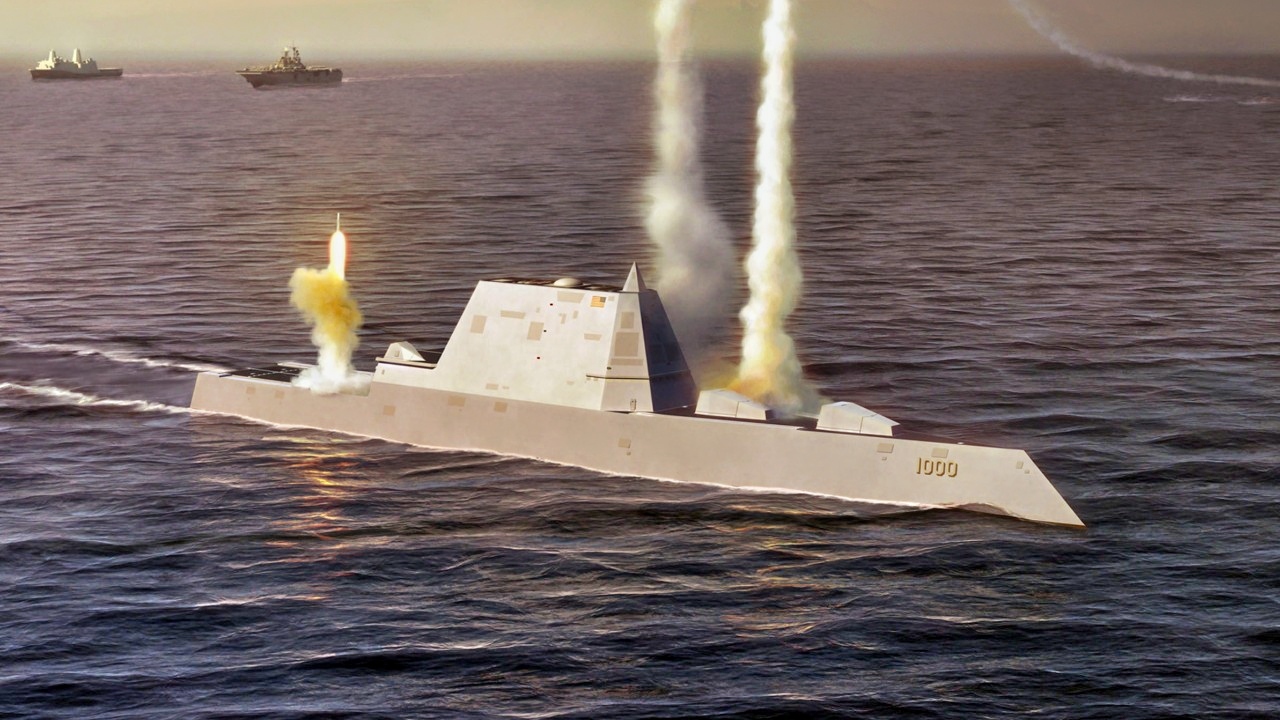
Key Points and Summary – This analysis argues that the U.S. Navy’s traditional manned surface fleet may be entering a “bygone era,” rendered increasingly obsolete by the threat of advanced anti-ship missiles and kamikaze drones.
-Citing recent, direct comments from senior Navy officials, the author details the service’s active push towards a “ghost fleet” of unmanned surface and undersea vessels.

A rare occurrence of a 5-country multinational fleet of the NATO countries, the Netherlands, France, the United States, Italy, and the United Kingdom, during Operation Enduring Freedom in the Oman Sea. Image Credit: U.S. Navy
-Concepts already being solicited include unmanned barges armed with vertical missile launchers.
-While the author, a self-described traditionalist, has reservations, the momentum towards an unmanned naval revolution appears inevitable, potentially supplanting the need for large, crewed warships.
Is the U.S. Navy’s Surface Fleet Part of a Bygone Era?
The U.S. Navy has always depended on its surface fleet. Over its long history, the fleet has included a dominating array of destroyers, cruisers, battleships, or aircraft carriers. If you are a young sailor or officer, you are likely to be steered toward a job on a surface vessel. This is the essence of the Navy.
Surface Ships Are Obsolete
But what if I told you there is a new vision for the maritime service? The surface fleet’s manned ships could be obsolescent and facing a gradual reduction in numbers, with more submarines and undersea combat drones taking their place. The growing threat to surface vessels is enemy anti-ship missiles and unmanned aerial vehicles designed to take out manned ships. These weapons are transforming naval warfare as we know it; subsea combat and drone missile barges could someday supplant the need for surface vessels.
Enemy Kamikaze Drones Will Rain Down on Manned Vessels
Aircraft carriers, frigates, and destroyers are expensive, and the people serving on fleet vessels are placed in the path of increasing harm, because of the presence of enemy missiles and kamikaze drones. Adversaries such as China are building more undersea unmanned combat drones.
Russia has a subsea drone armed with weapons they believe could take out cities on the British Isles or the coasts of the United States. Specifically, the Kremlin is hyping its Poseidon torpedo drone, which includes a nuclear warhead.
The U.S. Navy is Searching For Transformational Ideas
There is a movement underway to reduce the number of personnel on existing ships and to build more unmanned vessels. The Navy is looking for proposals from defense firms to do just that.
“When you introduce that capability to operate with people on board, it creates a lot of other requirements and cost and complications,” Capt. Matt Lewis, program manager for unmanned maritime systems, told USNI News on Aug. 21. “The solicitation that went out for industry … it was open, and we are eager to get proposals as we review them, to look at the proposals that don’t have people on board.”
It’s a Ghost Fleet That Will Haunt the Enemy
Will these be ghost ships? How will they be controlled? Could the unmanned seacraft be autonomous? It seems the Navy is open to many different innovative ideas. Such concepts could also be hatched by DARPA and the Navy’s Office of Naval Research, which conducts futuristic studies that aim to transform the Navy.
“We definitely want unmanned. Period. I mean, it’s that simple,” said Capt. Garrett Miller, commander of Surface Development Group One, which is responsible for the Navy’s experimental unmanned fleet.
Unmanned Barges Carrying Missiles
The Navy wants to collect proposals for what it calls a Modular Attack Surface Craft. This would deploy two 40-foot shipping containers. Each would have a Mk 70 Typhon vertical launcher that fires SM-6 interceptors. This unmanned craft would sail at 25 knots, with a range of 2,500 nautical miles.
The Navy wants to start with the smaller Modular Attack Surface Craft, and then pivot to creating larger unmanned vessels. We are far away from a time when unmanned ships completely replace manned vessels, but a future might be taking shape in which there will be few people onboard seaworthy craft.
The Navy could also create a group of floating or underwater drone swarms built to destroy enemy ships. These could be dropped by a manned airplane, or even an aerial drone – “drones deploying drones,” in other words. That probably sounds bad to traditionalists who believe in the human factor of war. But the Navy has studied the transformation of land warfare, with drones playing a large part during the war in Ukraine, and are thinking about unmanned warfare even more.
Unmanned supplements to the surface fleet will create a second revolution in military affairs. The surface fleet could become a thing altogether of the past, as the Navy transitions to remote-controlled or autonomous vessels. This will not be popular with sailors and aviators. It could mean that new frigates and destroyers will be replaced by “no-people” ships.
I’m not sure how I feel about this transition. I’m fine with a few drones, especially barges that carry missile launchers. Submerged drones should work well too, as should naval loitering munitions. But doing away with surface vessels is a dealbreaker for me, even though I wrote a book on future warfare that predicted the rise of sea drones. I have always believed in the human aspect of warfare and the importance of people in prosecuting combat.
But if commanders at some futuristic offices in the Navy have their way, change is inevitable. The shift to unmanned seacraft is assured, and traditionalists like me may be elbowed aside. Much of this will depend on how Congress decides to allocate funds, and the biggest argument made to lawmakers will be about the affordability of sea drones. This could tip the scales toward the unmanned revolution, leaving surface vessels as antiques that naval personnel will remember with nostalgia.
About the Author: Dr. Brent M. Eastwood
Brent M. Eastwood, PhD is the author of Don’t Turn Your Back On the World: a Conservative Foreign Policy and Humans, Machines, and Data: Future Trends in Warfare plus two other books. Brent was the founder and CEO of a tech firm that predicted world events using artificial intelligence. He served as a legislative fellow for U.S. Senator Tim Scott and advised the senator on defense and foreign policy issues. He has taught at American University, George Washington University, and George Mason University. Brent is a former U.S. Army Infantry officer. He can be followed on X @BMEastwood.
Military Affairs
China’s Stealth Air Force Has 1 Mission


Gage
August 23, 2025 at 7:50 pm
Dumbest sh*t I’ve read today
Floyd III
September 15, 2025 at 4:46 pm
I was ready to immerse myself into some engaging analysis of our fleet concepts. I was just getting into the Key Points and Summary, then saw the caption for the 5-country flotilla characterized as a, “rare occurrence.” This tells me that I’m dealing with someone who doesn’t have enough frame-of-reference to cover this subject. There are probably 1-2 valid concepts, that are surrounded by lots of porpoise poop, in the article.
Not very surprised, since you only received a Ph.D., and not the academically correct PhD.