

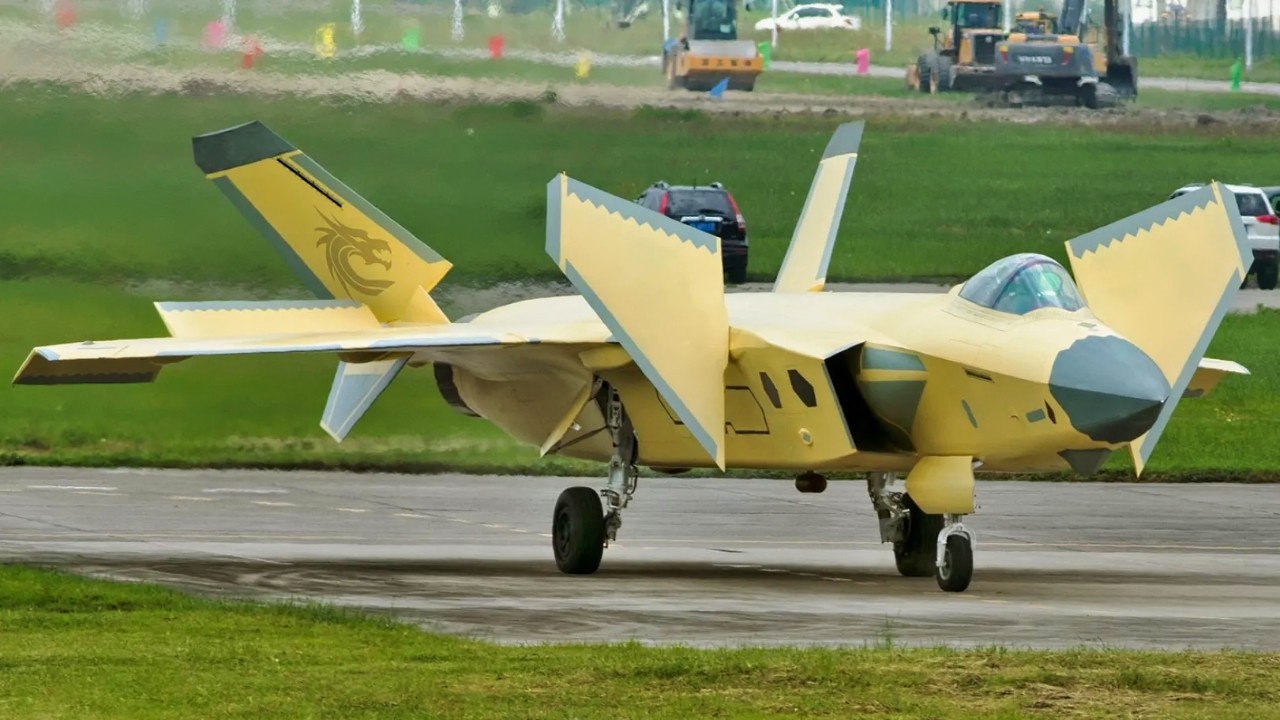
Key Points and Summary on the J-20 Mighty Dragon – China’s Chengdu J-20 “Mighty Dragon” stealth fighter, born from the PLA’s shock over American air power in the 1991 Gulf War, has rapidly evolved into a formidable platform.
-Initially reliant on Russian engines, the J-20 now reportedly flies with the domestically produced WS-15, giving it true fifth-generation supercruise capabilities.

J-20 Fighter. Image Credit: Creative Commons.
-With variants like the two-seat J-20S, likely designed to command drone wingmen, and a production line churning out new jets, the J-20 symbolizes China’s emergence as a top-tier aerospace power, directly challenging decades of American air superiority in the Indo-Pacific.
Meet China’s J-20 Mighty Dragon
The Chengdu J-20 “Mighty Dragon” was China’s first fifth-generation stealth fighter.
The aircraft turned a lot of heads in the aviation community for its striking resemblance to the U.S. F-22 Raptor, which led many to believe the Chinese copied a number of components.
But as time has gone on, the J-20 has undergone many improvements to its engine and avionics, further separating itself from its American counterparts.
China in the Post-Cold War World
The story of the J-20 begins in the 1990s, a decade that saw rapid advancements in military aviation technology around the world. The United States was developing the F-22 Raptor, the world’s first operational fifth-generation stealth fighter, while Russia was experimenting with advanced designs including the Su-47.
These developments did not go unnoticed by Chinese military planners. The 1991 Gulf War in particular had a profound impact on Chinese military doctrine. The war proved the effectiveness of stealth aircraft, precision-guided munitions, and network-centric warfare. China realized that to remain competitive and secure its regional interests, it needed to develop a comparable capability.
In response, China launched the J-XX program in the late 1990s. The initiative aimed to develop a next-generation fighter that could rival the F-22 and other advanced aircraft. The program was not initially tied to a specific design or manufacturer. Instead, it invited proposals from various Chinese aerospace firms. Among the contenders, Chengdu Aircraft Corporation emerged as the frontrunner with its Project 718.
Drawing on its experience with earlier aircraft such as the J-9 and J-10, Chengdu proposed a large, stealthy, twin-engine fighter with long-range capabilities and advanced avionics. The People’s Liberation Army Air Force (PLAAF) officially endorsed Project 718 in 2008, marking the formal beginning of the J-20’s development.
The Mighty Dragon is Born
The design philosophy was ambitious. The J-20 was intended to be a multirole stealth fighter capable of air superiority, long-range strike, and electronic warfare. The aircraft’s design reflects a careful balance between stealth, speed, and agility.
It features a canard-delta wing configuration, which provides excellent maneuverability and pitch control at high angles of attack. The use of diverterless supersonic inlets, internal weapons bays, and radar-absorbent materials helps reduce its radar cross-section, enhancing its stealth profile. The cockpit is fully digital, with a large touchscreen display, a wide-angle head-up display, and a helmet-mounted display system, all designed to improve pilot situational awareness.
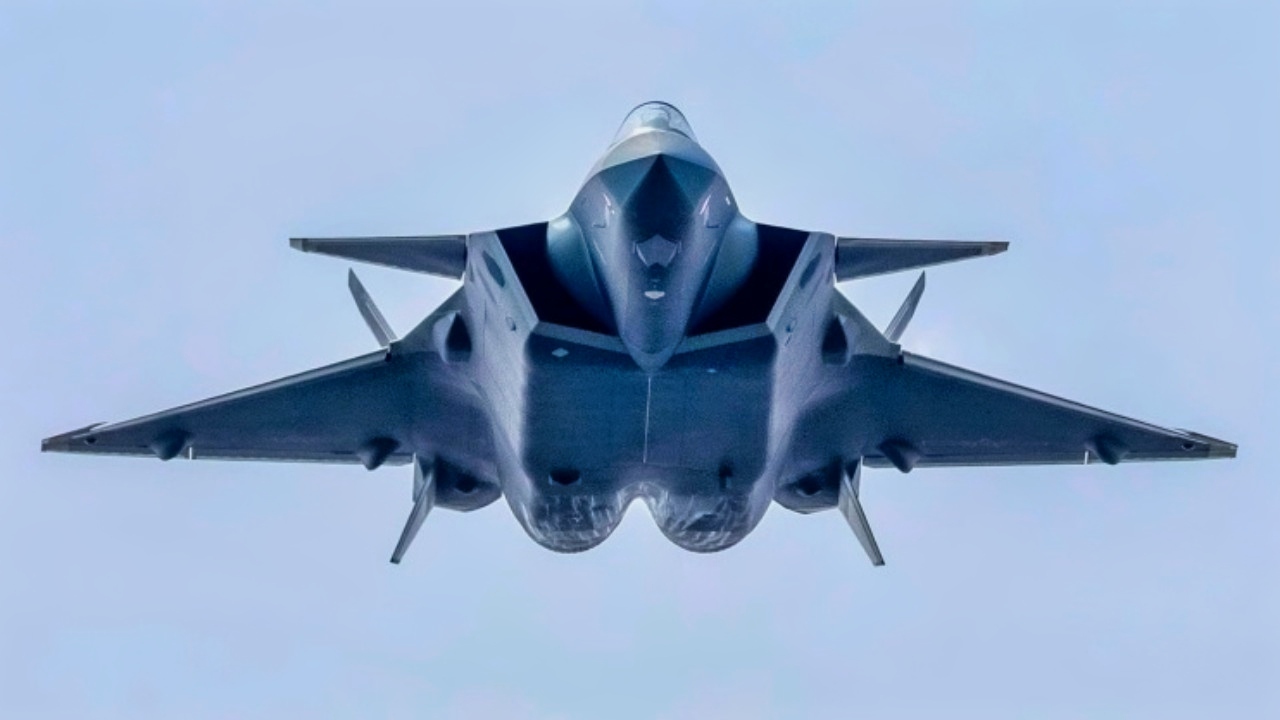
J-20 Fighter Screenshot from X. Image Credit: X.
The first prototype, designated “2001,” was spotted undergoing high-speed taxi tests in December 2010. On Jan. 11, 2011, the aircraft made its maiden flight in Chengdu. This event was symbolically significant, as it coincided with a visit to China by U.S. Defense Secretary Robert Gates, signaling China’s growing aerospace ambitions.
Over the next few years, Chengdu produced several more prototypes, each incorporating refinements based on flight testing and feedback.
By 2015, low-rate initial production models were observed, and in March 2017, the J-20 officially entered service with the PLAAF. The first operational unit was formed in February 2018, making China the second country after the United States to field an operational fifth-generation fighter.
The J-20 Evolves
One of the most significant challenges in the J-20’s development was its engine. Early prototypes were powered by Russian AL-31F engines, which were not optimized for stealth or supercruise. China developed the WS-10B and later the WS-10C engines as interim solutions.
The WS-10C, in particular, featured serrated nozzles to reduce radar signature and offered limited supercruise capability. However, the ultimate goal was to equip the J-20 with the WS-15, a high-thrust, stealth-optimized engine developed domestically. The WS-15 faced numerous technical hurdles, but by 2022 it had reportedly entered flight testing, and by 2023 it was in serial production. With the WS-15, the J-20 is expected to achieve true fifth-generation performance, including sustained supersonic flight without afterburners and improved fuel efficiency.
As the J-20 matured, it evolved into multiple variants. The initial production model, known as the J-20A, was followed by the J-20B, which featured improved engines and thrust-vectoring control. A particularly notable development was the twin-seat variant, the J-20S. This version is unique among stealth fighters and is believed to be designed for roles such as electronic warfare, command and control, or teaming with unmanned systems. The addition of a second crew member allows for greater mission flexibility and the integration of advanced technologies, including artificial intelligence.
Did the Chinese Steal Data from the U.S. for the J-20?
Western analysts have alleged that China may have benefited from cyber espionage to develop the J-20, particularly targeting U.S. defense contractors involved in the F-22 and F-35 programs. While China denies these claims, similarities in certain design elements, such as the chiseled nose and internal weapons bays, have fueled speculation.
However, the J-20 is not a direct copy of any Western aircraft. While it is impossible to prove or disprove espionage, it is a unique platform tailored to China’s strategic needs and operational doctrines.

U.S. Air Force Maj. Kristin “BEO” Wolfe, F-35A Lightning II Demonstration Team commander, flies over Kennewick, Washington, during the Tri-Cities Water Follies Airshow Over the River, July 30, 2023. The F-35 Demonstration Team participated in the 2023 Tri-Cities Water Follies airshow and various other events in support of their mission to recruit, retain and inspire new and old generations of Airmen. (U.S. Air Force photo by Staff Sgt. Kaitlyn Ergish)
With production of the J-20 in full swing, China is now a near-peer with the U.S. in terms of stealth fighter production. The J-20 enhances China’s ability to project power in the East China Sea, South China Sea, and Taiwan Strait.
It also serves as a deterrent against U.S. and allied air forces in the Indo-Pacific region. More broadly, the J-20 symbolizes China’s emergence as a peer competitor in aerospace technology.
It is a key component of China’s “informatized warfare” doctrine, which emphasizes the integration of sensors, communications, and command systems across multiple domains.
About the Author:
Isaac Seitz, a Defense Columnist, graduated from Patrick Henry College’s Strategic Intelligence and National Security program. He has also studied Russian at Middlebury Language Schools and has worked as an intelligence Analyst in the private sector.
More Military
The U.S. Navy’s Submarine Crisis Is Real


