
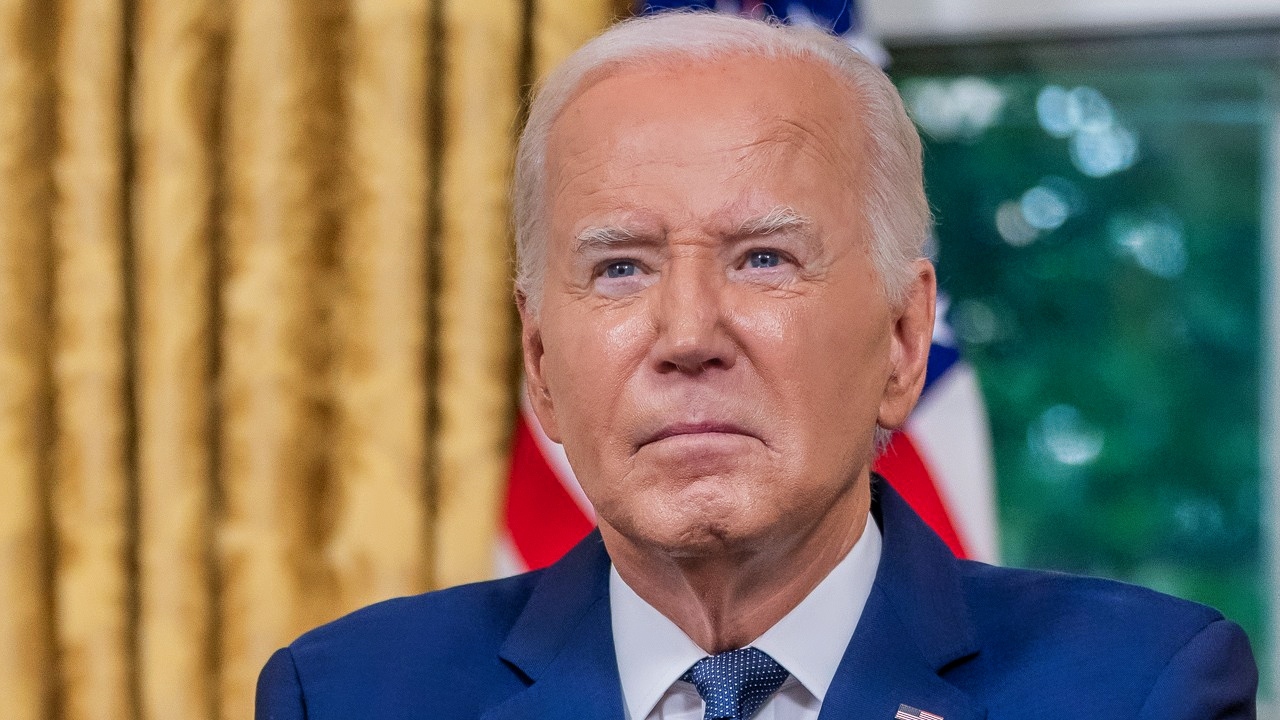
Former President Joe Biden provided an update on his ongoing battle with cancer last week, revealing in a social media post that his illness is preventing him from appearing publicly to promote his forthcoming memoir as extensively as he originally planned.
The 83-year-old former president announced on Sunday, November 8, that his doctors are encouraged by his response to treatment but admitted that his condition still affects his daily life.

Former Vice President of the United States Joe Biden speaking with attendees at the 2019 Iowa Federation of Labor Convention hosted by the AFL-CIO at the Prairie Meadows Hotel in Altoona, Iowa.

President Joe Biden receives an interagency briefing on the response to Hurricane Helene, Tuesday, October 1, 2024, in the Roosevelt Room of the White House. (Official White House Photo by Oliver Contreras)
The announcement comes only days before his new book, Promise Me, America, is set to be released on November 17. The memoir covers his four years in the White House and his decision to abandon his 2024 reelection campaign. The book is also expected to cover his relationship with President Donald Trump in detail. And on Monday, The Atlantic published an extensive excerpt of the upcoming book in which Biden offered a damning assessment of President Trump’s second term. Biden accused the current president of undermining American democracy and described some details of their final meeting in the Oval Office.
Biden’s Final Meeting with Trump
In the excerpt, Biden recalls meeting with President Trump eight days after the 2024 presidential election. The president-elect visited the White House ahead of his inauguration, and during the meeting, Biden said that Trump was surprisingly friendly despite their rivalry.
“Eight days after the 2024 election, I honored a presidential tradition by hosting a visit from the president-elect. Jill and I met President Trump and his entourage in the Diplomatic Reception Room. Then I escorted him into the Oval Office for our formal meeting, accompanied only by our chiefs of staff, Jeff Zients and Susie Wiles. He and I sat in chairs near a roaring fire; Jeff and Susie sat on sofas. Trump was immediately chatty and surprised me by adopting a tone so friendly that I thought he might be putting me on. It bordered on fawning,” Biden wrote.
Biden also recalled Trump telling him that they could have been great friends under different circumstances. He reportedly also praised Biden’s record on job creation and said he was relieved he did not have to run against him in the election.
Biden said he quickly moved away from the flattery and discussed foreign affairs. Still, Trump soon shifted to the personalities of world leaders rather than the issues confronting the United States.
Biden Gaslights Trump
Biden, who reversed virtually every executive order signed by President Trump on his first day in office, accused President Trump of deliberately working to reverse many of his administration’s achievements.
“On day one, Trump reversed many of my decisions. I rejoined the Paris climate accord on my first day in office; he canceled our participation again on his. That meant we were one of four countries outside the treaty; the other three were Iran, Libya, and Yemen. That was not a great look to the rest of the world. After that, it was like a bonfire, as one climate measure after another went up in smoke. That first day, he also signed executive orders to open up public lands to drilling for oil, to end support for electric vehicles, and to cancel projects for wind and solar energy,” Biden said.

President Joe Biden. Image Credit: 2020 Joe Biden for President/Flickr.

President Joe Biden talks on the phone with Chinese President Xi Jinping, Thursday, September 9, 2021, in the Treaty Room of the White House. (Official White House Photo by Adam Schultz).
The comment is extraordinary, given President Biden spent much of his first days in office reversing Trump’s executive orders, including some measures that were considerably less controversial than those concerning climate change and energy policy.
On May 14, 2021, President Biden signed Executive Order 14029, which revoked President Trump’s plans to establish a National Garden of American Heroes.
The project, which was first announced in July 2020, would have created a public park featuring statues honoring prominent Americans, including George Washington, Abraham Lincoln, Martin Luther King Jr., and other historical figures.
Biden also revoked an order meant to protect public monuments from vandalism.
Neither of those initiatives was directly related to any major policy disputes between the two administrations, making it quite clear that Biden was motivated by spite or a desire to dismantle his predecessor’s legacy.
Did Biden Help Put Trump Back in the White House?
One question President Biden needs to grapple with is whether his own decisions ultimately contributed to President Trump’s return to the White House.
Despite concerns about his age and mental fitness, President Biden insisted for months that he was capable of serving for another four years, and only abandoned his reelection campaign in July 2024 after a particularly disastrous debate performance.
His withdrawal left his vice president, Kamala Harris, with barely more than three months to build an entire presidential campaign against President Trump, who had been preparing for a rematch with Biden for years.

Vice President Kamala Harris speaks at the CHCI 47th Annual Legislative Conference, Wednesday, September 18, 2024, at the Ronald Reagan Building and International Trade Center in Washington, D.C. (Official White House Photo by Lawrence Jackson)
Biden may believe that President Trump represents a threat to American democracy, but his own reluctance to step aside earlier arguably helped create the circumstances that made Trump 2.0 possible.
If Trump was such a threat to democracy, why did Biden gamble the presidency the way he did?
About the Author: Jack Buckby
Jack Buckby is a British researcher and analyst specializing in defense and national security, based in New York. His work focuses on military capability, procurement, and strategic competition, and he produces and edits analysis for policy and defense audiences. He brings extensive editorial experience, with a career output spanning over 1,000 articles at National Security Journal, and has previously authored books and papers on extremism and deradicalization.


