

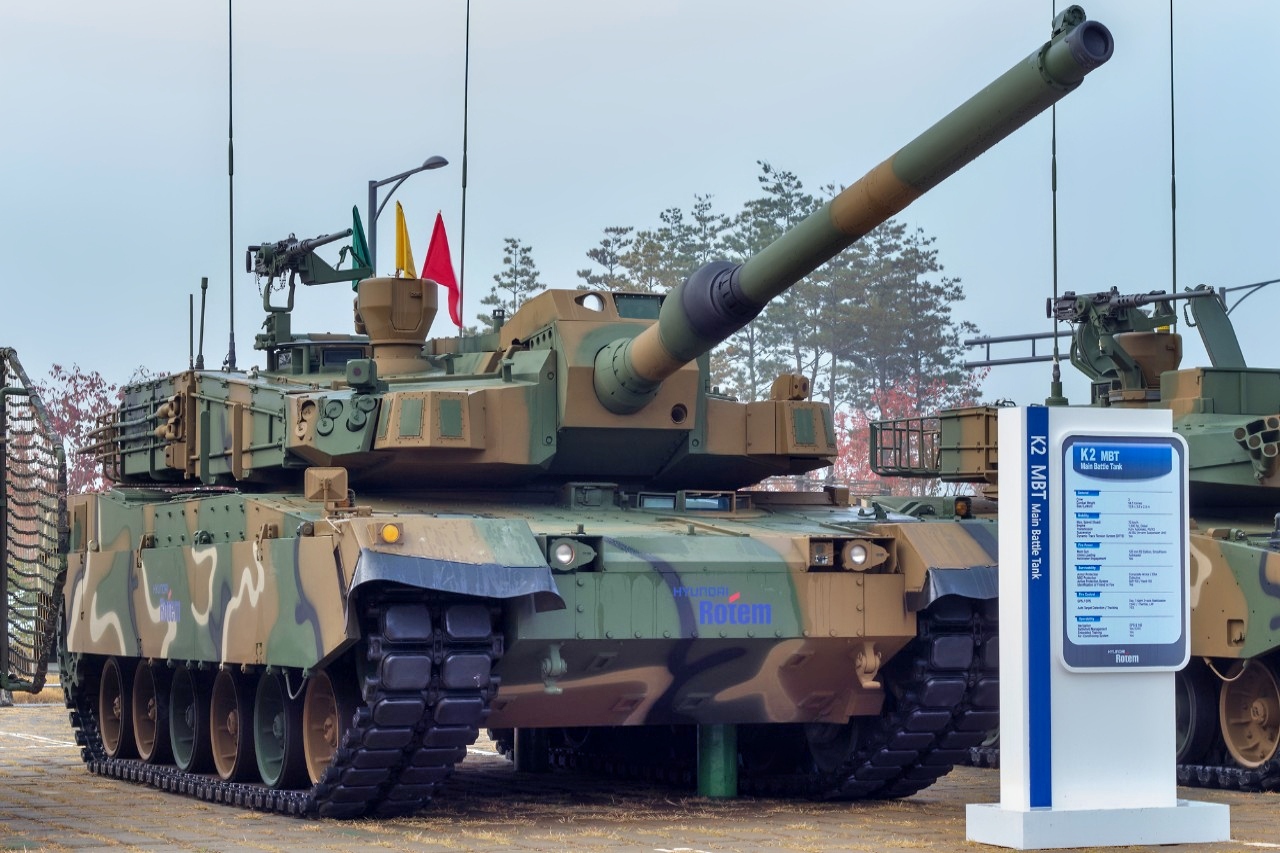
Key Points – South Korea’s K2 Black Panther main battle tank, a technologically advanced “digital-native” platform with features like active protection systems and advanced networking, represents a significant attempt to counter the threats (drones, precision strikes) that raise questions about the MBT’s continued relevance.
-Poland’s large-scale K2 acquisition reflects a pragmatic bet on the enduring need for armored maneuver in high-intensity peer conflict, valuing its current availability and NATO compatibility.
-While the K2 aims to be a survivable “node” in an integrated kill chain rather than a lone predator, its success may ultimately “buy time” for the tank concept to evolve rather than definitively stop its obsolescence.
The K2 Black Panther: Can This Tank Stop the Clock on Obsolescence?
For decades, the tank has served as both the literal and symbolic embodiment of hard power. From the thunder of Soviet T-72s rolling into Prague to the sleek silhouettes of M1 Abrams crossing the Kuwaiti desert, main battle tanks (MBTs) were once the defining feature of twentieth-century land warfare.
But we’re no longer in that century.
As the age of cheap drones, precision strike, satellite-guided artillery, and loitering munitions matures, it’s worth asking the uncomfortable question: is the MBT itself becoming obsolete?
Enter the K2 Black Panther – South Korea’s crown jewel in armored warfare and the object of intense interest from nations like Poland, which has embraced it with a fervor bordering on the romantic. At first glance, the K2 looks like the tank that might delay the onset of obsolescence, if not reverse it altogether. But that’s the question: can it?
Let’s be clear. No one in their right mind denies the K2’s technical prowess. This isn’t a warmed-over Cold War design. It’s a digital-native machine, boasting autoloaders, active protection systems (APS), advanced composite armor, hunter-killer fire control, and networking features that bring it closer to the F-35 in terms of battlefield integration than to the tanks it’s supposed to replace. It can “shoot on the move,” track multiple targets, and punch through the toughest adversary armor. It is fast, nimble, and versatile. On paper – and on YouTube – it looks like the answer to the tank’s mounting list of problems.
But we don’t fight wars on paper. The question isn’t whether the K2 is impressive. It is. The question is whether it changes the battlefield paradigm enough to justify doubling down on the tank as a concept. Poland clearly thinks it does. Having witnessed firsthand the mass attrition of Soviet-era tanks in Ukraine – both Russian and Ukrainian – Warsaw is not scaling back its armored ambitions. Instead, it’s gone shopping. South Korea’s K2s fit the bill: technologically superior, logistically compatible with NATO systems, and, crucially, available now. Unlike the Euro-tanks bogged down in industrial sclerosis or the American Abrams which require long lead times and are ill-suited for European terrain, the K2 is ready to ship and ready to fight.
Poland’s embrace of the K2 is not just about equipment – it’s about doctrine. Warsaw is betting big on high-intensity peer conflict, especially in the Suwałki Gap and along its border with Belarus. In such a scenario, it sees armored maneuver as not just relevant but essential. The K2, with its mobility and survivability, provides the punch Warsaw thinks it needs to hold the line – and, if necessary, punch through it.
And let’s not kid ourselves: the Korean tank also comes with political baggage – but the kind Poland welcomes. Buying Korean, for Warsaw, is a hedge against both Western industrial complacency and German unreliability. It’s a bet on a rising military-industrial power with a proven track record of delivering kit on time and at scale. And, perhaps most importantly, it’s a vote for autonomy. The U.S. will always be Poland’s cornerstone ally, but Poland is not content to be merely a passive client. With the K2, it gets not just a tank, but local production rights, technology transfer, and the ability to build toward a future domestic variant – what’s already being called the “K2PL.”
Still, none of this answers the fundamental question. Can any tank – no matter how advanced—truly stave off obsolescence in the age of drone swarms and precision fires? The war in Ukraine has shown us both the enduring value and shocking vulnerability of tanks. Russian armored columns were annihilated in the early stages of the war by $200,000 Javelins and even cheaper loitering drones. At the same time, when Ukraine has managed to mass armor effectively, it has often achieved local breakthroughs and held critical ground. The message is mixed: tanks aren’t useless – but they’re no longer the apex predators of the modern battlefield. They are hunted as much as they hunt.
Here’s where the K2 tries to change the equation. It’s built not to dominate in isolation but to survive in an integrated kill chain. Think of it less as a lone saber-toothed tiger and more as a node in a predatory swarm. With networked sensors, AI-assisted targeting, and active protection that intercepts incoming rounds, the K2 isn’t simply a more powerful version of the tanks we’ve known – it’s an attempt to redefine what a tank is.
But even that may not be enough. No matter how high-tech the platform, the fundamental liabilities remain: large heat signature, high maintenance burden, and vulnerability to saturation attacks from above. Active protection can only intercept so much; a drone swarm doesn’t need to get every tank – just enough to paralyze the formation. The problem isn’t that tanks are bad at what they do. It’s that what they do may no longer be decisive.
So what are the options? For countries like Poland, the choice is pragmatic. They’re not waiting for a doctrinal revolution from Brussels or Washington. They are rearming for the wars of the next decade, not some hypothetical future conflict. For them, the K2 represents a technological hedge – an investment in survivable armor for a survivable future. Better a tank that can maybe survive the first volley than one that certainly won’t. Better a tank with integrated sensors and APS than a Cold War relic with upgraded optics.
Other countries may choose a different path. The British Army, for example, is pivoting toward lighter, faster, and more deployable forces, with fewer tanks and more drones, missiles, and dismounted units. The Americans are caught in the middle – still married to their Abrams fleets, but dabbling in robotic combat vehicles and next-gen armor that may never arrive on time or at scale. Meanwhile, China is investing in massive numbers of MBTs – albeit supported by overwhelming ISR and drone cover – suggesting that in some theaters, armor still matters, at least as part of a layered system.
In the end, the K2 may not “save” the tank. But it might buy the tank time. Time to evolve. Time to integrate. Time to adapt to a world that no longer bends to the logic of steel and tread. Whether that’s enough remains to be seen. But one thing is clear: if the tank is doomed, it will not go quietly – and it certainly won’t go without a fight. The K2 Black Panther is the last, best argument that tanks can still matter. And nations like Poland, staring down a revanchist Russia, are not in the mood for academic debates. They want tools that work – and the K2, for now, works.
The age of the tank is not over. But it is perhaps on notice.
About the Author: Dr. Andrew Latham
Andrew Latham is a non-resident fellow at Defense Priorities and a professor of international relations and political theory at Macalester College in Saint Paul, MN. You can follow him on X: @aakatham.
Military Matters
Russia’s Su-57 Felon Stealth Fighter Is a Waste of Rubles


Pingback: North Korea's Hypersonic Missiles Summed Up in 4 Words - National Security Journal
Geof
June 4, 2025 at 1:35 am
I suspect the death of the tank is highly overstated. If an armored vehicles APS can knock down an anti-tank rocket/missile in flight, I’d have to think a slow moving drone is even more vulnerable.
Pingback: M103: America's Last Heavy Tank Was a Beast on the Battlefield - National Security Journal
Pingback: The K2 Black Panther 'PIP' Tank Might Be the Best on Earth (Not Made in USA) - National Security Journal
Pingback: 'Electromagnetic Armageddon': Era of Stealth Bombers and Fighters Might Soon Be Over - National Security Journal