


Key Points and Summary – In 1963, a U.S. Navy KC-130F Hercules turned “impossible” into routine by operating from the deck of the supercarrier USS Forrestal.
-As part of a Super COD trial, Lt. Jim Flatley and his crew flew the big turboprop onto the flattop without a tailhook, performing 29 touch-and-gos, 21 full-stop landings, and 21 unassisted takeoffs.
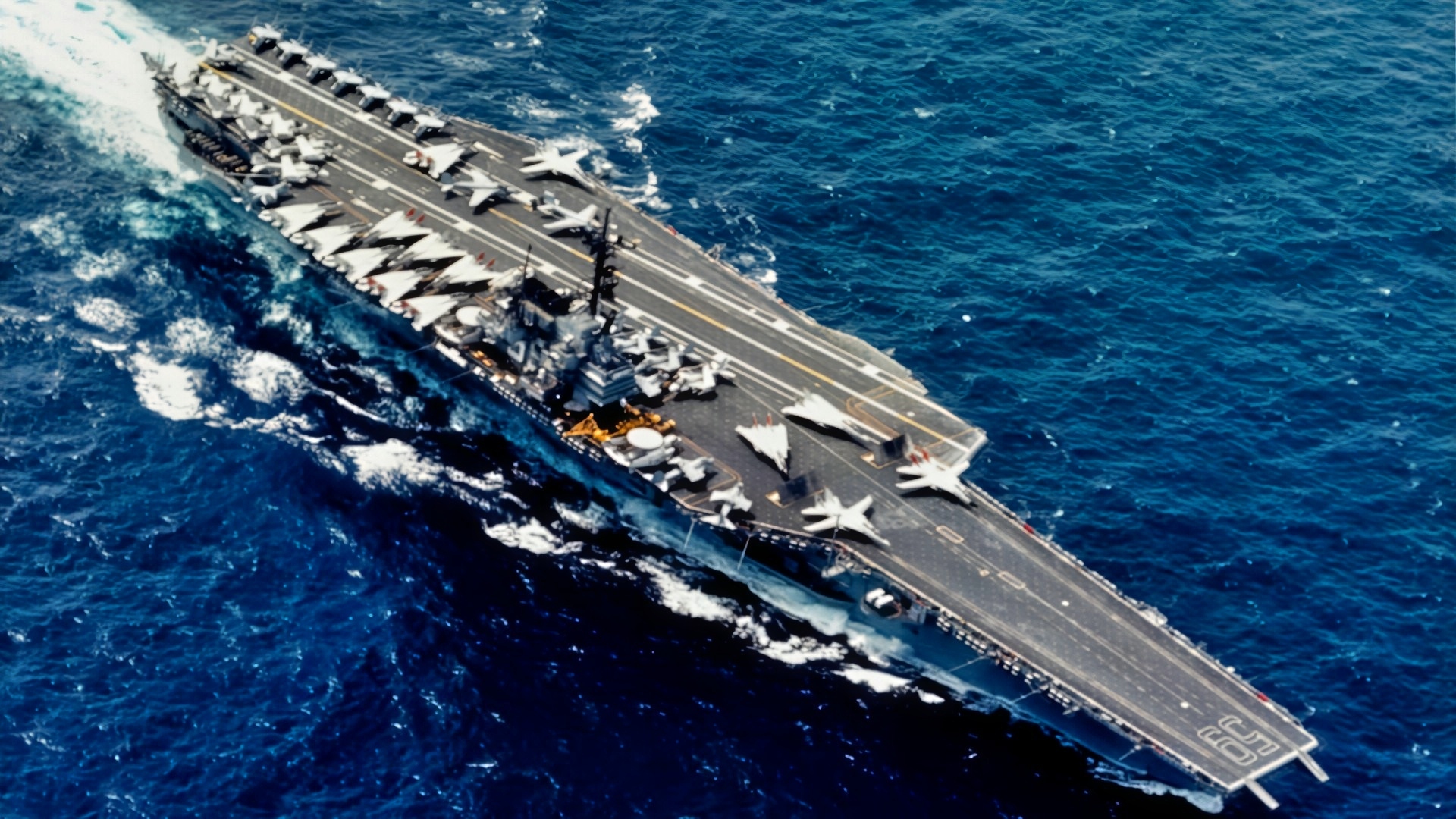
USS Forrestal Aircraft Carrier. Image Credit: Creative Commons.
-At 85,000 pounds the Herc stopped in just 267 feet and needed only 745 feet to launch, earning the fuselage slogan “LOOK MA, NO HOOK.”
-The record-setting BuNo 149798 now resides at the National Naval Aviation Museum, cementing its place in naval aviation lore.
The Legendary C-130 Hercules Was the Biggest Airplane Ever to Land on an Aircraft Carrier
“C-130 rollin’ down the strip/Airborne Ranger gonna take a little trip…” Thus begins one of the best-loved military running cadences of all-time, paying tribute to the Lockheed (now Lockheed Martin) C-130 Hercules AKA the “Herc,” which, with 71 years of continuous service, has the longest, continuous military aircraft production run in history and one of the top three longest, continuous aircraft production lines of any type. The mighty Hercules has done everything from dropping paratroopers to transporting cargo (“trash haulers,” as fighter jocks derisively call them) to chasing hurricanes to raining “Death From Above” in its AC-130 gunship version (and even all that doesn’t cover the full gamut of the C-130’s resume).
But arguably the craziest feat ever pulled off by a Herc was landing on the deck of an aircraft carrier (AKA a “flattop”). (Boy, and you dear readers thought the B-25 Mitchell medium bombers taking off from the flattop USS Hornet [CV-8] for the Doolittle Raid on Tokyo during World War II was impressive enough!)
The Basics of the Story
A key source of information for this story is Signore Dario Leone, founder and owner of The Aviation Geek Club, in a May 5, 2020, article titled “The Story of how the C-130 Hercules became the biggest aircraft to land on an aircraft carrier.”
The remarkable feat wasn’t pulled off just once, but indeed multiple times between October and November 1963.
The ship on the receiving end of the landings was the USS Forrestal (CVA-59), which Naval History and Heritage Command (NHHC) considers to be the world’s first supercarrier (though other military historians would argue that distinction actually belonged to the Imperial Japanese Navy carrier Shinano of World War II); with a hull length of 1,067 feet (325 meters), a beam width of 238 feet (73 meters), and a displacement of 60,610 tons 59,650 long tons), she was certainly big enough to accommodate a larger warbird like the Hercules (fuselage length 97 feet 9 inches [29.79 meters]; 132 feet 7 inches [40.41 meters]; empty weight 75,800 pounds [34,382 kilograms]; max takeoff weight 155,000 pounds [70,307 kilograms]).
The specific plane in question was a KC-130F, bearing the U.S. Navy/U.S. Marine Corps Bureau Number (BuNo) 149798, and was eventually given the nickname of “Look Ma, No Hook” (for reasons that will become evident shortly).
Debuting in January 1960 as the GV-1 under the old USN designation, the KC-130F variant was designed to undertake aerial refueling missions in support of USMC aircraft.
The motivation for the carrier landing tests was to determine whether a Hercules could be used as a “Super COD” (carrier on-board delivery) aircraft.
The modifications to the tests included installing a smaller nose-landing gear orifice, an improved anti-skid braking system, and removing the underwing refueling pods.
Executing the Mission
The honor and distinction of carrying out the mission fell upon then-USN LT James H. “Jim” Flatley III (now a retired Rear Admiral); when Jim first received his orders, he thought somebody was pulling his leg.

(Feb. 25, 2019) The aircraft carrier USS John C. Stennis (CVN 74) transits the South China Sea at sunset, Feb. 25, 2019. The John C. Stennis Carrier Strike Group is deployed to the U.S. 7th Fleet area of operations in support of security and stability in the Indo-Pacific region. (U.S. Navy photo by Mass Communication Specialist 1st Class Ryan D. McLearnon/Released)
“Operate a C-130 off an aircraft carrier? Somebody’s got to be kidding,” he said.
But it was no joke.
Accompanying then-LT Flatley on the guinea pig flight (so to speak) were LCDR W.W. Stovall, copilot; ADR-1 E.F. Brennan, flight engineer; and Lockheed engineering flight test pilot Ted H. Limmer, Jr.
That first flight took place on October 30, 1963, and although that was the day before Halloween, it proved to be a treat rather than a trick for the Navy; to make an already-impressive feat even more remarkable, the initial landings were made into a 40-knot wind.
All in all, LT Flatley and his intrepid crew successfully negotiated 29 touch-and-go landings, 21 unarrested full-stop landings, and 21 unassisted takeoffs at gross weights of 85,000 pounds up to 121,000 pounds. Among the pleasant surprises discovered in the process:
-At 85,000 pounds, the plane came to a complete stop within 267 feet, about twice the aircraft’s wingspan
-Even with the maximum payload, the Herc used only 745 feet for takeoff and 460 feet for landing roll
Regarding the last of these landings, Lockheed’s chief engineer (and eventual Vice President of that prestigious aerospace firm), Art E. Flock, recalled: “The airplane stopped right opposite the captain’s bridge. There was cheering and laughing. There on the side of the fuselage, a big sign had been painted on that said, ‘LOOK MA, NO HOOK.’”
Where Are They Now?
USN/USMC BuNo 149798 has been preserved for posterity at the National Museum of Naval Aviation, NAS Pensacola, Florida, arriving there in May 2003. (This writer has toured that museum twice and can vouch for its overall quality; however, both of those tours occurred before that plane’s arrival).

(June 18, 2021) As seen from the Ticonderoga-class guided-missile cruiser USS Shiloh (CG 67), the Navy’s only forward-deployed aircraft carrier USS Ronald Reagan (CVN 76) transits the Strait of Malacca with the Arleigh Burke-class guided missile destroyer USS Halsey (DDG 97). The ships are part of Task Force 70/Carrier Strike Group 5, conducting underway operations in support of a free and open Indo-Pacific. (U.S. Navy Photo by Mass Communication Specialist 1st Class Rawad Madanat)
Alas, CVA-59 has no analogous survival and preservation story.
Having been commissioned in 1955, she was decommissioned on September 11, 1993, stricken from the Naval Vessel Register that same day, and scrapped on December 15, 2015.
Luckily, at least her stern plate was saved and restored at the aforementioned museum in Pensacola.
In addition, Forrestal’s anchors were preserved and installed on the Nimitz-class supercarrier USS John C. Stennis (CVN-74; AKA “Johnny Reb”) during refueling and complex overhaul in July 2023.
About the Author: Christian D. Orr, Defense Expert
Christian D. Orr is a Senior Defense Editor. He is a former Air Force Security Forces officer, Federal law enforcement officer, and private military contractor (with assignments worked in Iraq, the United Arab Emirates, Kosovo, Japan, Germany, and the Pentagon). Chris holds a B.A. in International Relations from the University of Southern California (USC) and an M.A. in Intelligence Studies (with a concentration in Terrorism Studies) from American Military University (AMU). He is also the author of the newly published book “Five Decades of a Fabulous Firearm: Celebrating the 50th Anniversary of the Beretta 92 Pistol Series.”
More Military
The Army’s AH-64E Apache Helicopter Can Destroy Drones with Missiles
U.S. Navy Iowa-Class Battleship USS New Jersey’s ‘Comeback’ Is Now Complete
Blaze of Glory: The SR-71 Blackbird Retired Hitting Mach 3.21


Mark Rosenthal
November 28, 2025 at 8:19 pm
it’s on you tube also, awsome