

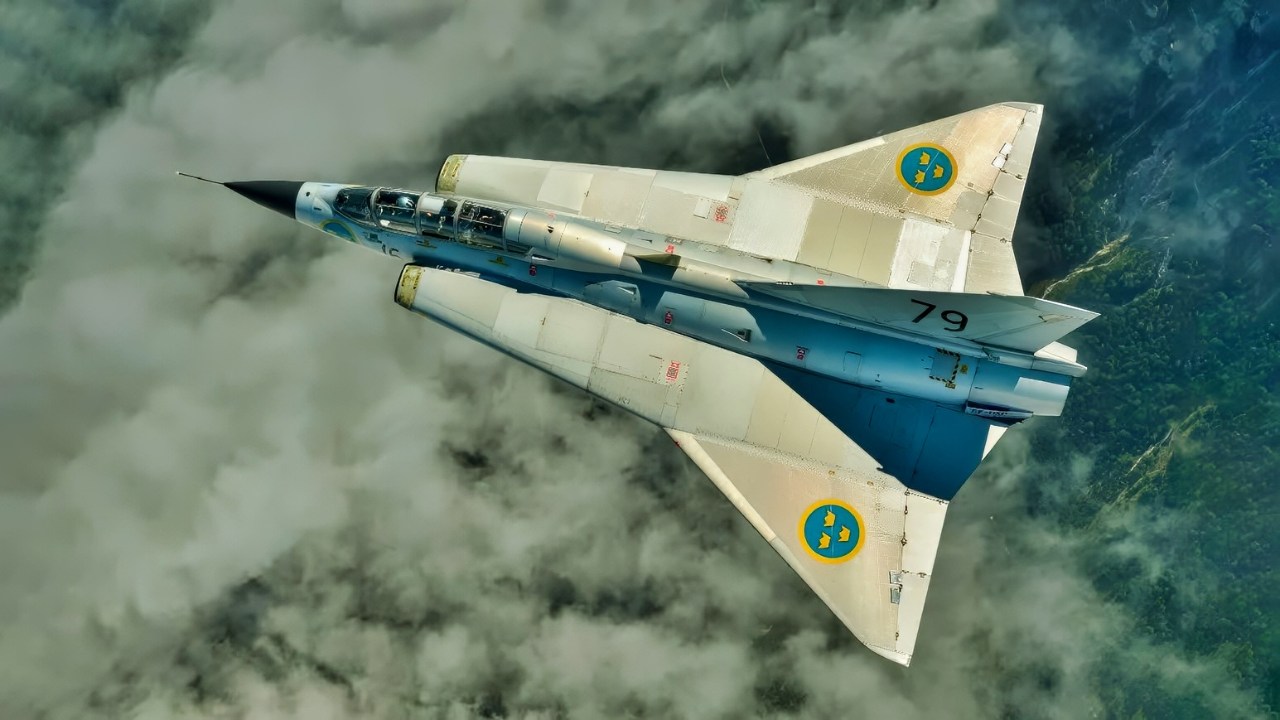
The Saab 35 Draken (Dragon) was a highly effective Cold War fighter designed for Sweden to intercept bombers in all-weather conditions. Known for its unique double-delta wing, it was capable of short-field operations from roads, possessed excellent high-altitude performance, and was considered a very capable dogfighter, though it required careful handling to avoid “superstalls.”

Saab 37 Viggen Flying. Image Credit: Creative Commons.
The Draken’s primary role was as a supersonic fighter-interceptor for the Swedish Air Force during the Cold War, designed to intercept Soviet bombers and operate from dispersed highway bases, and it also served as a versatile combat aircraft for Austria, Denmark, and Finland in fighter, reconnaissance, and training roles.
Its innovative double-delta wing enabled Mach 2+ speeds, high-altitude performance, and the unique “Cobra maneuver,” making it a capable dogfighter and a flexible platform.
Meet The Saab 35 Draken
The Draken had several significant features and capabilities. The Draken was the first Western European aircraft to achieve Mach 2 in level flight.
Erik Bratt, a gifted aircraft engineer, along with a team of more than 500 technicians, designed a unique, radical “double delta” wing shape after studying different ways to package the fuel and equipment.
The Draken is easily recognizable by its large, triangular wings, which are widest at the rear and taper inwards toward the nose of the plane. It featured superb design and maneuverability.

Saab 29 ‘Flying Barrel’ Fighter.
The Draken and The Cobra Maneuver
Its unique double-delta wing design allowed it to perform the “Cobra” maneuver before the Soviet Union. It offered exceptional turn performance, often surprising opponents in exercises.
The vortex lift created by the double-delta wing design was discovered by accident and later inspired advanced wing designs on jets such as the F-16 and Rafale.
The Cobra maneuver, or dynamic deceleration, is an advanced, high-alpha aerial maneuver in which a fighter jet abruptly raises its nose to a vertical or slightly past-vertical position without changing altitude, acting as a full-body air brake, before returning to normal flight. It is used to quickly decelerate, forcing a pursuing enemy to overshoot.
This Cobra move was showcased in the Top Gun films.
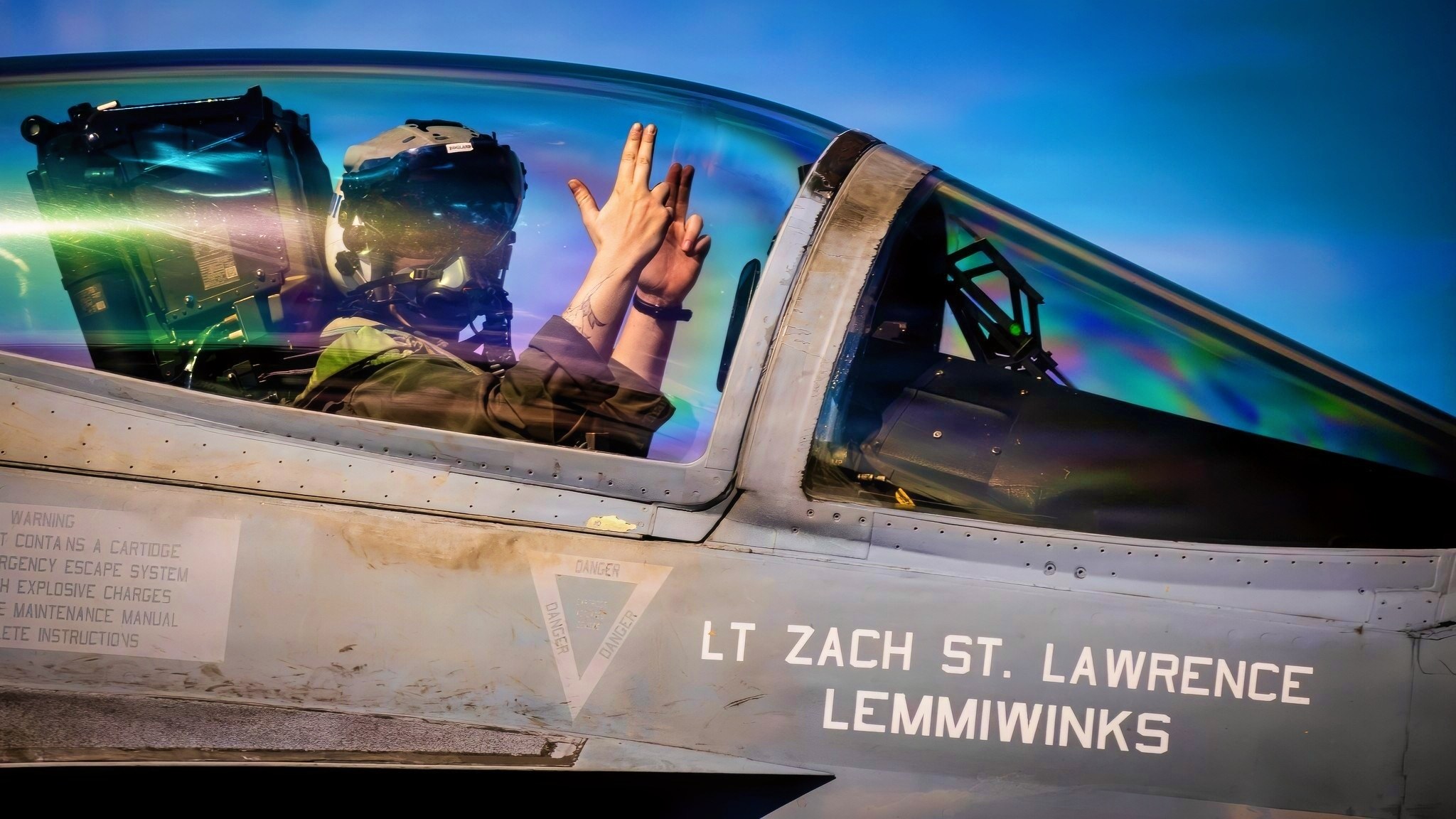
A U.S. Sailor assigned to Strike Fighter Squadron 37 signals to arm ordnance in an F/A-18E Super Hornet aircraft on the flight deck of the world’s largest aircraft carrier, Ford-class aircraft carrier USS Gerald R. Ford (CVN 78), while underway in the Caribbean Sea, Nov. 30, 2025. U.S. military forces are deployed to the U.S. Southern Command area of responsibility in support of Operation SOUTHERN SPEAR, Department of War-directed operations, and the president’s priorities to disrupt illicit drug trafficking and protect the homeland. (U.S. Navy photo)
The Draken was known for its versatility. Beyond its primary interceptor role, it was adapted for reconnaissance and served in the air forces of Sweden, Finland, Austria, and Denmark.
Like later Saab and Swedish aircraft such as the JAS 39E Gripen, it was designed to be rearmed and refueled in under 10 minutes by conscript troops without much training or specialized experience. It perfectly represented the Swedish defensive philosophy, emphasizing dispersed air operations and rapid maintenance.
The Draken Was Hard To Handle
While the aircraft was fast and powerful, the Draken was initially challenging to fly, particularly regarding its “superstall” characteristics at high angles of attack.
The unstable design of the double delta wing made it difficult to land early versions of the J 35, as they had to be manually stabilized during landing.
Its legacy was unmatched by the aircraft’s longevity. The Draken was so advanced that it remained in active service for over 45 years, with the last examples being retired by Austria in 2005.
It pioneered beyond-visual-range (BVR) missile tactics and was considered a very capable dogfighter for its era.
According to the pilots who flew it, the Draken was considered a superb fighter, able to hold its own against most threats until the arrival of the F-15, F-16, and MiG-29. It was also considered more capable than the MiG-21 in terms of radar and endurance, though the MiG was faster.
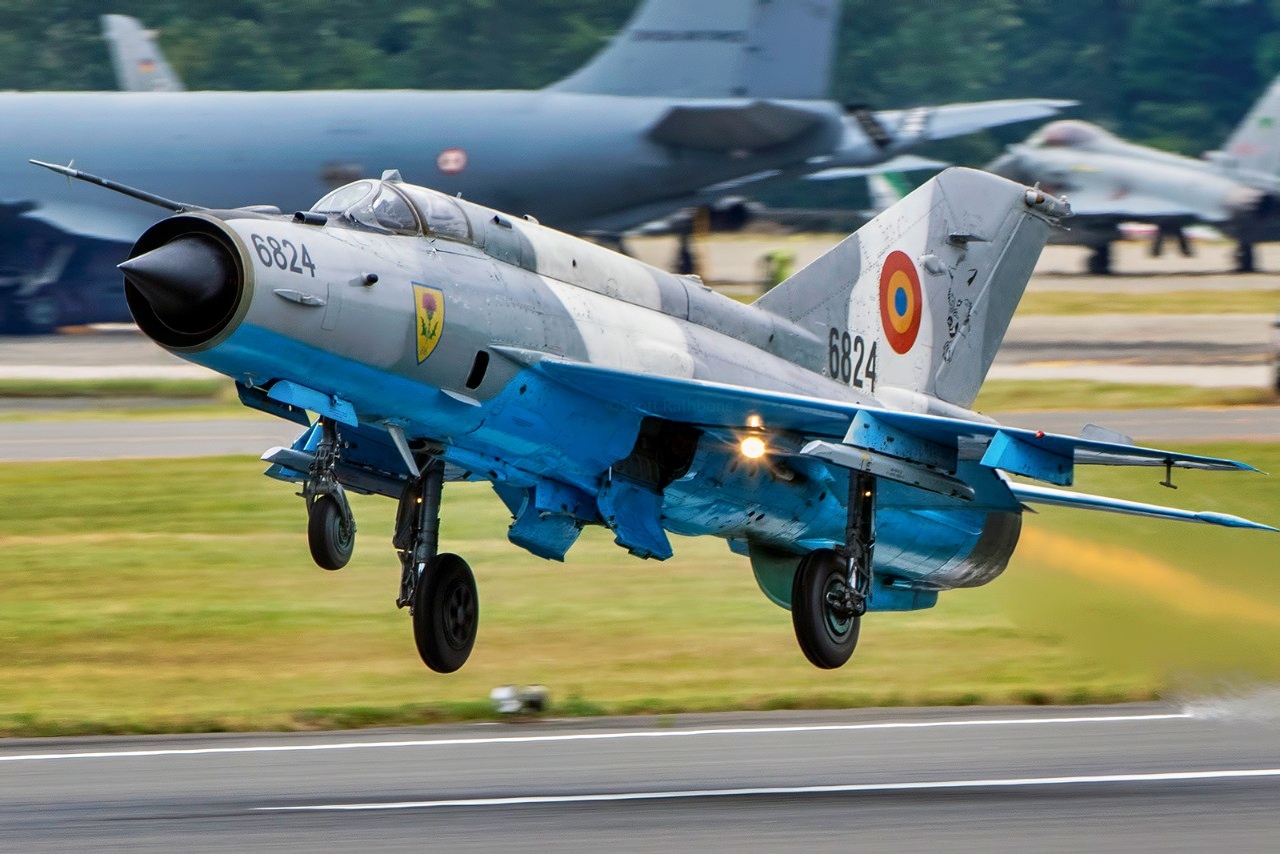
MiG-21 Fighter from Russia. Image Credit: Creative Commons.
The Saab J-35 Powerplant
The Draken was powered by a Swedish version of the Rolls-Royce Avon RM6 turbojet engine. The Rolls-Royce Avon was the first axial flow jet engine designed and produced by Rolls-Royce. Introduced in 1950, the engine became one of their most successful post-World War II designs.
The Maximum thrust was 12,690 lbf (56.4 kN) dry, 16,360 lbf (72.8 kN) with reheat.
-Maximum speed: 2,450 km/h (1,520 mph, 1,320 kn) at 11,000 m (36,000 ft), Mach 2.3
-Ferry range: 2,750 km (1,710 mi, 1,480 nmi) with external drop tanks
-Service ceiling: 20,000 m (66,000 ft)
-Rate of climb: 199 m/s (39,200 ft/min)
Saab Draken Armaments:
The aircraft was armed with 2× 30 mm akan m/55 ADEN cannon with 100 rounds per gun (in Saab 35F, one cannon was omitted (with 120 rounds) to fit avionics needed for Falcon missile integration.
The aircraft’s hardpoints featured six for ordnance, or drop tanks on the bottom two hardpoints, with a capacity of 2,900 kg (6,393 lb), with provisions to carry combinations of 2× 75 mm air-to-ground rocket pods ventrally or 12× 135 mm rockets on six underwing pylons, or RB 24, RB 27, and RB 28 air-to-air missiles.
The Danish export version (F-35) was modified according to NATO standards and was fitted with 1,000lb bomb hardpoints
A total of 651 Drakens were manufactured by Saab. Sweden’s Draken fleet comprised six versions, with two additional models offered to prospective export customers.
The Draken never saw combat against the Soviet Union’s fighters and bombers, but it excellent design and capabilities speak for themselves. The Draken would have more than held their own during the Cold War.
The final Saab 35 Draken in service with the Austrian Air Force was retired in 2005, which is a testament to its effective design and capabilities.
About the Author: Steve Balestrieri
Steve Balestrieri is a National Security Columnist. He served as a US Army Special Forces NCO and Warrant Officer. In addition to writing on defense, he covers the NFL for PatsFans.com and is a member of the Pro Football Writers of America (PFWA). His work was regularly featured in many military publications.


