


A top German General says Russia is preparing to launch a wider war as it fights a full-scale conflict in Ukraine.
The Kremlin, he says, is using hybrid attacks to probe NATO’s defenses.
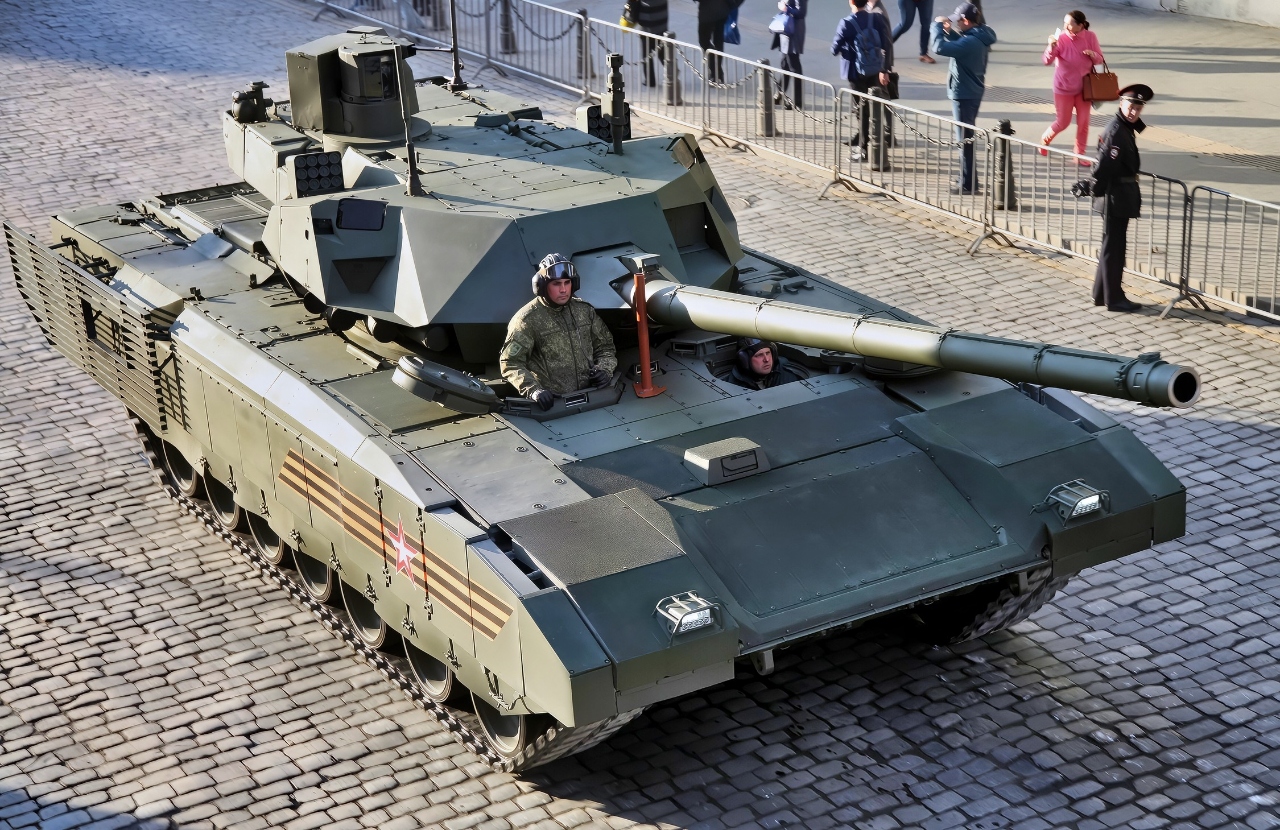
T-14 Armata Tank Russia. Image Credit: Creative Commons.

T-14 Armata. Image Credit: Creative Commons.
The warning comes from Gen. Carsten Breuer, the 17th Inspector General of Germany’s Bundeswehr.
In his position, he acts as the top military advisor to the German government and leads the nation’s ongoing military rearmament and strategic defense overhaul.
Russia, he says, has been systematically using drones to probe the air defenses of NATO’s European members.
The purpose of these increasing drone intrusions is for Russia to discover weaknesses in NATO’s defensive measures and procedures that can be exploited.
Breuer calls Moscow’s intensifying gray-zone campaign one designed to destabilize the continent’s governments and security and military institutions.
“Hybrid attacks are taking place every day in NATO countries,” especially those nations like Poland that are part of the alliance’s eastern flank, Breuer said in an interview he gave to the US Wall Street Journal.
“Russia is testing us and looking at how we respond,” so it can refine its tactics for a future conflict.
Berlin’s New Military Posture
Breuer currently heads a major rework of the country’s defenses, with the end objective of transforming the German armed services into a powerful, combat-ready force.
This change comes after years of what many, both inside and outside the country, have described as “underinvestment” in national security institutions.
Russia, he says, is “already shifting its economy and military to prepare for a wider conflict with the West.” For Russia, the war in Ukraine has as its second-order objective to use the lessons learned from the conflict and develop a set of “weak points” in NATO’s defenses that can be exploited by Moscow when the time comes.
This assessment of the threat that Russia presents to the alliance is the basis for Germany’s new military strategy, originally reported on several months ago in December 2025.
This 1,200-page document is the first strategic planning program the country has produced since the end of World War II.
A declassified summary of the plan was published by Berlin in April 2026.
It calls for Germany to take a more active leadership role across the European security environment.
The document was drawn up at Berlin’s Julius Leber Barracks and details how 800,000 or more German, US, and other NATO troops would move east via ports, rivers, rail, and roads to face an attack launched by Russia, and how these units would be supplied and protected en route.
A Race Against Time
Based on what has been taking place in recent weeks, a Russian attack on NATO could be closer than many would suspect.
There are increasing reports of what the WSJ describes as “US intelligence assessments [that] say Russian President Vladimir Putin could seek to test the resolve of the North Atlantic Treaty Organization with a limited attack on one of its members.”
In the meantime, drone incursions continue to test not only the resolve of NATO but the alliance’s procedures and reactions to any Russian provocations – “mapping” the decision-making command chains and communications mechanisms. Russian strategists constantly engage in what they describe as “reflexive control.”
These reflexive control “pin prick” provocations always operate just below the NATO Article 5 threshold. In this manner, the “Kremlin can observe and evaluate NATO’s collective responses, operational timelines, and escalation thresholds.”
This all comes down to Russia learning enough about how an adversary responds in any given crisis so as to be able to feed false impulses – impulses that cause that same adversary to unknowingly make wrong decisions that are to its detriment.
Drones are playing a growing role in these provocations and incursions of one sort or another, which continue to increase.
On Thursday, German police disarmed an explosive-laden drone that was discovered near a Ukrainian cargo plane at Leipzig/Halle airport in the former East Germany.
Authorities are reported to still be investigating the drone’s origins. Germany’s interior minister has said this act represents “a new level of danger.”
Germany is seeking a leadership role now because Berlin sees the US abrogating its responsibilities in the European security arrangement.
This has come about from a now-discredited US policy that was proposed before the February 2022 invasion of Ukraine.
The proposed plan of action called for the US to hand over the former Soviet Republic to Moscow.
The theory at the time was that this would satisfy Russia’s appetite for expansion and would permit the Pentagon to withdraw from Europe and focus exclusively on the threat posed by China.
“Washington is perceiving China as its first strategic priority,” Breuer said. “For us, for geographical reasons, Russia is our first priority.” Germany, he says, will provide the “strategic glue” aligning the Baltic, Nordic and eastern front-line states with the rest of Europe.
“We have the resources. We are building a deterrent that will be powerful,” Breuer told the WSJ.
About the Author: Reuben F. Johnson
Reuben F. Johnson has thirty-six years of experience analyzing and reporting on foreign weapons systems, defense technologies, and international arms export policy. Johnson is the Director of Research at the Casimir Pulaski Foundation. He is also a survivor of the Russian invasion of Ukraine in February 2022. He worked for years in the American defense industry as a foreign technology analyst and later as a consultant for the U.S. Department of Defense, the Departments of the Navy and Air Force, and the governments of the United Kingdom and Australia. In 2022-2023, he won two awards in a row for his defense reporting. He holds a bachelor’s degree from DePauw University and a master’s degree from Miami University in Ohio, specializing in Soviet and Russian studies. He lives in Warsaw.


