

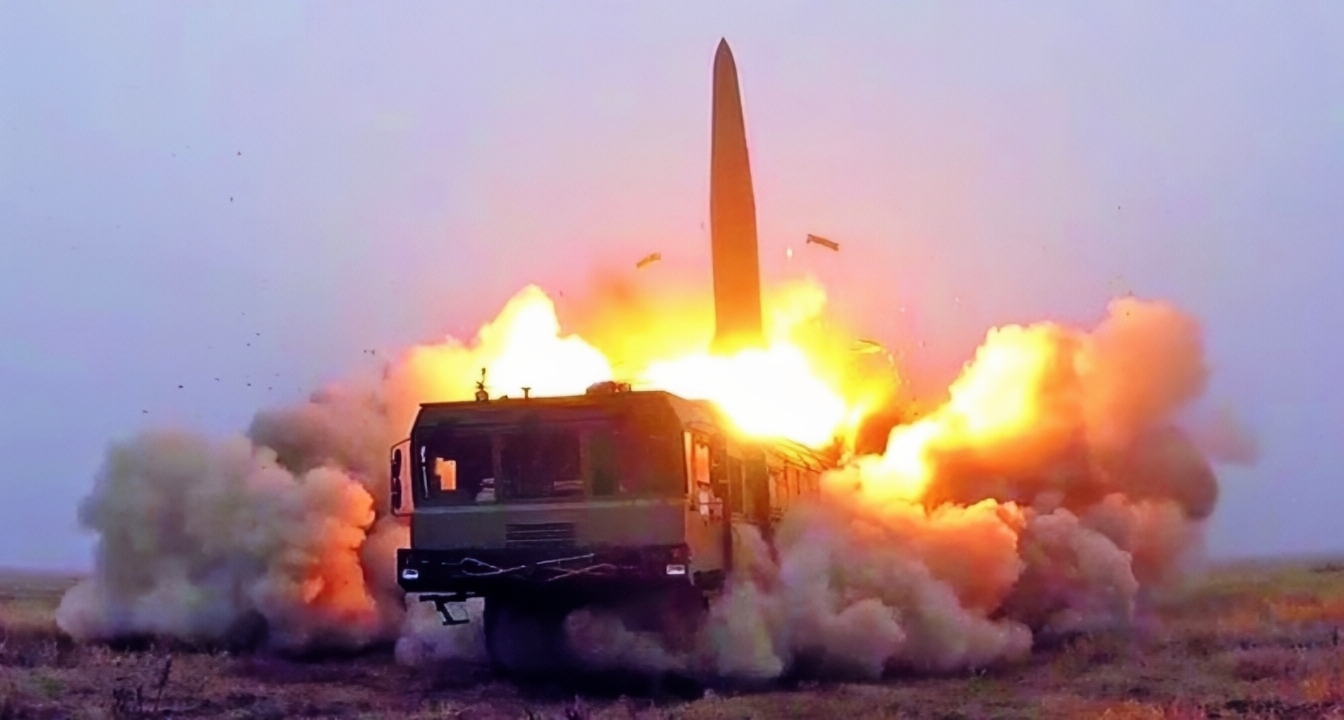
According to open-source estimates, Russia has launched around 150 Iskander-M ballistic missiles alone at Kyiv, Ukraine. Of these missiles, only around seven have been intercepted by Ukrainian air defenses.
The reason for the insanely low interception rates, as has been widely reported, is a critical shortage of PAC-3 interceptor missiles for the Patriot air defense system, Kyiv’s most reliable defense against ballistic missiles.

Iskander-M. Image Credit: Creative Commons.
Unfortunately, Ukraine is not the only nation running low on interceptors. According to multiple reports, the United States is also facing a shortage of PAC-3 interceptors, albeit to a much lesser degree.
After five months of war with Iran, the U.S.’s own stocks of Patriot missiles are starting to dry up.
Patriot Shortages in Kyiv
Over the weekend, Moscow launched yet another attack against Kyiv, utilizing around 18 ballistic missiles and eight Zircon hypersonic cruise missiles.
Of those missiles, official Ukrainian sources reported that only one missile had been successfully intercepted (OSINT sources confirmed that only one Patriot interceptor had been launched). “Only one ballistic missile was intercepted, simply because there are no interceptors for the Patriot systems,” President Zelenskyy wrote on social media. On Wednesday morning (local time), Russia launched yet another major attack against Kyiv, utilizing 30 ballistic missiles. According to initial reports, not one missile was intercepted.
The Patriot air defense system has been a vital cornerstone of Ukraine’s missile defense infrastructure since the United States first donated it in 2023.
PAC-3 interceptors are currently among the few Western-made interceptors capable of reliably shooting down ballistic missiles.
However, after years of fending off Russian missiles, Kyiv’s stockpiles have been virtually exhausted.
This is especially concerning considering that winter is only four months away, and the Russians are bound to launch another air campaign to degrade Ukraine’s energy infrastructure.
Ukraine is therefore forced to choose whether to save what precious few PAC-3s it can obtain for the winter or fend off Russian missiles currently threatening the capital.
U.S. Stocks Are Also Running Low
Meanwhile, in the Middle East, the U.S. is running low on its own interceptor missiles. According to a CSIS report released last week, the U.S. has used roughly 65% of its Patriot interceptor missiles from the start of Operation Epic Fury through the end of July.
Likewise, the U.S. has reportedly used roughly 38% of its THAAD ballistic missile interceptors, which are among the most effective anti-ballistic missile systems in the world.
The true number of interceptors in U.S. stocks is highly classified, but a U.S. official, speaking on condition of anonymity, confirmed that the estimates provided by CSIS were accurate.
Despite the efforts by the U.S. Armed Forces to degrade Tehran’s offensive capabilities, the Iranian regime has remained surprisingly resilient.
The IRGC has continued to launch salvo after salvo at American bases, which has forced the U.S. to expend large numbers of PAC-3 interceptors.
After only five months of war against Iran, the constant barrages have taken a considerable toll on American air defenses.
In its original May report, CSIS estimated that it would take around three years to replenish U.S. stockpiles to prewar levels. Roughly two months later, Patriot stockpiles have dwindled even further.
According to reports, the U.S. is being forced to buy older, less capable PAC-2 missiles for the Patriot system in an attempt to rebuild its stocks.
Europe Left in the Rain
Consequently, the wars in Iran and Ukraine have created a looming Patriot interceptor shortage.
To meet the increased demand, the U.S. DoD announced on Monday that it had reached an agreement with Lockheed Martin and Northrop Grumman, the key manufacturers of Patriot and THAAD missiles, to increase production capacity.
The main goal for the DoW is to increase production of sub-tier components, which is the primary bottleneck. Currently, PAC-3s are produced at a rate of 800-850 per year worldwide. By 2030, the Pentagon hopes to increase that number to 2,000.
Some countries have obtained licenses to produce PAC-3. Japan, for example, currently produces around 30 interceptors per year.
The U.S. also plans to establish a PAC-3 maintenance facility in Europe to improve the overall readiness of NATO’s air defenses.
The issue is that, as the primary manufacturer and customer of PAC-3 missiles, the U.S. is the top priority for any new Patriot missile deliveries.
With the war against Iran still ongoing, the U.S. needs all the air defenses it can get in case the war flares up again and Tehran decides to launch another salvo of ballistic missiles at American bases in the region.
Consequently, Europe has been more or less placed on the back burner as the line for interceptors grows ever longer.
Ukraine is another high-priority customer; however, Europe has already donated a substantial amount of interceptors—often from its own inventories.
With NATO increasingly fearing a direct confrontation with Russia, the alliance is faced with a less-than-ideal dilemma: should it arm Ukraine or keep its own inventories stocked? Unfortunately, there are not enough missiles for both options.
About the Author: Isaac Seitz
Isaac Seitz, a Defense Columnist, graduated from Patrick Henry College’s Strategic Intelligence and National Security program. He has also studied Russian at Middlebury Language Schools and has worked as an intelligence Analyst in the private sector.


