

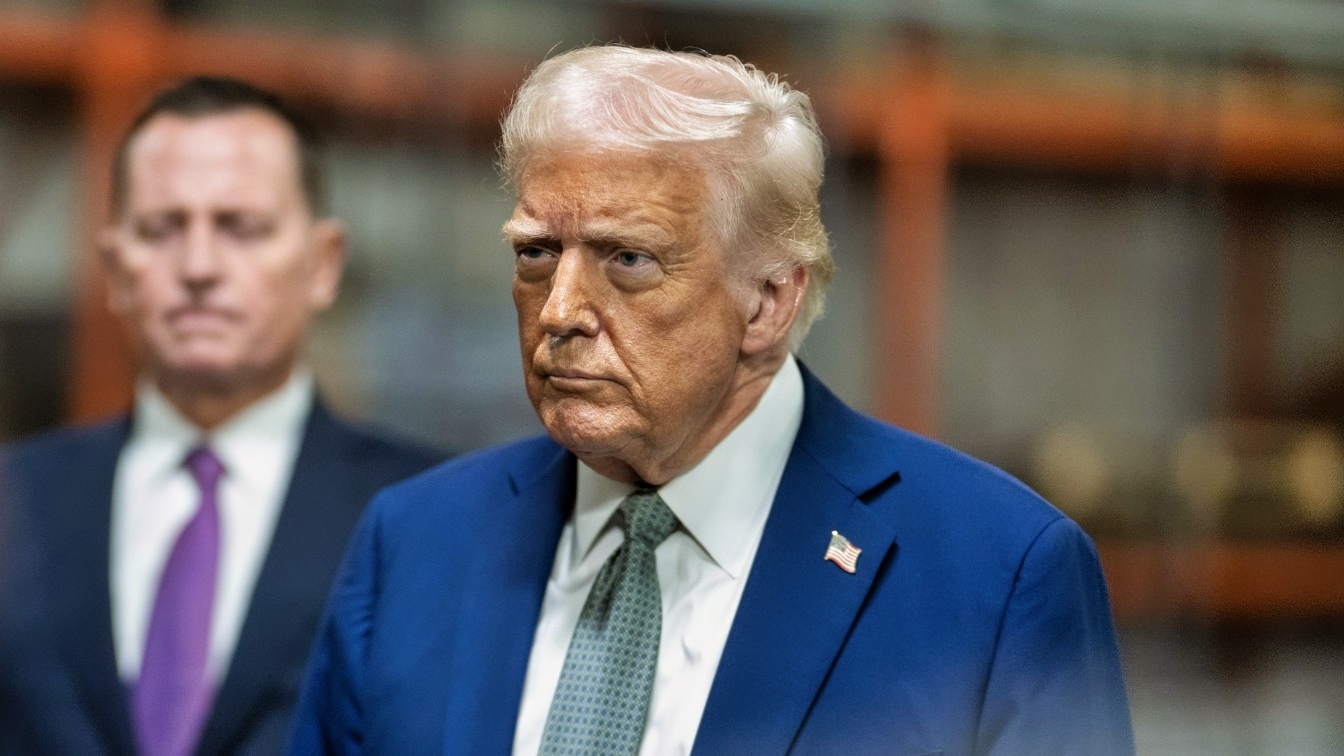
President Trump is backtracking on allowing Ukraine to build Patriot missiles, saying in an interview he was “not sure” about the move.
The president told the Financial Times in a phone interview that “We’re looking at it,” Trump said. ” It’s a very extraordinary weapon, and we have to be a little bit careful of who we license it to. We don’t really license equipment.”
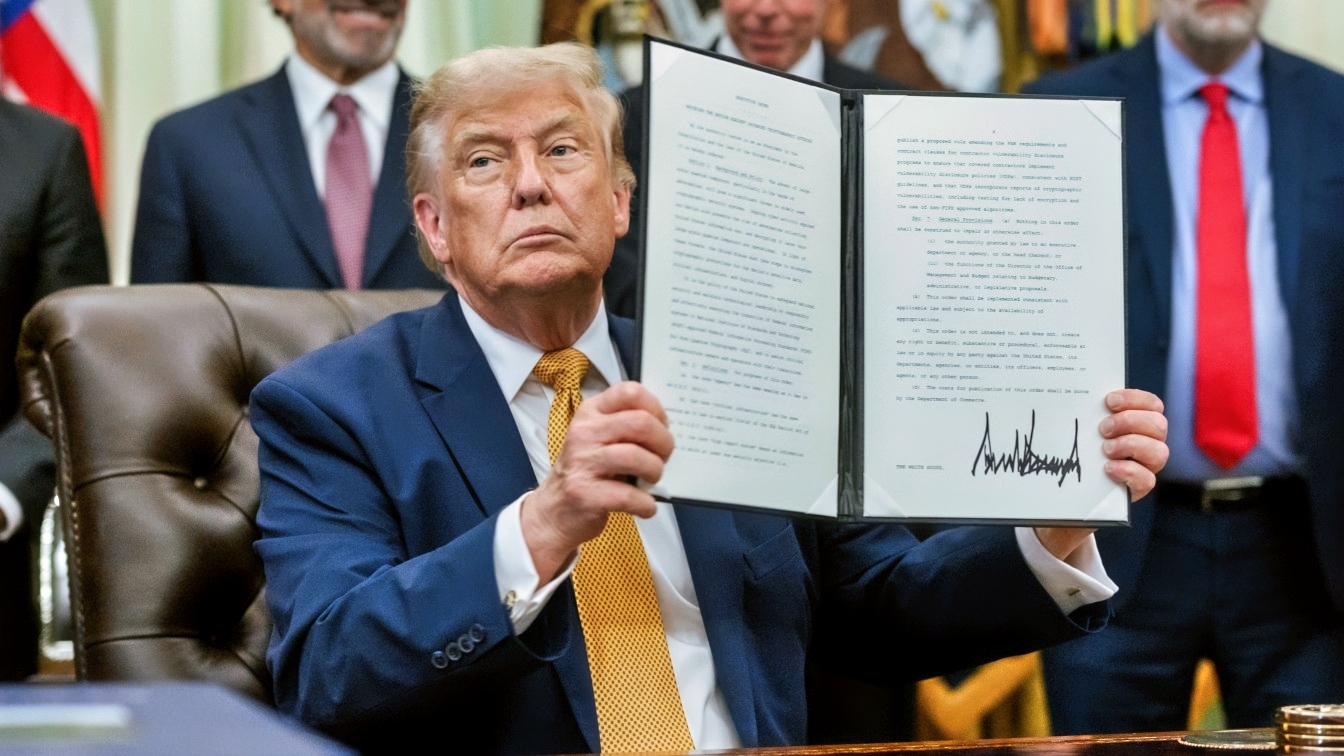
President Donald J. Trump, joined by Secretary of War Pete Hegseth, Physicist John M. Martinis, Science and Technology Policy Director Michael Kratsios, Secretary of Commerce Howard Lutnick, Secretary of Energy Chris Wright, OMB Director Russ Vought, and others, delivers remarks after signing an Executive Order on quantum computing in the Oval Office, Monday, June 22, 2026. (Official White House Photo by Joyce N. Boghosian)
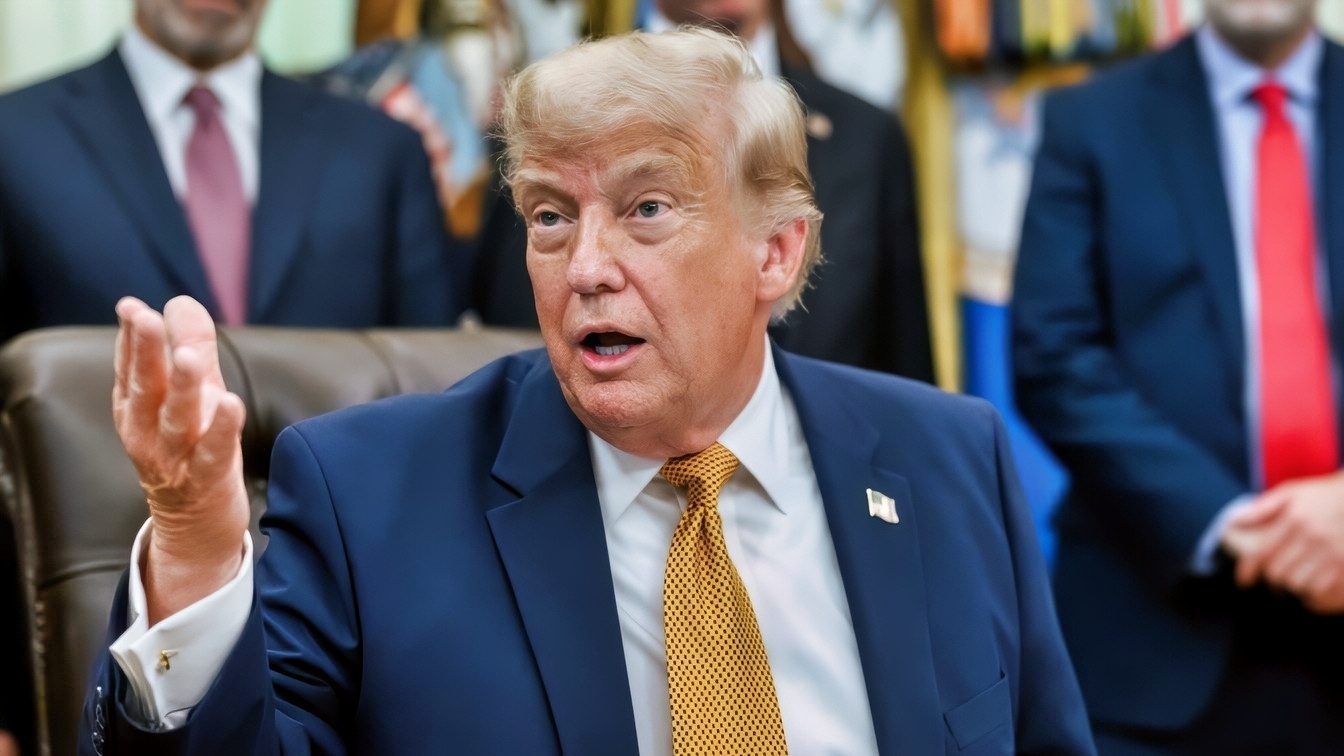
President Donald J. Trump, joined by Secretary of War Pete Hegseth, Physicist John M. Martinis, Science and Technology Policy Director Michael Kratsios, Secretary of Commerce Howard Lutnick, Secretary of Energy Chris Wright, OMB Director Russ Vought, and others, delivers remarks after signing an Executive Order on quantum computing in the Oval Office, Monday, June 22, 2026. (Official White House Photo by Joyce N. Boghosian)
Earlier this week, it seemed like this was a done deal.
Ukrainian President Volodymyr Zelenskyy met with the president at the White House, where Zelenskyy said the two were discussing plans along with manufacturer Raytheon to allow Kyiv to manufacture its own Patriot air defense missiles.
“I am grateful for the company’s readiness to take our partnership to an even higher level, where Ukraine would co-produce, together with Raytheon, some of the most vital air defense assets – Patriot interceptors,” Zelenskyy wrote on X.
But now Trump has changed his tune, telling the FT that his focus is on ending the war.
“Very simply put, we want the war in Ukraine with Russia ended,” Trump said. “I’m not looking for missiles. We’re looking for peace.”
He also said that senior peace envoys Jared Kushner and Steve Witkoff would travel to Ukraine soon for their first visit to the country.
Raytheon Sending A Team of Experts To Ukraine
President Trump said during the NATO summit in Turkey this month that Washington would grant Ukraine a license to manufacture Patriot missile interceptors.
“We’re going to give a license to you to make Patriots. That’s pretty cool. This way, you can’t complain that we’re not giving ’em enough,” Trump said at a meeting with Zelenskyy at the NATO summit in Ankara.
Officials from Patriot manufacturer Raytheon have visited Ukraine, and Lockheed Martin is working to send a team of experts as the two countries coordinate on system support, missile supplies, and potential co-production of Patriot interceptors.
Zelenskyy said discussions with the Raytheon delegation, led by Vice President Joseph DeAntona, also focused on “other areas of partnership regarding non-offensive military equipment.”
Zelenskyy met U.S. ambassador to NATO Matthew Whitaker in Kyiv on Wednesday, with the discussion focusing on licenses, and added that he wanted “faster action and greater support” from Kyiv’s partners.
Ukraine Is Increasingly Unable To Defend Against Russia’s Missiles
While both Ukraine and Russia continue to attack each other with drones and missiles, the Ukrainians are woefully short on air defense missiles that target ballistic missiles.
In an attack on Kyiv on July 30, Russia launched over 70 missiles and 280 drones. The attack killed eight people, three of whom were children.
Ukraine’s air force said it shot down just one of nine ballistic missiles sent into its airspace.
Ukrainian President Zelenskyy recently joined several heads of state in Paris at a meeting of the “Coalition of the Willing” to discuss how to support Ukraine and pressure Russia to end the war.
The coalition’s plans include developing a new anti-ballistic missile system as a cheaper alternative to the United States’ Patriot system. Unfortunately, that wouldn’t produce anything until the end of 2027 at the earliest.
Overall, 10 countries, along with a dozen firms from the defense sector, met to discuss what they called the Integrated Anti-Ballistic Missile Coalition.
“We believe that the protection of Europe requires a global solution of integrated missile defense architecture to deter and defeat future missile threats,” the leaders of Denmark, France, Germany, Italy, the Netherlands, Norway, Spain, Sweden, Ukraine, and Britain said in a statement released.
“It will complement existing ballistic missile defense systems, including sovereign European solutions already acquired or to be acquired by participating countries.”
President Zelenskyy has pleaded with leaders of the United States, NATO, and the West for more air defense weapons and has urged Europe to work with it on a joint anti-ballistic missile defense system.
During the early July NATO summit in Ankara, Turkey, President Trump pledged to let Ukraine build its own Patriot interceptor missiles after recognizing that, in Zelenskyy’s words, Ukraine is “a country that is ready to do this.”
Despite the US and European allies ramping up production of their missile defense systems, there is still a significant shortfall between demand and production.
And the political will and continued fear of provoking Russia remain serious issues for Ukraine’s European allies.
40,000 Ukrainian Civilian Casualties According To The UN
Since the war started in early 2014, Russia has targeted civilians and civilian infrastructure (apartment buildings, hospitals, small neighborhoods), trying to terrorize and break the will of the Ukrainian people.
In one of the most deadly strikes against civilians earlier this month, an 11-hour drone and missile strike across Kyiv killed at least 30 civilians. It injured nearly 100 others, severely damaging apartment blocks and an ambulance station.
Since the full-scale invasion in 2022, the UN estimates that there have been between 15,000 and 40,000 civilian casualties, with targeted bombings consistently destroying residential areas, energy grids, and medical facilities.
The UN admits that these numbers are probably much lower than the actual ones, as the exact number of casualties isn’t known yet.
Human rights organizations and the UN continue to document these actions as violations of international humanitarian law. Ukraine’s civilian casualties have skyrocketed by more than 31 percent in 2025.
Ukraine and Zelenskyy are acutely aware of the shortage of air defense systems to protect their people and are trying to develop one quickly.
Even if the US allows Ukraine to build its own Patriot missiles, the realistic timeframe would be 18 to 24 months at the earliest before they began rolling off the assembly lines.
And with the US and its Middle East partners burning through Patriot missiles in the conflict with Iran, there won’t be any missiles coming to Ukraine in the near term.
But the president’s backtracking won’t further any peace negotiations; it will only serve to embolden Russia and Putin.
About the Author: Steve Balestrieri
Steve Balestrieri is a National Security Columnist. He served as a US Army Special Forces NCO and Warrant Officer. In addition to writing on defense, he covers the NFL for PatsFans.com and is a member of the Pro Football Writers of America (PFWA). His work was regularly featured in many military publications.


