
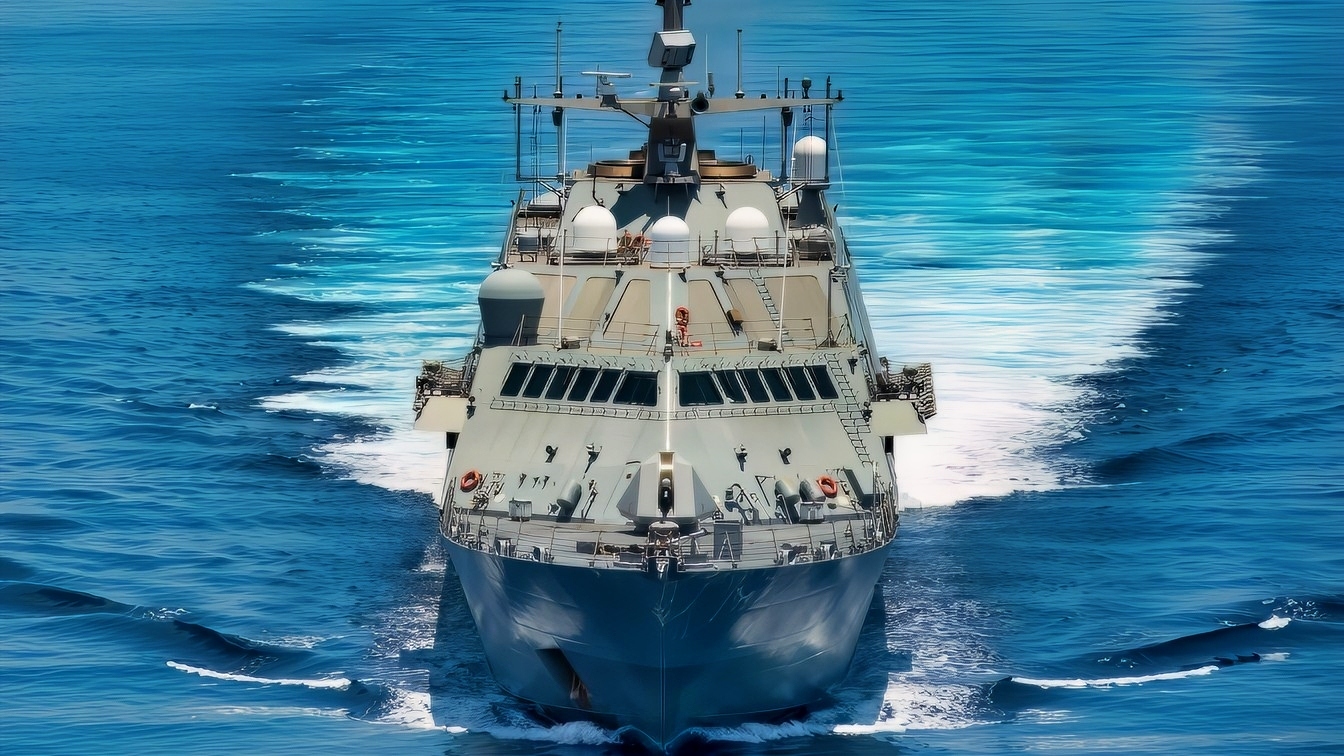
U.S. President Donald Trump claimed on Tuesday, August 18, that the Strait of Hormuz is open and operational, and even went as far as to share a map that labeled the waterway as “NEW U.S. Territory.”
But the ships aren’t moving, and Trump’s narrative appears to be based on the fact that a limited number of ships continue to move through the Strait.
Oil Platform. Image Credit: Creative Commons.

Generic Oil Tanker Image. Image Credit: Creative Commons.
The president also claimed that all naval mines have been removed from the strait, in a clear attempt to calm concerns among shipping companies, crews, and insurers, and said that the U.S. naval blockade of Iran remains in full force and effect.
But if Trump’s words mean anything, it’s really just that the Strait of Hormuz is not completely blocked, and that some ships are passing through.
Today, commercial shipping through Hormuz is a small fraction of what it was pre-war, with independent tracking data showing significant declines in recent months.
Oil prices are also rising again as traders prepare for a prolonged disruption and increased military hostilities between Iran and the U.S.
What the Tanker Data Shows
The White House, naturally, would prefer commercial shipping operations to trust that the Strait of Hormuz is open and that U.S. naval forces will ensure the safe passage of ships through the waterway. But shipping data shows activity that looks nothing like a normally functioning Strait of Hormuz.
Only six commodity vessels crossed Hormuz on Monday, according to preliminary Kpler data Reuters reported.
That was an improvement from just three crossings Saturday and two Sunday, but still well below even the depressed 10-day average of 11. None of Monday’s vessels was a very large crude carrier or LNG tanker.
Before the War
Before the war, more than 130 ships routinely passed through Hormuz each day.
On Friday, only two vessels crossed, and Kpler detected no crude oil shipments through the waterway. The disparity is particularly significant because Energy Secretary Chris Wright has argued that substantially more oil is leaving the Persian Gulf than commercial tracking companies can detect.
Wright’s argument, however, hinged on the fact that oil is escaping the Gulf region through alternative routes – meaning that the Strait of Hormuz must, therefore, not be operating as normal.
Nine Million Barrels
Wright says roughly 9 million barrels of oil move through Hormuz each day and that the Trump administration has better information than private firms because many tankers operate covertly with their Automatic Identification System transponders switched off.
But even then, private estimates remain substantially lower, and even the Trump administration’s best estimates are dramatically lower than the quantities that moved through the strait before the war began in February.
How Much Oil Is Really Getting Through?
Nobody can say with absolute certainty how much oil is moving through Hormuz, though estimates can be made based on exports from Gulf producers and global purchases.
That information, however, is not always easily available—especially with ships moving through the Strait of Hormuz with their transponders switched off and buyers purchasing sanctioned oil.
The war with Iran has fundamentally changed how tankers operate today, not just switching off transponders but also changing their routes and sailing close to Iranian or Omani waters.
Some are also arranging passage through channels that conventional vessel-tracking systems cannot easily observe.
That all makes Wright’s underlying argument technically plausible: commercial trackers are almost certainly missing some traffic.
Windward, a maritime intelligence company that supplements AIS information with satellite imagery and other data, has previously documented dozens of what are known as “dark transits.”
The dispute, then, is perhaps over the scale of the missing traffic – though it remains the case that global oil supply is dwindling, the U.S. is continuing to deplete its Strategic Petroleum Reserve supplies, and Asian and European buyers are competing for the same alternative supplies.
Matt Smith, the director of commodity research at Kpler, told Politico that Wright appeared to be just “pulling a number out of the air” and estimated flows at closer to five million per day.
Rory Johnston, founder of Commodity Context, said that the recent peak might actually be closer to 7 million barrels per day – which is still 2 million below Wright’s figure.
The difference may seem small, but it is enormous. At Wright’s claimed rate, an additional 14 million barrels would leave the Gulf every week compared with an estimate of 7 million.
The behavior of the shipping industry, more generally, offers good insight into how safe it truly is to transit the Strait of Hormuz today.
Shipowners still face elevated insurance premiums, and some major operators are still avoiding the route entirely.
Chinese state-owned shippers COSCO and China Merchants are reportedly deploying tankers outside of the Gulf entirely and using ship-to-ship transfers to avoid sending vessels through Hormuz.
That doesn’t sound like the strait is open.
About the Author: Jack Buckby
Jack Buckby is a British researcher and analyst specializing in defense and national security, based in New York. His work focuses on military capability, procurement, and strategic competition, and he produces and edits analysis for policy and defense audiences. He brings extensive editorial experience, with a career output spanning over 1,000 articles at 19FortyFive and National Security Journal, and has previously authored books and papers on extremism and deradicalization.


