

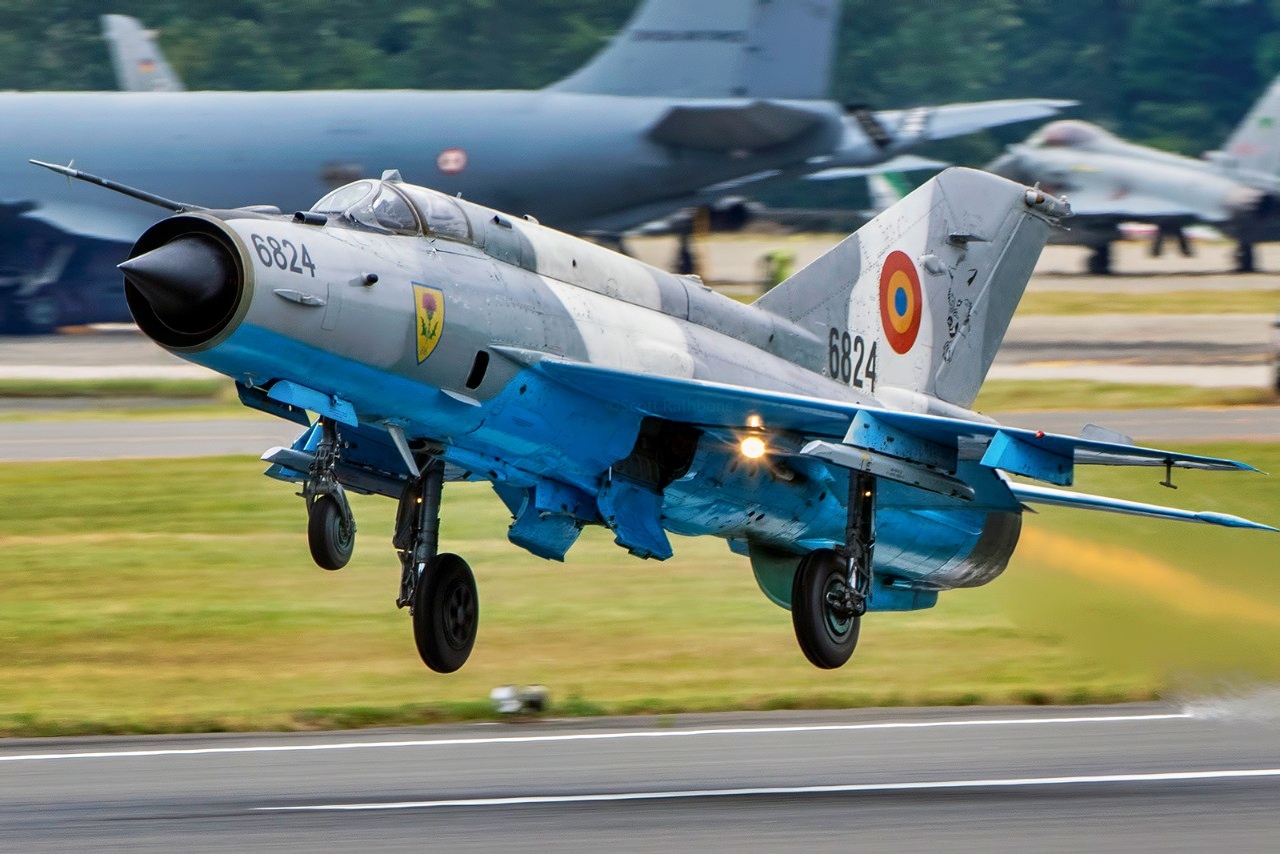
Key Points and Summary – The North Korean Air Force is arguably the most obsolete in the world, primarily flying a motley collection of ancient Soviet-era and Chinese-copy aircraft that would be museum pieces in any other country.
-Its fleet is dominated by hopelessly outdated jets like the MiG-21, Su-7, and the Chinese J-7, all of which lack modern avionics and weapons.
-Compounding this issue is a severe lack of pilot training, with pilots reportedly getting as little as 15 flight hours per year due to fuel shortages.
-Ultimately, Pyongyang’s true power lies in its nuclear arsenal, not its decrepit air force.
Flying Nightmare: A Deep Dive into North Korea’s Decrepit Air Force
The Korean People’s Army Air Force has a motley collection of aircraft in service, most of which are legacy Soviet designs passed down to the KPAAF during the Cold War era, or Chinese copies of Soviet designs.
In most other air forces, the jets would be museum pieces.
But without a domestic air industry, and heavily reliant on the political whims of Beijing and Moscow, Pyongyang can little afford to scrap the few dated fighters it has, proving the adage that beggars can’t be choosers.
MiG-21
The Soviet Union’s MiG-21 first flew in 1955, during the early days of the Cold War. Built to be a high-speed interceptor as well as a fighter, the jet was a capable plane — but 70 years ago. Noted for its simplicity and ease of maintenance, the MiG-21 could accelerate to high Mach 2 speeds when needed. Early versions of the fighter lacked an onboard radar, which hindered its effectiveness, and the jet lacked the range and beyond-visual-range missiles necessary to match the effectiveness of its Western counterparts. Today, it is far outclassed in every respect by virtually any other fighter in Western or most Asian air forces.
Su-7
A contemporary of the MiG-21, Sukhoi’s jet also first flew in 1955. Primarily used as a fighter-bomber, the jet served as a versatile ground-attack platform that could also execute high-speed maneuvers at Mach 2 speeds.
Its delta wing design was noted for its ruggedness, reliability, and simplicity, although it too lacked an advanced targeting system or precision munitions. One of the jet’s notable engagements was during the Indo-Pakistani wars.
Today, however, there are only former Su-7 operators — with North Korea the lone exception, holding the unique distinction of still flying the Soviet jet.
Chengdu J-7
Last but not least is the Korean People’s Army Air Force’s Chengdu J-7, a license-built Chinese copy of the MiG-21. Emblematic of the close relationship between China and the Soviet Union before the Sino-Soviet split, the J-7 is broadly similar to the MiG-21 and lacks a modern cockpit and avionics.
However, unlike the previous two fighters, the J-7 is still flown by several countries in Africa, Asia, and the Middle East, thanks in part to a range of modernization programs.
Still, compared to the two countries the Korean People’s Army Air Force would be likely to face — the United States and South Korea — the J-7 is hopelessly outdated.
Pilot Training
Irrespective of the obsolescence of North Korea’s fighters, an equally important metric is the amount of flight hours each North Korean pilot has, which is very tricky to parse, given the information firewall that prevents information inflow or outflow from the hermit kingdom.
“Defence experts estimate that North Korea possess up to 120 later-variant MiG-21s — a now-ageing aircraft known as “Fishbed” to Nato forces and produced in large numbers between 1959 and 1985, becoming the most produced combat aircraft since the end of the Korean War,” the Financial Times reported in 2010 following the crash-landing of a North Korean MiG-21 in China.
“According to an assessment by Jane’s, North Korean air force pilots manage to fly only 15-25 hours per year because of a shortage of aviation fuel.”
North Korea’s Air Force Drama Show
Given North Korea’s status as a nuclear power, the state of the Korean People’s Army Air Force is significantly less relevant than it may initially seem. That atomic guarantor of security counts for vastly more than an advanced or even an operational air force.
About the Author: Caleb Larson
Caleb Larson is an American multiformat journalist based in Berlin, Germany. His work covers the intersection of conflict and society, focusing on American foreign policy and European security. He has reported from Germany, Russia, and the United States. Most recently, he covered the war in Ukraine, reporting extensively on the war’s shifting battle lines from Donbas and writing on the war’s civilian and humanitarian toll. Previously, he worked as a Defense Reporter for POLITICO Europe. You can follow his latest work on X.
More Military
The U.S. Navy’s Submarine Crisis Is Real


