


Summary and Key Points: Putin’s 2022 invasion of Ukraine was centered on armored columns racing toward Kyiv. Instead, Russian tanks became the war’s most destroyed weapon.
-Cheap FPV drones now routinely throw their turrets into the air — the “jack-in-the-box” effect — and the losses are staggering: Oryx confirms over 4,000 destroyed or captured, while Ukraine claims more than 10,000.

T-80 Tank from Russian Army. Image Credit: Creative Commons.
-Unable to build enough new tanks, Russia has resorted to pulling 70-year-old T-54s and T-55s from storage.
-The tank-led assault may be over.
Russia’s War in Ukraine Has Been a Disaster for the Tank
When Russian forces crossed into Ukraine in February 2022, the plan was built around steel.
Long armored columns of T-72s, T-80s, and the more modern T-90s would punch through Ukrainian defenses, race toward Kyiv and the other major cities, and decapitate the government before any serious resistance could organize.
Tanks were central to Russia’s initial invasion plan, the spearhead of a campaign that was supposed to be measured in days.
The image of a Russian armored column rolling unopposed into a European capital was the entire theory of victory.
Russia entered the war with roughly 3,330 operational tanks, one of the largest active armored forces on the planet, backed by thousands more in long-term storage. The doctrine that governed how those tanks would be used was the battalion tactical group, a combined-arms formation that paired armor with infantry, artillery, and air defense in a self-contained package.
On paper, it was a formidable instrument. In practice, the opening weeks of the war exposed it as one of the most overrated military concepts of the modern era, and the tanks that were supposed to win the war quickly became the most visible symbol of how badly the plan had failed.
Why The Armored Spearhead Broke in the Ukraine War
The first problem was that Russia used its tanks badly.

A soldier from the Idaho Army National Guard, Charlie Company, 2-116th Combined Arms Battalion, 116th Cavalry Brigade Combat Team makes Idaho National Guard history with the first firing of a Javelin anti-tank missile.
In a historic moment of training for the Idaho Army National Guard, soldiers from Charlie Company, 2-116th Combined Arms Battalion, 116th Cavalry Brigade Combat Team, fired the FGM – Javelin portable anti-tank missile on Sunday while conducting a series of field training exercises scheduled for the week on the Orchard Combat Training Center ranges.
The battalion tactical groups that drove toward Kyiv were chronically short of infantry, and a tank without enough infantry screening it is a blind, vulnerable target in close terrain. Russian columns funneled down predictable roads, bunched up in traffic jams, ran out of fuel, and presented themselves to Ukrainian ambush teams who picked them apart with shoulder-fired anti-tank missiles.
The NATO-supplied Javelin and the Ukrainian-built Stugna-P turned the approaches to Kyiv into killing grounds, and the wreckage of Russian armor along those roads became the defining imagery of the invasion’s failure.
The deeper problem only became fully clear as the war ground on. The tank, as a weapons system, had become extraordinarily difficult to keep alive on a battlefield saturated with cheap aerial robots. The Soviet-pattern design that nearly every Russian tank shares stores its main gun ammunition in a circular carousel below the crew, a choice made to keep the tank’s silhouette low.
When a top-attack strike penetrates the turret and ignites that ammunition, the result is a catastrophic explosion that blows the turret clean off the hull, the phenomenon grimly nicknamed the jack-in-the-box effect. Ukrainian drone crews now routinely capture footage of a single cheap FPV drone striking a Russian tank and throwing its turret into the air on a column of fire. A weapon costing a few hundred dollars could now destroy a vehicle worth millions, with effectively unlimited numbers of such weapons available.
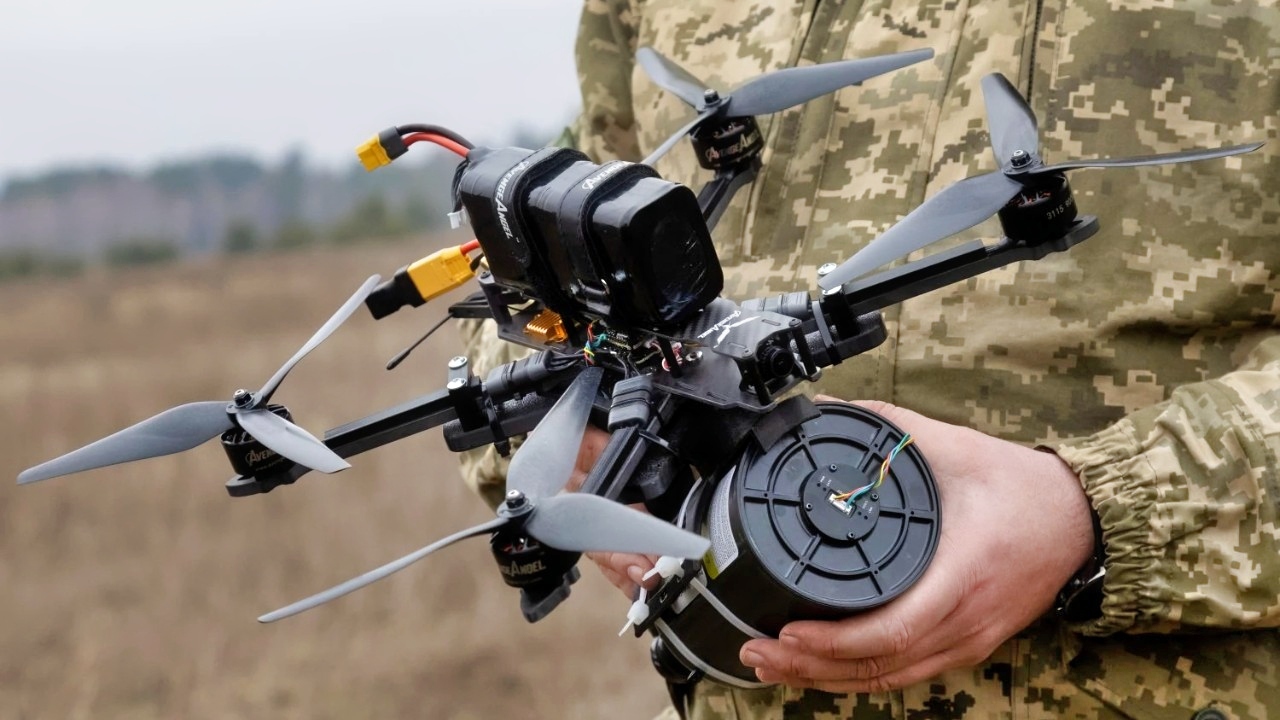
Ukraine Drone. Image Credit: Creative Commons.
The Losses Mounted Into The Thousands
The scale of the destruction is difficult to overstate. The independent visual-verification project Oryx, which counts only losses it can confirm with photo or video evidence, has documented more than 4,000 Russian tanks destroyed, damaged, abandoned, or captured, a figure roughly equal to the entire active tank force Russia fielded on the eve of the wider war. Because Oryx counts only what can be visually proven, the true total is understood by every serious analyst to be considerably higher.
The Ukrainian General Staff, which counts everything its forces report hitting, places the figure far higher still, reporting losses of 10,864 tanks as of late May 2026, along with more than 22,000 other armored vehicles.
The rate of loss has not slowed. Ukrainian Commander-in-Chief Oleksandr Syrskyi reported that Ukrainian forces hit more than 1,159 Russian tanks in a single year-to-date period, along with more than 2,500 armored vehicles, a pace that no production line on earth could match. The losses have been so severe that they have begun to reshape how other militaries think about armor entirely. The United States Army, watching the carnage, has concluded that its own tank battalions must become a lot leaner and has begun planning to send drones ahead of armored units rather than letting tanks spearhead assaults the way Russian doctrine demanded in 2022.
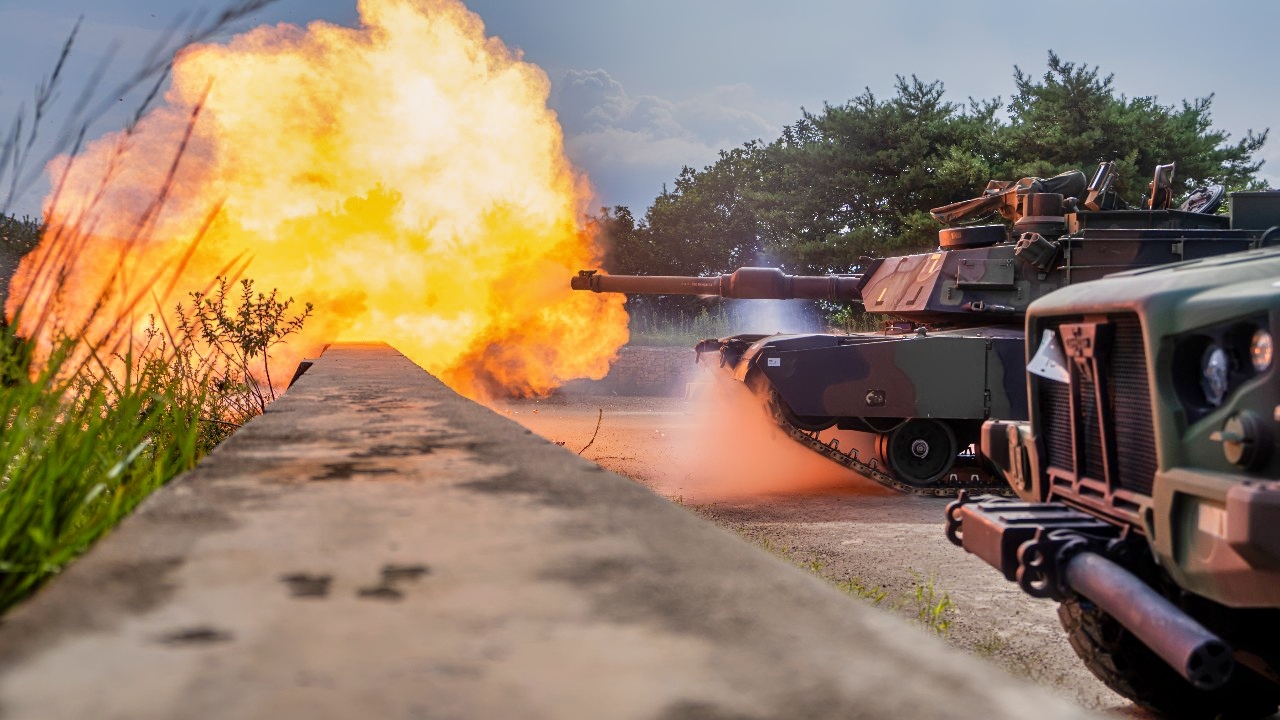
An M1A2 SEP v2 Abrams assigned to Bravo Company, 4th Battalion, 70th Armored Regiment, 1st Armored Brigade Combat Team, 1st Armored Division, fires at a target during a zero range at Rodriguez Live-Fire Complex, South Korea, Aug. 5, 2024. The unit is participating in a deployment readiness exercise in support of Operation Pacific Fortitude, which supports long-standing agreements to the Republic of Korea by deploying forces, drawing and transporting equipment to validate unit readiness and the U.S. commitment to the alliance. (U.S. Army photo by Cpl. David Poleski)
Reaching Back To The 1950s To Fill The Gap
Russia could not build new tanks fast enough to cover losses on that scale. Its production lines turn out only a few hundred genuinely new tanks per year against annual losses many times higher.
So the Kremlin did the only thing it could. It went into its Soviet-era storage depots and started pulling out the tanks of its grandfathers’ generation.
The process began earlier than most people realize. By May 2022, just months into the war, Russia was already shipping T-62 tanks pulled from deep storage to the front, a design that first entered service in 1961. The 50-year-old tanks were assessed by British intelligence as particularly vulnerable to modern anti-tank weaponry, and Ukrainian forces were advised to single them out as easy targets.
The reliance on these obsolete vehicles only deepened as the modern fleet was ground down, and the T-62 losses mounted steadily as they were pushed forward into roles they were never built to survive.
Then came the truly remarkable step. Russia began pulling T-54 and T-55 tanks from storage, a design that dates to the immediate aftermath of the Second World War. In one of the war’s stranger ironies, a Ukrainian military expert observed that these ancient tanks were sometimes in better condition than the newer Soviet models Russia had been pulling out of service, because the Stalin-era storage practices that preserved them had been more rigorous than those used in later decades. The tanks coming out of the 1295th Central Tank Reserve and Storage Base in the Russian Far East represented the bottom of the barrel, vehicles designed for a battlefield that bore no resemblance to the drone-saturated front of 2026.

Tim Murry, a foreign threats compound contractor, drives a T-72 battle tank into position to serve as adversary targets for a joint service exercise, Emerald Flag, at Eglin Air Force Base, Fla., Nov. 30. Emerald Flag is a multi-service exercise aimed to unify information sharing across joint domain platforms. (U.S. Air Force photo/1st Lt Karissa Rodriguez)
These resurrected tanks were never going to fight as the assault-leading combat vehicles their designers intended. The crude improvised shields welded over their turrets, mockingly labeled “cages” on social media, were unlikely to stop a Javelin or a Stugna-P but could at least deflect the grenades dropped by small civilian drones. They had become mobile gun platforms firing from concealed positions, not the spearhead of a blitzkrieg.
A Tank Force That Can No Longer Lead
The cumulative effect has hollowed out the very capability Putin built his invasion around. Russia still fields tanks at the front in numbers, a force sustained almost entirely by drawdown from storage.
But the way armor can be used has fundamentally changed, and not only for Russia. After the frontline stabilized, both sides tried to resume maneuver-mechanized warfare, but failed because the integration of pervasive drone reconnaissance, precision artillery, and FPV drones into what analysts call a tactical reconnaissance strike complex made massed armored breakthroughs nearly impossible against any prepared defender.
The tank has been demoted from the maneuver weapon that was supposed to roll into Kyiv to a cautious support platform firing from cover. Neither side now uses main battle tanks in the massive mechanized assaults that defined twentieth-century land warfare, because the vehicles have become too visible and too vulnerable to survive in the open.
The weapon Russia built its entire invasion plan around has been pushed to the margins of the very war it was meant to win.
What This Means For Russia’s Future and the Ukraine War
The implications run well beyond the current war. Russia’s storage reserve is finite. Open-source analysts estimated a maximum of around 7,000 tanks in storage at the war’s outset, and the Kremlin has been burning through that reserve at a furious pace for more than three years. Each withdrawal pulls out an older, less capable, more poorly preserved vehicle than the last, and at some point, the depots that have sustained the war will no longer be able to. Russia can maintain the number of tanks at the front for now, but their quality is diminishing over time, and production lines cannot fill the gap.
The Russian army that emerges from the Ukraine war will be a fundamentally diminished armored force. It will have expended the Soviet inheritance that gave it strategic weight, consumed a tank reserve built over decades that cannot be quickly rebuilt, and learned the hard way that the doctrine it entered the war with no longer matches the battlefield.
The combined-arms armored breakthrough, the concept at the heart of Russian and Soviet military thinking for generations, has been rendered enormously costly by a weapon that fits in a soldier’s backpack.
About the Author: Harry J. Kazianis
Harry J. Kazianis (@Grecianformula) was the former Senior Director of National Security Affairs at the Center for the National Interest (CFTNI), a foreign policy think tank founded by Richard Nixon based in Washington, DC. Harry has over a decade of experience in think tanks and national security publishing. His ideas have been published in the NY Times, The Washington Post, The Wall Street Journal, CNN, and many other outlets worldwide. He has held positions at CSIS, the Heritage Foundation, the University of Nottingham, and several other institutions related to national security research and studies. He is the former Executive Editor of the National Interest and the Diplomat. He holds a Master’s degree focusing on international affairs from Harvard University.


