

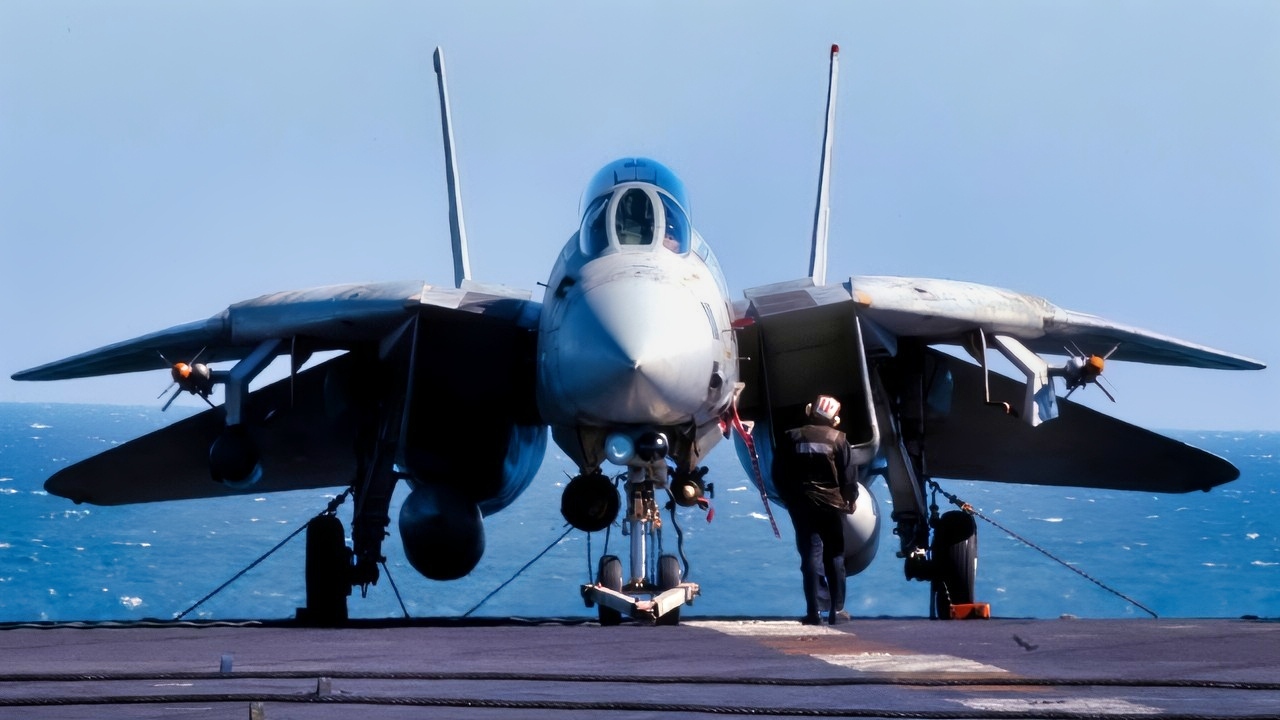
Operation Epic Fury, the joint U.S.-Israeli air campaign against Iran, destroyed most of Tehran’s F-14 Tomcat fleet — the only F-14s flying anywhere outside the United States. Congress is now moving the “Maverick Act,” a bill that would transfer three F-14Ds (Bureau Numbers 164341, 164602, and 159437) from Navy storage to the U.S. Space and Rocket Center Commission in Huntsville, Alabama, with one of the three to be made flyable for airshows and commemorative events. The aircraft Tom Cruise made famous in Top Gun has been out of U.S. service for 20 years.
The Great F-14D Tomcat Comeback?

F-14D Tomcat Up Close on USS Intrepid. Image Credit: National Security Journal.

F-14D Tomcat Photo Onboard USS Intrepid. National Security Journal Photo.
A trio of F-14D aircraft could be revived and breathe new life into them should the Maverick Act, a bill, pass a vote in the House of Representatives. If passed, three F-14Ds would be transferred from storage to the U.S. Space and Rocket Center Commission in Huntsville, Alabama. The three F-14s have already been identified, and are Bureau Numbers 164341, 164602, 159437 — aircraft that are “excess to the operational requirements of the Navy.” They’ll live on for some time to come, not again as combat aircraft, but instead as museum pieces.
Fit for Transfer
The stipulations surrounding the aircraft are carefully exact. Some of the more notable details read as follows.
“The Secretary shall provide excess spare parts to make one of the F–14D aircraft flyable or able to complete a static display, provided that any part transferred is from existing Navy stock, with no items being procured on behalf of the Commission.”
However, the bill makes clear that the F-14s “do not have any capability for use as a platform for launching or releasing munitions or any other combat capability that it was designed to have.” That being said, the Secretary of the Navy would have no further involvement in the F-14D project itself beyond supplying the aircraft.
“The Secretary will not be responsible for transferring any additional parts or providing any additional support beyond what is stated in this section, during or after the conveyance of the aircraft.”
But the bill specifies that the Secretary of the Navy can leverage his connections to help source experts to restore the aircraft.
“The Secretary may authorize the Commission to enter into agreements with qualified nonprofit organizations for the purpose of restoring and operating the aircraft transferred under subsection for public display, airshows, and commemorative events to preserve naval aviation heritage.”
Importantly, however, the Pentagon is eschewing all costs related to the project.

F-14 Missiles at Smithsonian Outside of DC. National Security Journal Photo. All Rights Reserved.

F-14D Tomcat at Smithsonian In Washington DC. Image by Brent M. Eastwood/National Security Journal.

F-14D Tomcat Fighter NSJ Original Image. Taken by Dr. Brent M. Eastwood.
“Any costs associated with such conveyance, costs of determining compliance with terms of the conveyance, and costs of operation and maintenance of the aircraft conveyed shall be borne by the Commission,” the bill explains.
A Break with Tradition
The United States has historically tried to keep a tight clamp on the F-14D while in service, but perhaps surprisingly, once it left service as well. Besides the United States Navy, only Iran had flown the F-14, with 79 Tomcats in service at one point.
Though Tehran was cut off from the spare parts needed to keep its Tomcat fleet reliably airborne after the 1979 Iranian Revolution, the country still managed to source them clandestinely. In the late 1990s and early 2000s, Iran, in particular, managed to purchase F-14 Tomcat parts at U.S. surplus auctions through intermediaries. The Iran-Contra Affair also resulted in some parts being delivered to Iran.
But Iran has also had some success in reverse-engineering components. And by integrating indigenous weapons systems and other subsystems into their F-14s, Iran managed, in effect, to partially skirt sanctions altogether.
War in Iran
Operation Epic Fury, the joint Israeli-American operation against Iran, has been primarily an air-centric campaign. And while the United States has suffered some aircraft losses, as well as damage to several military installations, Iran’s losses have been significantly steeper. Most of Iran’s naval vessels have been destroyed, as well as a significant percentage, including much of Iran’s F-14 Tomcat fleet.
Deep Overhaul
With likely all of Iran’s F-14s destroyed, the Pentagon could afford to adopt a more relaxed stance vis-à-vis the F-14s in its storage, perhaps part of the impetus for this refurbishment push. And while the United States keeps thousands of aircraft in storage as a hedge against a variety of contingencies, the F-14s selected by the Secretary of the Navy would have to have their airframes, engines, and other subsystems cleared by the Federal Aviation Administration before transfer.
With possibly no F-14s in the world capable of combat outside the United States, the risk of a repeat incident with Iran is likely as close to zero as it could be. While there is no life left for the Tomcats in active service anywhere, on display, they’ll remain aloft for a lifetime.
About the Author: Caleb Larson
Caleb Larson is an American multiformat journalist based in Berlin, Germany. His work covers the intersection of conflict and society, focusing on American foreign policy and European security. He has reported from Germany, Russia, and the United States. Most recently, he covered the war in Ukraine, reporting extensively on the shifting battle lines in Donbas and writing about the war’s civilian and humanitarian toll. Previously, he worked as a Defense Reporter for POLITICO Europe. You can follow his latest work on X.


