


The F-14 Tomcat that Tom Cruise made famous in Top Gun is coming back to the sky. Congress just passed the Maverick Act of 2026 unanimously, transferring three F-14Ds from Davis-Monthan to the U.S. Space and Rocket Center, with at least one to be restored to flying condition. The Pentagon spent 20 years destroying F-14 parts to stop Iran from flying its own fleet.
The F-14D Tomcat Comeback?
The possibility of an American F-14D Tomcat flying again just went from internet fantasy to actual legislation. According to multiple defense and aviation news outlets, Congress is moving forward with its bipartisan “Maverick Act,” a bill that would transfer three surviving F-14D Tomcats from long-term storage at Davis-Monthan Air Force Base to the United States Space and Rocket Center in Huntsville, Ala.
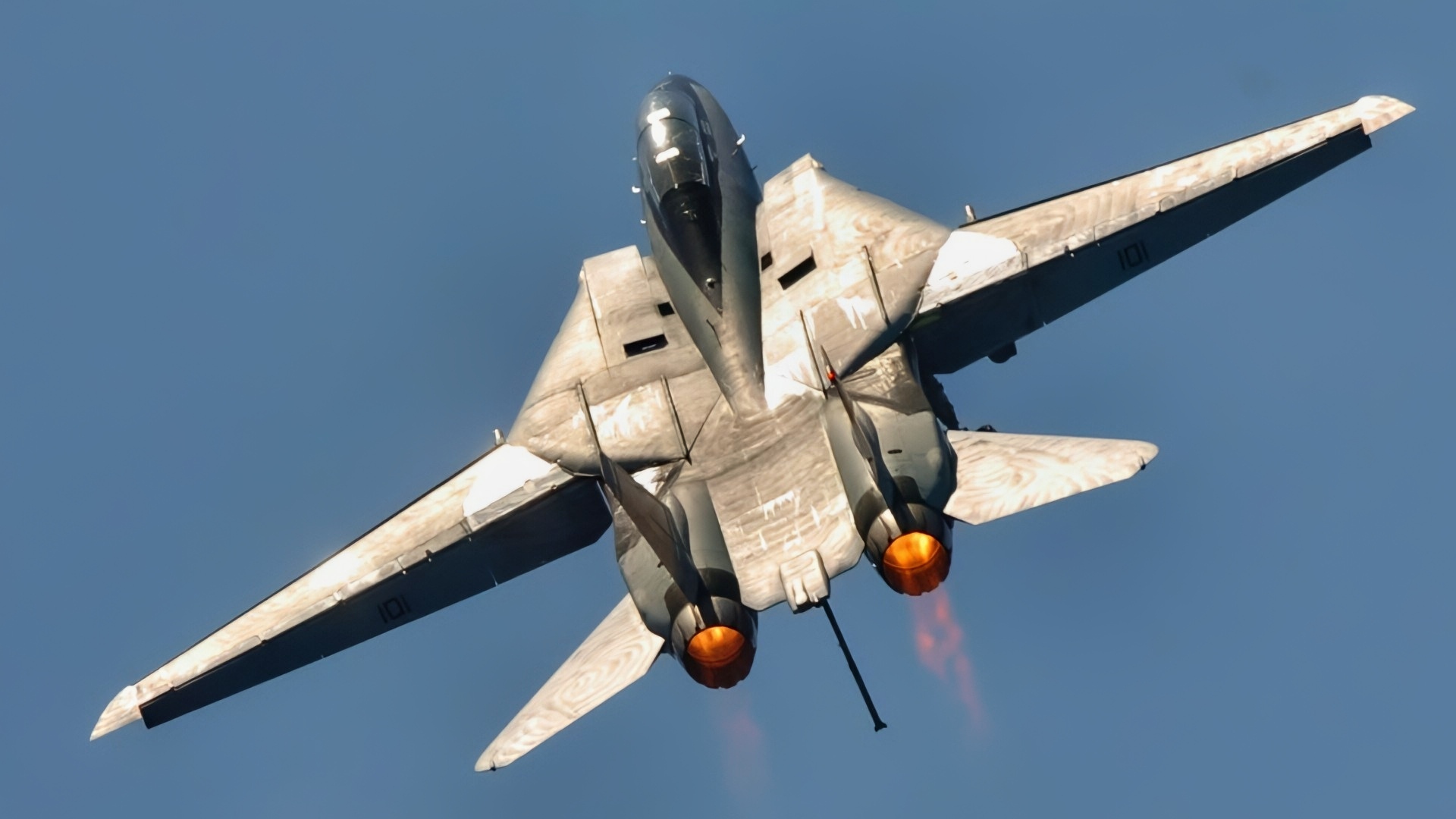
(June 19, 2006) – An F-14D Tomcat from Fighter Squadron Three One (VF-31), the “Tomcatters,” performs a fly by past the Nimitz-class aircraft carrier USS Dwight D. Eisenhower (CVN 69). For the past 30 years, the F-14 Tomcat has assured U.S. air superiority, playing a key role in ensuring victory and preserving peace around the world. The F-14 Tomcat will be removed from service and officially stricken from the inventory in September of 2006. U.S. Navy photo by Photographer’s Mate 2nd Class Miguel A. Contreras PH2 CONTRERAS MIGUEL

F-14D Tomcat Photo Onboard USS Intrepid. National Security Journal Photo.

F-14D Tomcat in NYC on USS Intrepid. Image Credit: National Security Journal Taken on 9/19/2025.
The key twist in this story is that at least one of those F-14Ds could be restored to flying condition for demonstrations and heritage flights. As a reminder, the F-14 Tomcat was made famous by a young Tom Cruise in the original Top Gun film.
F-14D Tomcat Reborn: The Maverick Act of 2026
Pushed forward by Democratic Party Representative Abraham Hamadeh and Senator Tim Sheehy, the “Maverick Act of 2026” passed the Senate unanimously earlier this month. This bill is important because the US government has spent nearly 20 years ensuring the F-14s never flew again after retirement.
After the Tomcat retired in 2006, the Pentagon aggressively destroyed spare parts for the iconic birds because Iran still operated the F-14 Tomcat (purchased before the Islamic Republic arose and replaced the US-aligned Shah of Iran in 1979).
The concern was that if surplus parts leaked onto the global market, Iran could keep its fleet operational indefinitely. Thus, most surviving F-14s were demilitarized, spare parts were shredded or cut apart, many museum aircraft were rendered unflyable, and the F-14 effectively disappeared from US skies.
Why the Pentagon Wanted the Tomcat Gone
The Maverick Act represents the first serious federal effort to reverse 20 years of deliberate Tomcat extinction policy. What’s more, it highlights the fact that the F-14s might not have been as obsolete as the Pentagon brass wanted the American people and their elected representatives to believe.
After all, why would the US military care if an old plane in Iran still flew?
Certainly, the US warplane fleet was far more advanced and completely unthreatened by the aging F-14s of the Iranian Air Force.
Originally designed by Grumman for the US Navy after the collapse of the F-111B program, the Tomcat combined massive radar technology, long-range missile capability, carrier compatibility, high speed, variable-sweep wings, and serious dogfighting performance (do you have the need for speed?)
The F-14 became legendary during the latter half of the Cold War, the Gulf of Sidra clashes with Libya, various air operations over Iraq, and the aforementioned Top Gun appearances.

F-14 Tomcat from Outside DC NSJ Image.
The F-14D Was the Ultimate Tomcat
The F-14D was the final and most advanced Tomcat variant. It was essentially a rebuilt and modernized aircraft compared to earlier F-14 versions. Tomcats were manned by a crew of two; they had an unswept wingspan of 64 feet and a fully swept wingspan of 38 feet, two inches. Tomcats had a maximum takeoff weight of around 74,000 pounds. Two powerful GE F110-GE-400 turbofan jet engines powered this bird.
These planes had a total thrust of around 54,000 pounds with afterburners, which provided a maximum speed of Mach 2.34 (about 1,500 miles per hour), a 500-nautical-mile radius, and a ferry range of 1,850-2,000 miles. The F-14D’s rate of climb was considered extremely high for an aircraft carrier-based plane, too.
As for the weapons onboard, the F-14D could pack quite a wallop and was designed for excellent carrier defense. These birds carried AIM-54 Phoenix long-range missiles, AIM-7 Sparrow missiles, AIM-9 Sidewinders, precision-guided bombs, LANTIRN targeting pods, and one 20mm M61 Vulcan cannon. It was that Phoenix missile system, though, that was the Tomcat’s defining feature. The AWG-9/APG-71 radar could track up to 24 targets at once and engage multiple aircraft at very long ranges.
The Tomcat is Becoming American Heritage
Still, getting the Tomcat airborne again will not be easy. These few planes will have to endure shortages of surviving spare parts; the airframes are aging; maintaining the engines will prove more complex than most realize; the onboard avionics are obsolete; and there’s also a serious lack of trained maintainers.
Then, of course, the F-14Ds must undergo ejection-seat certification and additional flight-safety protocols.
Oh, and there’s the ever-present concern of insurance and liability issues arising from potentially flying an aging aircraft that has such a limited supply chain and has been sitting in mothballs for 20 years.
But the Maverick Act signals something more: that the United States is treating Cold War military gear as living heritage rather than disposable surplus. The F-14 Tomcat represented a specific era of US airpower, unlike anything that came before or even since the Tomcat’s glory days.
Not only will future generations get to see these iconic planes in their element in the Top Gun films, but, thanks to the Maverick Act, they will also be able to witness them flying and operating as if they were still frontline fighters.
Nobody has seen that since 2006, when the final Tomcat flight occurred.
About the Author: Brandon J. Weichert
Brandon J. Weichert is the Senior National Security Editor at 19FortyFive.com. Recently, Weichert became the editor of the “NatSec Guy” section at Emerald. TV. He was previously the senior national security editor at The National Interest. Weichert hosts The National Security Hour on iHeartRadio, where he discusses national security policy every Wednesday at 8 p.m. Eastern. He hosts a companion show on Rumble entitled “National Security Talk.” Weichert consults regularly with various government institutions and private organizations on geopolitical issues. His writings have appeared in numerous publications, among them Popular Mechanics, National Review, MSN, and The American Spectator. And his books include Winning Space: How America Remains a Superpower, Biohacked: China’s Race to Control Life, and The Shadow War: Iran’s Quest for Supremacy. Weichert’s newest book, A Disaster of Our Own Making: How the West Lost Ukraine, is available for purchase at any bookstore. Follow him via Twitter/X @WeTheBrandon.


