


Ever since they replaced battleships as naval capital ships during World War II, aircraft carriers have kept that place as the ultimate power projectors of the U.S. Navy.
This is especially true of nuclear-powered supercarriers (CVNs) such as the venerable Nimitz-class warships and their anointed successors, the bigger and mightier Gerald R. Ford-class CVNs. These vessels are marvels, both for their sheer size and technological capabilities.
The Ford-class is the largest warship ever constructed.
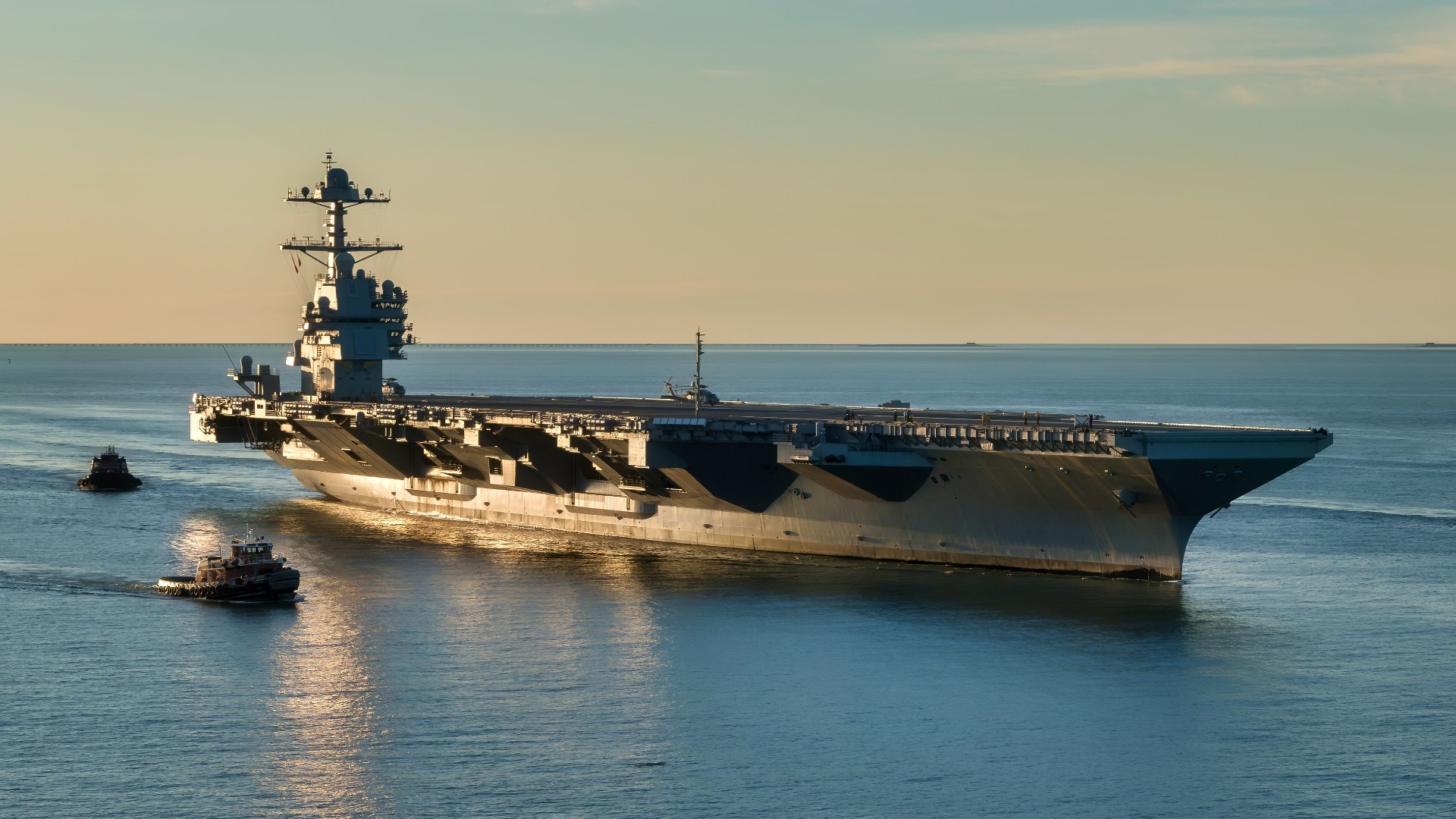
(April 14, 2017) The aircraft carrier Pre-Commissioning Unit (PCU) USS Gerald R. Ford (CVN 78) pulls into Naval Station Norfolk for the first time. The first-of-class ship – the first new U.S. aircraft carrier design in 40 years – spent several days conducting builder’s sea trails, a comprehensive test of many of the ship’s key systems and technologies. (U.S. Navy photo by Matt Hildreth courtesy of Huntington Ingalls Industries/Released)
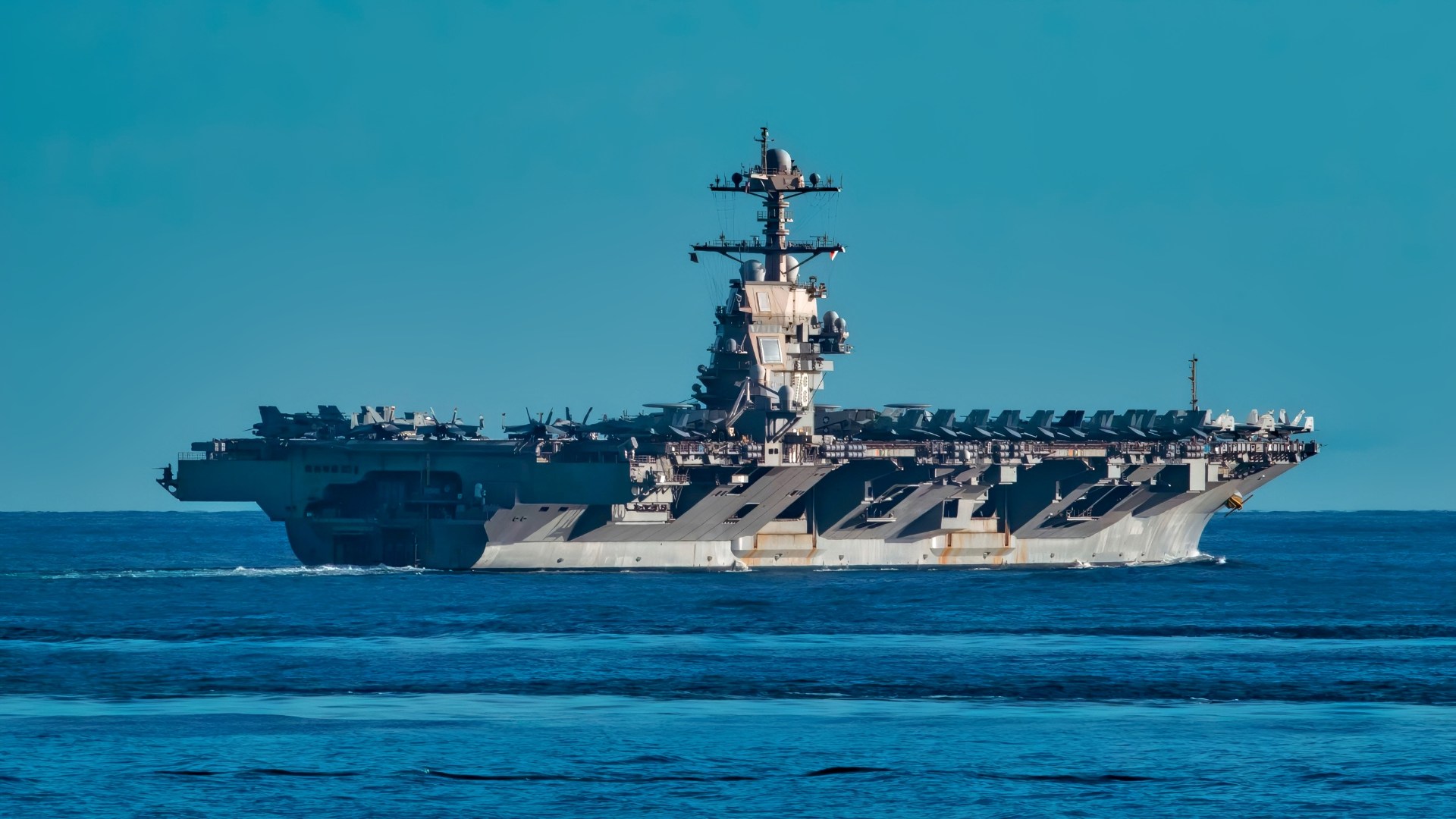
The Arleigh Burke-class guided-missile destroyer USS Winston S. Churchill (DDG 81) sails alongside the world’s largest aircraft carrier the USS Gerald R. Ford (CVN 78), Sep. 24, 2025. Winston S. Churchill, as part of Carrier Strike Group 12, is on a scheduled deployment in the U.S. 6th Fleet area of operation to support the warfighting effectiveness, lethality and readiness of U.S. Naval Forces, Europe-Africa, and defend U.S. Allied and partner interest in the region. (U.S. Navy photo by Mass Communication Specialist Seaman Hector Rodriguez)
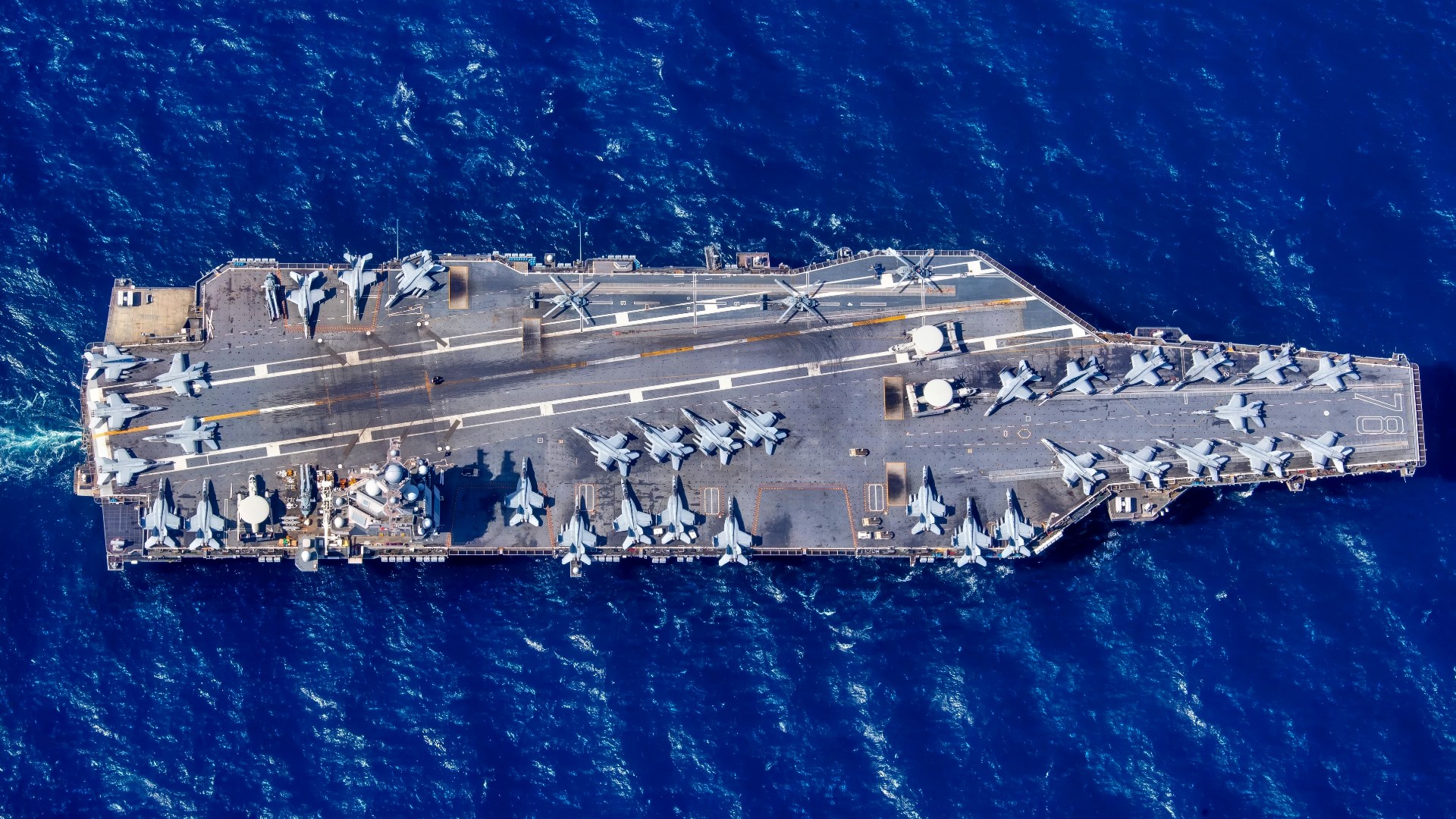
The first-in-class aircraft carrier USS Gerald R. Ford (CVN 78) transits the Atlantic Ocean, March 19, 2023. Ford is underway in the Atlantic Ocean executing its Composite Training Unit Exercise (COMPTUEX), an intense, multi-week exercise designed to fully integrate a carrier strike group as a cohesive, multi-mission fighting force and to test their ability to carry out sustained combat operations from the sea. As the first-in-class ship of Ford-class aircraft carriers, CVN 78 represents a generational leap in the U.S. Navy’s capacity to project power on a global scale. (U.S. Navy photo by Mass Communication Specialist 2nd Class Jackson Adkins)
Nuclear-powered carriers have their downsides: Foremost is their vulnerability to ship-killing missiles. Another is their exorbitant expense—both when building new carriers and later, given their constant maintenance needs. Often carriers are relegated to “hangar queen” or “dock dweller” status.
What keeps a CVN in the dock longest is the extremely time-consuming process of refueling.
But why does it take so long to refuel a supercarrier?
Bottom Line Up Front (BLUF): The RCOH Rigamarole
Yes, we’ve discussed the “RCOH rigamarole” before, but it bears repeating. RCOH stands for Refueling Complex Overhaul, and the process involves cutting a massive hole into the hull and replacing everything from catapult systems to water purifiers.
Daksh Chaudhary elaborates further for SlashGear:
“Nuclear aircraft carriers, such as those in the Nimitz class, are powered by two massive reactors, which are strong enough to run everything onboard—from lights and engines to radar systems—for more than 20 years without needing new fuel. This is about how long an aircraft carrier can stay at sea without refueling. But when that time comes, the process is complex and risky. First, the reactors must be cooled down and shut off, which takes days. Then, workers carefully remove the hundreds of radioactive fuel rods, following strict safety procedures. This all happens in dry docks, where the entire ship is drained of water and lifted above for inspection.”
Nimitz-class and Ford-class vessels have a fully laden displacement of more than 100,000 tons, which requires some pretty serious heavy lifting.
Moreover, continues Chaudhary, “RCOH isn’t just about fuel. In fact, it’s the Navy’s once-in-a-lifetime chance to modernize everything: combat systems, electronics, radar arrays, software, fire controls, and even the ship’s wiring. It’s the only time in 25 years that they can get to some of the ship’s deepest systems, which is why they don’t take any shortcuts.”
There is only one shipyard in the United States that handles this job—Newport News Shipbuilding in Virginia.
That lack of infrastructure is a sobering reminder of just how much U.S. shipbuilding capability has declined in the post-Cold War era, something that President Donald Trump is attempting to rectify via his April 2025 executive order, “Restoring America’s Maritime Dominance.”
The good news is that RCOH happens only once in each carrier’s half-century service life.
But that’s slim comfort to the crew of a carrier caught in the midst of the procedure, and even slimmer comfort to the nation as China’s People’s Liberation Army Navy (PLAN) grows in numbers and capabilities.
RCOH Slowdown Examples
-The USS Harry S Truman (CVN-75): On 12 February 2025, the Truman collided with the Panamanian-flagged bulk carrier M/VBesiktas-M whilst transiting near Port Said, Egypt.
Fast-forward eight months, and “HST” was finally scheduled for the completion of her repair work as part of her RCOH procedure at Newport News. The process is expected to be completed in the next eight months.
-The USS George Washington (CVN-73): HST’s sister ship was out of action for a whopping 2,100 days while awaiting ROCH.
-The USS John C. Stennis (CVN-74): Fans of the late great Tom Clancy will remember the heroic role that “Johnny Reb” played in the bestselling novels Debt of Honor and Executive Orders. Well, with all due respect and love to Mr. Clancy, he apparently never heard of RCOH. In the real world, the Stennis has been out of action since 2021, and her projected return to service has just been pushed back with a date looking more and more like 2027.
They Don’t Make ‘Em Like They Used To
Contrast the RCOH process with the speed at which carriers before the nuclear age could be fully repaired from serious battle damage. A prime example is one of the most famous flattops of World War II, the USS Yorktown (CV-5).
During the Battle of the Coral Sea (May 4–8, 1942), the Yorktown was struck in the center of her flight deck by a single 250-kg. semi-armor-piercing bomb dropped by an Imperial Japanese Navy Aichi D3A “Val” dive bomber.
The enemy bomb penetrated four decks before exploding, causing severe structural damage to an aviation storage room and killing or seriously wounding 66 seamen. The blast also damaged the superheater boilers and rendered them inoperable.
Compounding the damage, the shockwaves of the explosions of a dozen near misses damaged the hardy vessel’s hull below the waterline.
In a testament to the ship’s and her crew’s ruggedness, the Yorktown limped back home to Hawaii.
Initially, it was estimated it would take two weeks to repair her, yet amazingly, she was put back out to sea a mere 72 hours after entering drydock at Pearl Harbor.
This enabled her to contribute to the next major battle with Japan’s navy, the smashing victory at the Battle of Midway. Sadly, CV-5 was sunk during this engagement, but her sacrifice certainly was not in vain.
About the Author: Christian D. Orr, Defense Expert
Christian D. Orr is a Senior Defense Editor. He is a former Air Force Security Forces officer, Federal law enforcement officer, and private military contractor (with assignments worked in Iraq, the United Arab Emirates, Kosovo, Japan, Germany, and the Pentagon). Chris holds a B.A. in International Relations from the University of Southern California (USC) and an M.A. in Intelligence Studies (concentration in Terrorism Studies) from American Military University (AMU). He is also the author of the newly published book “Five Decades of a Fabulous Firearm: Celebrating the 50th Anniversary of the Beretta 92 Pistol Series.”


