

After listing several major developments from the war with Russia, Ukrainian President Volodymyr Zelensky last week delivered an extensive debrief of his nation’s intelligence findings. These reports are based on Russian operations uncovered by his Defense Intelligence Service (HUR) and the Ukraine Security Service (SBU) units operating in the field.
His list of findings, delivered on 25 July, was headlined by his report that Russian President Vladimir Putin has asked the Democratic People’s Republic of Korea (DPRK) for 30,000 North Korean People’s Army (KPA) soldiers. These troops are to be sent to fight alongside Russian units against Ukraine’s armed forces.

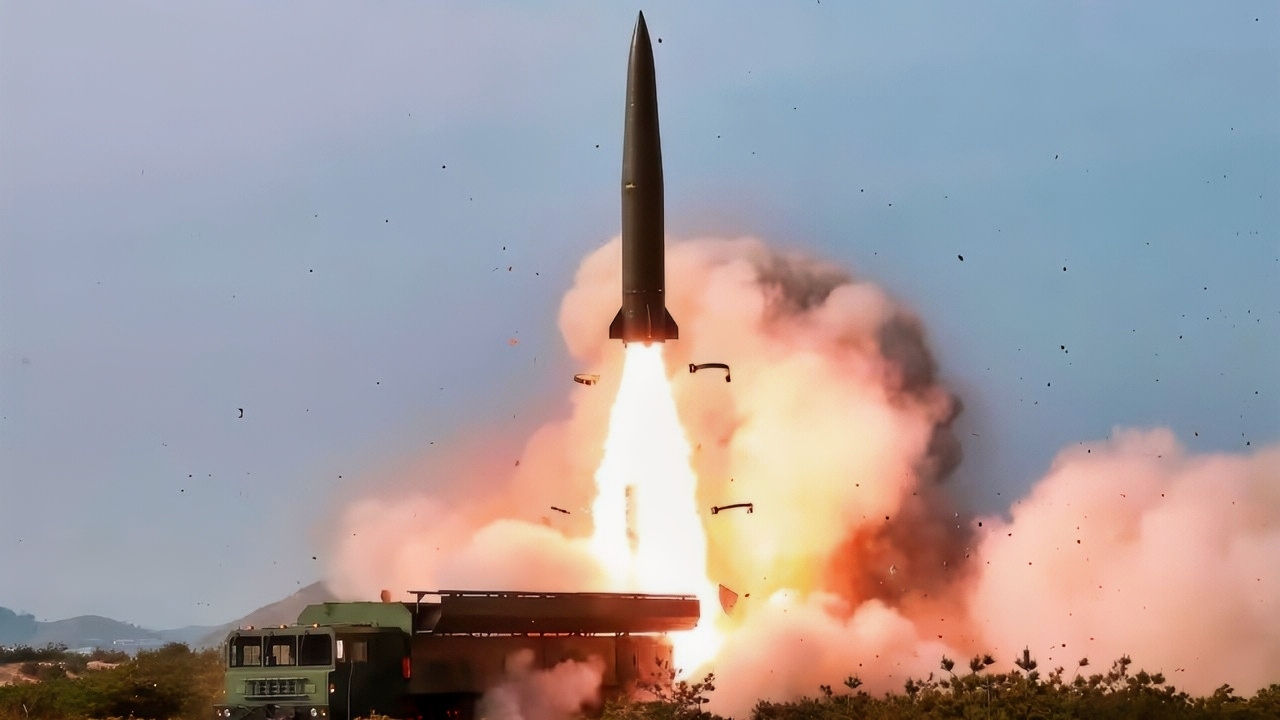
Iskander-M. Image Credit: Creative Commons.
Zelensky also accused Russia of providing Iran with extensive satellite imagery of US bases in the Middle East – thereby assisting their targeting of those US facilities.
What has been less reported are other technical details about the cooperation taking place in the field between Russian military and North Korean KPA units. While the specter of this number of North Korean soldiers entering into the conflict carries significant implications, there are some technical details involving weapons design and modifications that will have an impact in other regions of the world far beyond the battlefields of Ukraine.
A Ballistic Missile Lab
One of the most dangerous and longest-lasting consequences for multiple nations is the degree to which Russia has been using the Ukraine war as a live-fire test and development program for DPRK ballistic missile designs.
Russian engineers and designers have made major design changes to these missiles, specifically the KN-24 and KN-23 ballistic missiles.
Once those modifications were tested out and proven in combat, they were then shipped back to Pyongyang. These upgraded designs will be used as prototypes for newly improved models that will roll off DPRK production lines and be shipped to customers like Iran, the Houthi rebels, and Yemen.

North Korean ICBM. Image Credit: KCNA/North Korean State Media.
The missiles are not only performing far more effectively, but the upgraded designs are adding to the range of missions they can perform. It is this fact that prompted Zelensky’s warning about the danger these new DPRK models and their ability to present a significantly expanded target set pose.
“All of this poses a threat to every country in Asia that lies within range of North Korean missiles,” he said. This is the outcome of all the lessons learned that the Russians are turning into design improvements, which is what has those familiar with these designs calling the cooperation between Moscow and Pyongyang in the field “a ballistic missile lab.”
The most talked-about and concerning “successful experiment” from this missile lab is what the Russian and DPRK militaries were able to achieve with the North Korean KN-23 short-range ballistic missile.
This weapon initially entered the Ukraine war in December 2023 with a dismal Circular Error Probable (CEP) margin of error. CEP is defined as the radius of a circle that half of a large number of identical missiles operating without malfunction would land within.
The original variants made a less than spectacular impression. The missile’s original error margin had the weapon landing 0.6 to 1.9 miles off target. Ukrainian troops treated it as something of a joke.
Just How Much Improved
But then some Russian missile engineers got involved. By June 2026, Ukrainian military sources reported that CEP had shrunk to a minuscule 3.3 to 16.4 feet. This is such a high level of precision that it would make this version of the KN-23 one of the most accurate short-range ballistic missiles (SRBM) in the world.
In mathematical terms, that comes to between a 300- to 3,000-times improvement in performance – and accomplished in a period of only 18 months. Moreover, this dramatic enhancement was not achieved by a domestic North Korean test program but instead through analysis of live combat launches against real Ukrainian targets by Russian specialists.
Russian missile engineers then analyzed the telemetry and methods for improving the missile’s guidance system. Those enhancements were then provided to the DPRK manufacturer, who then began inserting them into the production line.
One of the long analysis articles on the subject published this week detailed the exact sequence of events. “The Foundation for Defense of Democracies confirmed in May 2026” that Russia’s improved accuracy for the KN-23 was inserted into “at least one recently improved missile type.”
That missile has already been transferred back to the DPRK along with the necessary technical documentation required to dial these modifications into this and other DPRK missile programs.
“That detail,” reads the analysis, “makes the Ukraine war something it has rarely been called: the most productive ballistic missile development program in the world — run by Russia, for Pyongyang’s benefit, at the cost of Ukrainian civilian and military lives.”
This missile is now a new threat to any of the nations in the region near the DPRK, near Russia, near Iran, or any other nation that has been a customer for Pyongyang’s missile. It is a development many of those watching the Ukraine war develop for years now warned for years was in the offing. Now it is too late.
About the Author: Reuben F. Johnson
Reuben F. Johnson has thirty-six years of experience analyzing and reporting on foreign weapons systems, defense technologies, and international arms export policy. Johnson is the Director of Research at the Casimir Pulaski Foundation. He is also a survivor of the Russian invasion of Ukraine in February 2022. He worked for years in the American defense industry as a foreign technology analyst and later as a consultant for the U.S. Department of Defense, the Departments of the Navy and Air Force, and the governments of the United Kingdom and Australia. In 2022-2023, he won two awards in a row for his defense reporting. He holds a bachelor’s degree from DePauw University and a master’s degree from Miami University in Ohio, specializing in Soviet and Russian studies. He lives in Warsaw.


Joey
July 28, 2026 at 5:53 pm
Like the world needs more bad news!
Swamplaw Yankee
July 30, 2026 at 10:08 pm
Really? Xi’s PRC Han Engineers send their functional CEP calculations to North Korea who assembles all the Hardware. Fully Functioning missiles are then shipped on credit to the PRC vassal Putin. In hidden corners of military launch facilities, academic Muscovy ethnics determine how to refine the CEP so the missile is right cross hair on Ukrainian targets.
This data goes back to PRC Han Intelligence who mail the improved missiles from North Korea to where ever their super AI tells them to select as their next kinetic theatre in the jagged Unique World War Xi.
Oh, there might be some Yankee service staff in the Muslin GULF State geopolitical region who will feel the Ukrainian test result improvements. Can that be?