


Ukraine Has Taken Roughly a Third of Russia’s Black Sea Fleet Out of the Fight: Ukraine’s campaign against Russian maritime power widened again in July 2026 as long-range drone units struck vessels and port infrastructure across the Black Sea and Sea of Azov. Reuters observed one Ukrainian unit launching FP-1 and FP-2 drones and reported that Kyiv’s forces claimed more than 180 maritime targets in three weeks. Those recent totals remain unverified, but the accumulated damage to Russia’s Black Sea Fleet is well established.
A British defense statement said by October 2024 that 26 Russian Black Sea vessels had been destroyed or damaged. A U.S. naval official later estimated that Russia had lost about 40 percent of the fleet. The percentages vary because analysts count patrol craft, landing ships, submarines and support vessels differently.
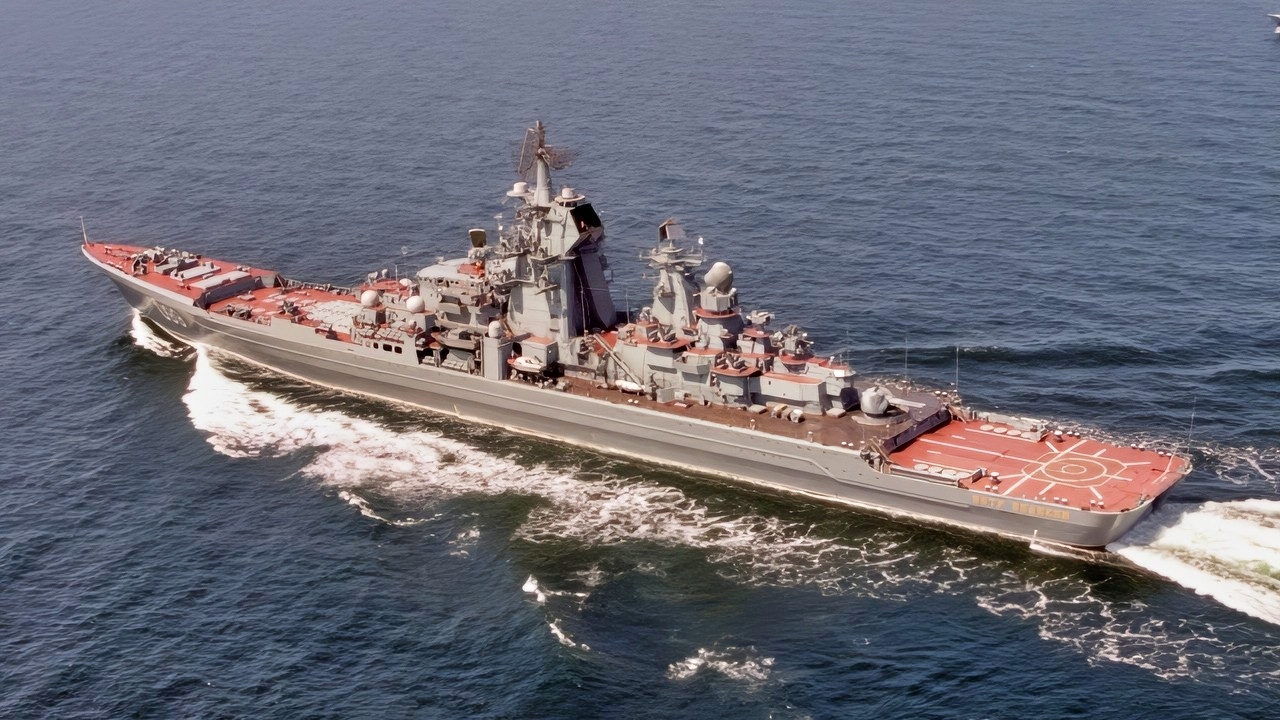
Russian Navy Kirov-Class. Image Credit: Creative Commons.
The losses began with major symbols and capabilities. The missile cruiser Moskva, the fleet flagship, sank in April 2022 after Ukraine said Neptune anti-ship missiles struck it. Russia attributed the loss to a fire and ammunition explosion, while U.S. officials later supported the missile-strike account. Ukraine also sank the landing ship Saratov at Berdyansk and damaged other amphibious vessels early in the invasion.
Ukraine then attacked ships inside Russian-controlled ports. A September 2023 missile strike on Sevastopol caused heavy visible damage to the landing ship Minsk and submarine Rostov-on-Don. Later operations hit patrol vessels, repair yards and the Black Sea Fleet headquarters. Russia eventually acknowledged that Ukrainian attacks had forced many combat ships to relocate from Sevastopol to Novorossiysk.
Ukraine Forced Russia to Abandon Its Original Black Sea Plan
Russia began the full-scale invasion with a blockade of Ukrainian ports and the ability to threaten an amphibious operation near Odesa. Ukrainian coastal missiles, aerial drones and unmanned surface vessels gradually pushed Russian ships away from the western Black Sea. The campaign became a demonstration of sea denial by a country with almost no conventional fleet.
The relocation carried operational costs. Ships based at Novorossiysk operate farther from western Crimea, while Sevastopol lost much of its value as a secure headquarters, repair center and staging base. Russian official Dmitry Rogozin said the fleet had changed its residence because large ships had become easy targets for unmanned vessels. The result is a smaller force operating from less convenient bases.
Ukraine’s pressure also helped restore a maritime export corridor from Odesa after Russia withdrew from the UN-backed grain agreement. Moscow has since intensified missile attacks on Ukrainian ports and merchant vessels. Russia can still disrupt maritime trade from the air. Its surface fleet no longer patrols the western Black Sea with the freedom it possessed in February 2022, leaving Crimea harder to supply and protect.

Kirov-Class from the Russian Navy. Image Credit: Creative Commons.

Kirov-Class Russian Navy. Image Credit: Creative Commons.
The Russian Navy Still Retains Dangerous Capabilities
The Black Sea Fleet has not ceased to function. Surviving submarines and surface ships can launch Kalibr cruise missiles from safer waters. Naval aviation and coastal missile batteries continue attacking Ukrainian infrastructure and shipping. Russia’s Northern and Pacific fleets retain nuclear submarines, ballistic-missile submarines and major surface combatants that Ukraine has not destroyed.
Moscow also faces a difficult replacement problem. Several lost vessels were Soviet-era designs, and specialized submarines require long construction and repair cycles. The damage has added to a wider Russian naval modernization burden. Repeated attacks on Kilo-class submarines show why every additional undersea loss carries unusual weight.
Novorossiysk Is No Longer a Completely Safe Refuge
Ukraine has followed the fleet east. The landing ship Olenegorsky Gornyak was badly damaged near Novorossiysk in 2023, and later operations targeted oil terminals, submarines, tankers and port facilities. On July 22, 2026, Russia imposed temporary nighttime restrictions on vessel movements at Novorossiysk because of Ukrainian drone attacks.
The latest campaign has spread into the Sea of Azov, where Russia had concentrated commercial and military logistics after fortifying the Black Sea approaches. Ukraine is now exploiting the weaker protection around that shipping network. The attacks target cargo vessels and oil tankers as well as naval assets, widening the burden on Russian defenses.
Russia Lost More Than Warships
Russia has lost its flagship, landing capacity, at least one submarine, patrol vessels, support ships and secure use of Sevastopol. It has also lost freedom of movement. Warships now require additional protection while moored, ports need barriers and air defenses, and logistics routes have to account for unmanned attacks from the air, surface and below the water.
The fleet can continue launching missiles and supporting Russian operations. It cannot return easily to the posture it held at the start of the invasion. Turkey’s wartime control of the straits has limited Moscow’s ability to move replacement warships into the Black Sea, while damaged Soviet-era vessels and specialized submarines are difficult to replace quickly.
Ukraine has inflicted a documented operational defeat on the Black Sea Fleet by removing roughly a third of its strength, driving valuable ships away from Crimea and denying Moscow uncontested use of the western Black Sea. Four years after Russia began the war with maritime dominance, even Novorossiysk restricts nighttime movements because Ukrainian drones may arrive.
About the Author: Harry J. Kazianis
Harry J. Kazianis (@Grecianformula) was the former Senior Director of National Security Affairs at the Center for the National Interest (CFTNI), a foreign policy think tank founded by Richard Nixon based in Washington, DC. Harry has over a decade of experience in think tanks and national security publishing. His ideas have been published in the NY Times, The Washington Post, The Wall Street Journal, CNN, and many other outlets worldwide. He has held positions at CSIS, the Heritage Foundation, the University of Nottingham, and several other institutions related to national security research and studies. He is the former Executive Editor of the National Interest and the Diplomat. He holds a Master’s degree focusing on international affairs from Harvard University.


