

Ukraine President Volodymyr Zelenskiy confirmed on 15 August that his armed forces had successfully struck Russia’s Savasleyka military airbase and a key Roscosmos production facility in Samara Oblast. The attack was carried out with Ukraine’s own domestically produced FP-5 Flamingo missiles.
The Flamingo cruise missile is produced in Ukraine and was developed by the defense manufacturer Fire Point. It carries a 1,150 kg warhead and has a range of up to 3,000 kilometers. The specific targets that were hit were the Progress Rocket & Space Centre in Samara, the Savasleyka aerodrome, and the Ust-Luga oil terminal.

T-90 Tank from Ukraine War. Image Credit: Creative Commons.
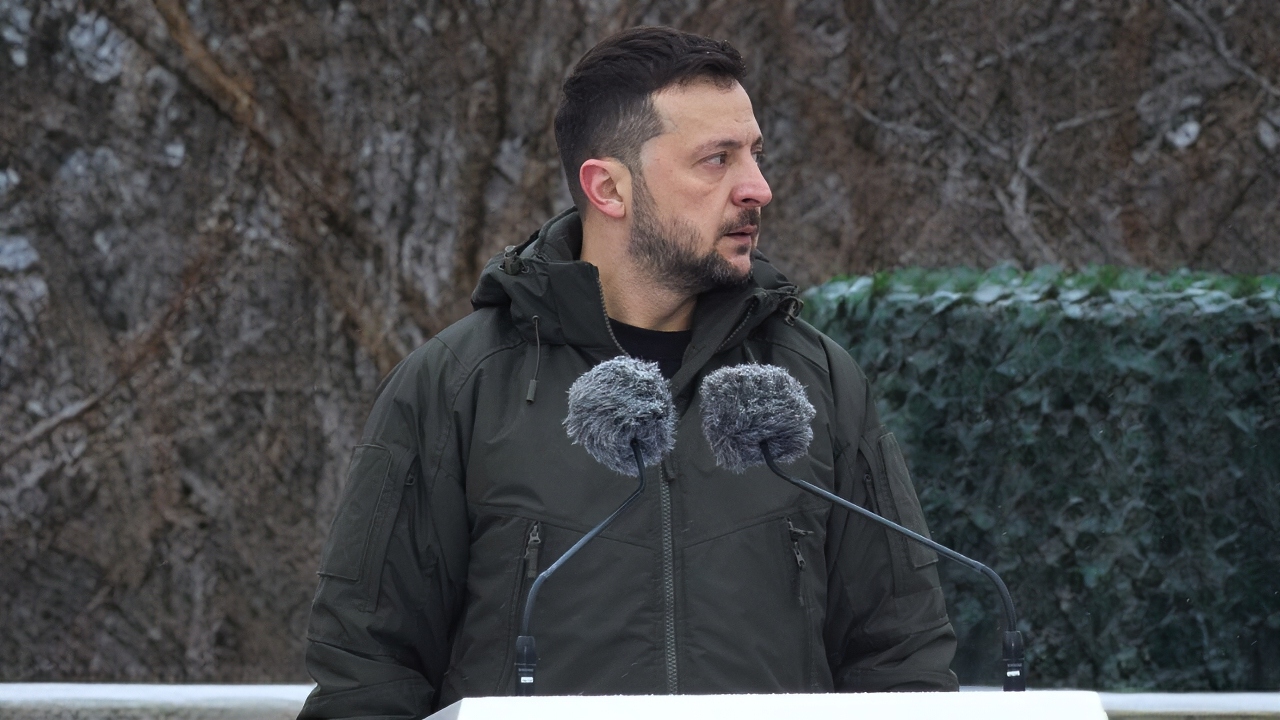
Image Credit: Office the the President, Ukraine.
“The Savasleyka airfield, where the carriers of Russian missiles that strike our cities and villages are based, was also reached by our long-range sanctions,” said Zelenskiy on one of his internet channels. “It is about 700 kilometers from Ukraine,” he added.
Several of the specially modified Mikoyan MiG-31K fighter jets that can carry and fire Russia’s air-launched Kinzhal ballistic missiles had previously been stationed at this airfield. An open-source monitoring channel had reported on 15 August that Russia moved four MiG-31K aircraft from Savasleyka after the attack began. These aircraft reportedly flew to the supposed safe haven of Begishevo Airport in Tatarstan.
The aerodrome is in the Nizhny Novgorod region, home to the Sokol aircraft production plant that originally manufactured the MiG-31 during the Cold War. The aircraft used to launch the Kinzhal is the MiG-31K, which is a modified version of the original two-seat interceptor. At least one of the aircraft that were at the Savasleyka facility was said to have been damaged in the attack.
Taking Out Russian Ballistic Missiles Before They Can Be Launched
The MiG-31 itself has been out of production for many years, and the line cannot be re-engaged at this point. MiG-31KBeodels are standard MiG-31 jets that have undergone an extensive refit of their on-board avionics and fire control systems, enabling them to launch the Kinzhal, an air-launched ballistic missile.
“Russia is incapable of manufacturing new MiG-31K aircraft for Kinzhal deployment,” read a profile on the aircraft in the Ukrainian publication Defense Express, “so any loss in this category is especially painful.” Russia had only 12 MiG-31Ks in inventory in 2022 when the invasion of Ukraine was launched, but there are now supposedly as many as 24 that have undergone the conversion process. This is according to the 2024 edition of the Military Balance yearbook.
Explosions were additionally reported in the Russian city of Samara, where Ukraine’s missiles hit the Progress Rocket Space Center, which is one of the key enterprises that belong to the Russian state space industry corporation Roscosmos. It is one of the main production sites for components used in the same Russian ballistic missiles that are hitting Ukrainian cities on almost a daily basis.
“The Progress center, which was involved, among other things, in producing [missile system] electronics, was hit. Flamingo missiles were used — a good achievement. Our plan of long-range sanctions against Russia for this war is being implemented, and it is important that Russia’s war potential be reduced,” Zelensky also said.
The Samara Oblast Governor Vyacheslav Fedorishchev had said earlier that Ukrainian missiles had struck an “industrial facility” in the region but without identifying which specific site he was referring to. He also stated that local authorities were in the process of ascertaining whether there were casualties or additional damage to the industrial site.
Ukraine Loses Civilian Lives, Degrades Russian Logistical Capacity
Zelensky said the Progress center itself is about 900 kilometers (560 miles) from Ukraine’s border, while the Savasleyka airbase is about 700 kilometers (435 miles) from Ukraine. Ukrainian media sources cannot confirm the extent of damage to these sites, partly due to their distance from the Ukrainian border.
Russia’s ballistic missile strikes have been killing Ukrainian civilians in major cities in repeated attacks launched from its airbases and military sites. On 11 August, Russian forces attacked Zaporizhzhia and Kyiv using North Korean ballistic missiles and Zircon cruise missiles, authorities reported.
A Russian ballistic missile attack on 8 August killed four people, including a three-year-old child, in Ukraine’s capital and outside the city in the Kyiv Oblast. A previous ballistic missile attack on 5 August killed 17 people.
Ukraine has been hitting Russia’s military infrastructure far beyond its borders, deep inside Russia, to degrade logistical support for Moscow’s armed forces. On the night of 14 August, Ukrainian forces hit the Ust-Luga port in Russia’s Leningrad Oblast, the region that encompasses Russia’s second city, St. Petersburg. The attacks damaged two processing plants and started an oil fire – a by-now common occurrence at Russian oil industry facilities.
This site is one of Russia’s largest ports on the Baltic Sea and hosts an oil terminal that serves as a major hub for the export of Russian crude and refined petroleum products. Gazprom’s Neftekhim Salavat oil refinery complex in Russia’s Republic of Bashkortostan was hit by Ukraine the night before on 13 August, said the Ukrainian General Staff.
About the Author: Reuben F. Johnson
Reuben F. Johnson has thirty-six years of experience analyzing and reporting on foreign weapons systems, defense technologies, and international arms export policy. Johnson is the Director of Research at the Casimir Pulaski Foundation. He is also a survivor of the Russian invasion of Ukraine in February 2022. He worked for years in the American defense industry as a foreign technology analyst and later as a consultant for the U.S. Department of Defense, the Departments of the Navy and Air Force, and the governments of the United Kingdom and Australia. In 2022-2023, he won two awards in a row for his defense reporting. He holds a bachelor’s degree from DePauw University and a master’s degree from Miami University in Ohio, specializing in Soviet and Russian studies. He lives in Warsaw.


