

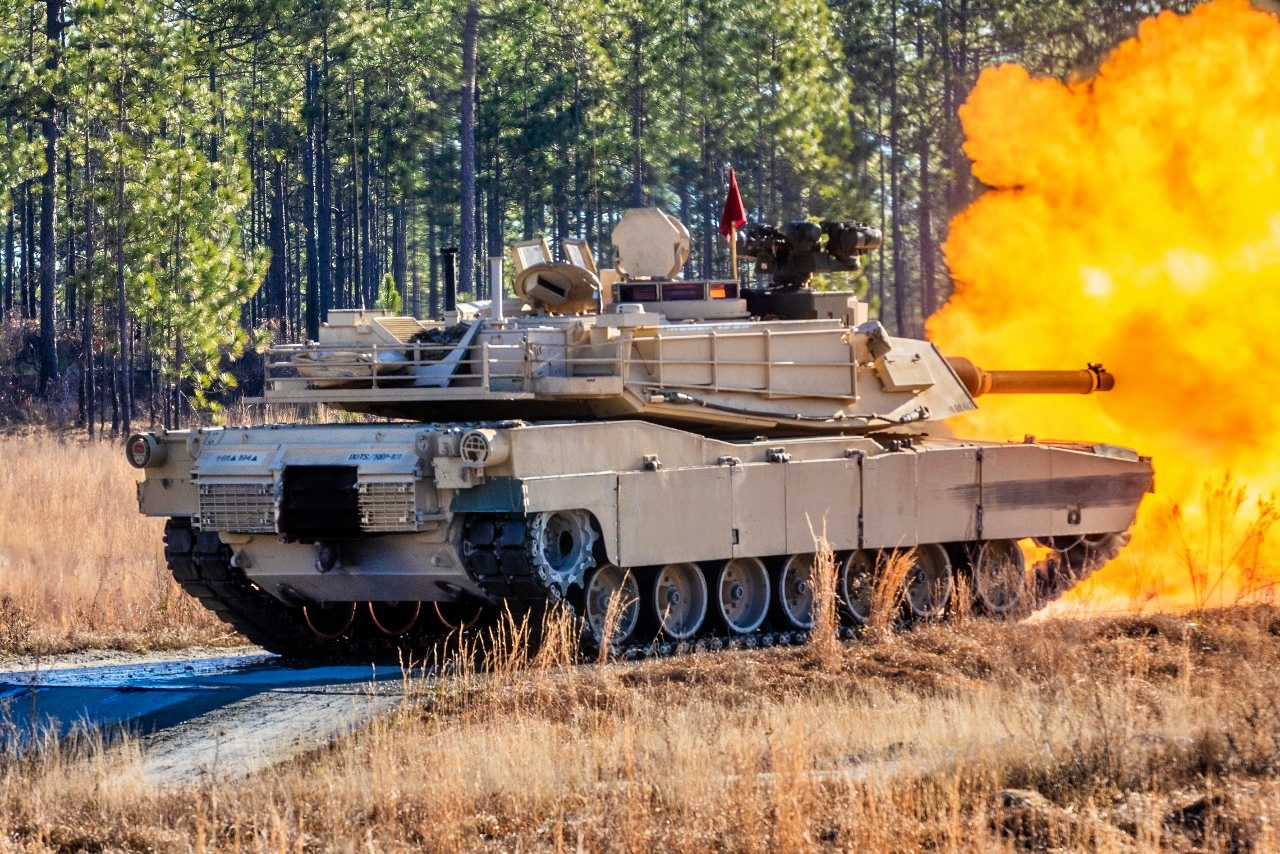
Key Points and Summary – While the U.S. Army has fielded many exceptional tanks, several have been plagued by significant flaws.
-The M3 Lee/Grant, a WWII stopgap, was a top contender for the worst due to its high profile and awkwardly placed main gun.
-The M3 Stuart light tank was obsolete upon arrival, though useful for reconnaissance.
-The recently canceled M10 Booker was a “Frankenstein” vehicle that became too heavy for its intended air-droppable role.
-The Vietnam-era M551 Sheridan, while air-droppable, was a deathtrap with thin armor and combustible ammunition.
-Lastly, the Disston Tractor Tank was so bad the Army refused to buy it.
The 5 Worst Tanks In U.S. Military History
The United States’ tank doctrine and strategy have undergone significant changes since World War I and World War II. It has evolved with the development of our armored forces.
The US was late to the tank design competition in the early 20th century. The military believed tanks were only infantry support vehicles, not spearhead forces like the ones envisioned by cavalry officers such as George S. Patton and Adna Chaffee.
The US Army has fielded numerous exceptional tanks over the past century. And a few that weren’t so great. So, in this instance, we’re not looking for the best of the best; we’re looking for the five worst tanks in US history.
For that, we have to go back to the beginning of World War II, a war for which the US was unprepared. The military began rebuilding around 1940 but was lagging in many areas, particularly in armored forces.
For this list, we’ll start with the worst and proceed from there.
Worst US Tank Ever
It is hard to pick the worst of the US tanks built because I don’t necessarily buy that any were terrible. As a fledgling force created in 1940/41, they were playing catch-up from the start. And tank production, once it got going, showed US industrial might, which was incredible.
Many will read this and automatically assume that the M-4 Sherman tank is inferior. The Sherman has been much-maligned by historians. But you’d be wrong.
Sure, the Sherman had some bad flaws. Its profile was too tall, the armor was never good enough, and tankers were forever welding extra armor pieces or road wheels to the tank where they could. The standard 75mm main gun was a medium-velocity weapon. It was generally worthless against the frontal armor of Germany’s best tanks.
When the Sherman was designed in 1941, it was a very good tank. When it made its appearance in late 1942 or 1943, it was already a step behind; by 1944, it had been completely outclassed by modern German designs.
However, late in 1944, the US made upgrades; a high-velocity 76mm gun was a significant improvement. Armor was added. But what made the Sherman outstanding was the American war machine.
The arsenal of democracy produced 50,000 Sherman tanks between 1942 and 1945. It was the most-produced tank of the war. German tank production couldn’t hope to keep up.
By comparison, the top four German tank designs produced a total of 16,000 or more.
No, the “worst” tank in the US arsenal was a tank produced as a stopgap measure. It was supposed to “hold the line” until the Shermans were ready to go. That tank, as a stopgap measure, will have more drawbacks than benefits, but it filled a necessary role. That was the M3 Lee/Grant tank.
Meet The M3 Lee/Grant Tank
The M3 Lee/Grant tank was a “stopgap” tank designed to aid the US and its British allies in North Africa until the M4 Shermans began rolling off the assembly lines.
The tank was called the Lee by the Americans and the Grant by the British. The design appeared to be a stopgap measure and was not particularly effective. It had an even higher profile than the Sherman. The armor was suitable for 1942, but by the time the first Tigers arrived in North Africa in January 1943, it was already inadequate.
An interesting feature of the M3 Lee was that it had two main guns. However, the medium-velocity 75mm gun was loaded in a side sponson, while a 37mm gun was located in a turret atop the vehicle. The M3s were given to the British and were quickly pressed into action.
The 37mm was obsolete for anti-tank fire, but the 75mm was powerful for the time and definitely got the Germans’ attention.
By January of 1943, the Lees and Grants were replaced by the M4 Shermans.
Issues With the M3 Lee/Grant
Obviously, the very high profile of the tank was an absolute drawback. Having the 75mm gun in an outdated side sponson was not good. For one, it had only 15 degrees of traverse on either side, with an elevation of 20 degrees and a minus nine-degree.
The other issue with the 75mm gun was that, because it was located in the hull, the Lee couldn’t hull-down shoot like most tanks with just the turret exposed. It was, therefore, out in the open. In late 1942, the Germans began to get high-velocity 75mm guns for anti-tank units and in their Mark IV tank. The Lee/Grant became exposed for its flaws.
The hull was riveted, so when the tank took a direct hit, even if the round didn’t penetrate, deadly spalling took place where the rivets on the inside of the tank bounced around until they found flesh.
As a stopgap measure, the M3 did its job. But the design was lacking, and the Germans took advantage of that.
The chassis, however, was used to build the M7 “Priest,” a 105mm self-propelled artillery piece which was quite successful.
M-3 Stuart Light Tank
The M-3 Stuart had the misfortune of being obsolete when it first saw combat in the Philippines during Japan’s invasion right after Pearl Harbor.
The American M3 Stuart light tank was sent to the United Kingdom as part of the Lend-Lease program during World War II. The Germans quickly outgunned them. The updated version, the M-5, deployed by the US Army, was an attempt to fix the problem, but it didn’t change the fact that the armor was still too thin and the main gun was too weak.
However, the tank was referred to as “Honey” by the British due to its smooth ride and suspension.
Therefore, the powers that be decided to utilize the M3 Stuart as a reconnaissance or a screening vehicle. And in that aspect, it was reasonably successful.
While deployed in the Pacific, the light tank’s ability to maneuver in jungle environments made it a support weapon for Marine infantry. However, by 1944, the Marines were abandoning it for M-4 Shermans, largely due to the 75mm gun’s superior firepower against fixed positions and pillboxes.
The Disston Tractor Tank
Many readers will wonder why the tank isn’t listed as the worst. Well, because the US took one look and refused to buy it.
It is officially listed as a Disston product, but in essence, the tank was a Caterpillar Tractor Model 35. A simple steel box was attached over it, and a 37mm gun, along with a .30-caliber machine gun, was added on the side. It traveled at a robust 6.5 miles per hour.
It was produced in 1934 during the height of the Depression, but no one wanted one. Finally, the company sold five to Afghanistan. The leaders were so thrilled that they declared a national holiday and had a parade in honor of the tanks’ adoption. At least someone was happy with it.
An interesting footnote is that these five Disston tanks were still in Afghanistan when the US was there in the mid-2010s.
M10 Booker, Not To Be Confused With the M-10 Wolverine
The M10 Booker combat vehicle, initially envisioned as a lightweight, airdroppable tank for infantry support for the 82nd Airborne and 101st Airborne Divisions, faced significant issues that led to its cancellation by the US Army.
These problems included excessive weight, a lack of airdrop capability, and maintenance restrictions, ultimately rendering it unsuitable for its intended purpose.
The US Army spent well over a billion dollars on a light tank, but the Army terminated the program just as it was slated to enter full-rate production. The program was formerly known as the Mobile Protected Firepower (MPF) program.
The M10 Booker was going to be the first new combat vehicle to enter the force in four decades.
The M10 Booker was intended as a lightweight, C-130 airdroppable “light tank” to support airborne and light infantry units; successive requirement additions (“creep”) resulted in a 42-ton vehicle that was too heavy for airdrop and even some base infrastructure, such as bridges at Fort Campbell.
“This is not a story of acquisition gone awry,” Alex Miller, the Army’s chief technology officer, said. “This is a story of the requirements process creating so much inertia that the Army couldn’t get out of its own way, and it just kept rolling and rolling and rolling.”
The M-10 was too heavy for eight of the 11 bridges at Fort Campbell, where the 101st Airborne Division, which was slated to receive the tanks, is stationed.
The M551 Sheridan Light Tank
The M551 Sheridan was referred to as an AR/AAV, or Armored Reconnaissance/Airborne Assault Vehicle. But it was an Army light tank. It was amphibious and could swim rivers at 3-4 mph. The most interesting aspect of the Sheridan was that it could be dropped by parachute, which extended its service life significantly as the only organic armor in the 82nd Airborne Division.
Dale Dye wrote, “The infantry loved the Sheridan’s M265 canister round, an updated version of the venerable battlefield favorite Beehive. The Sheridan’s canister rounds were the money shots in Vietnam.” Used against enemy troops in close quarters, the canister round fired 1,000 flechettes to devastating effect.
Troops distrusted the Sheridan even before it arrived in South Vietnam because of its lack of armor. The hull was made of aluminum and was very thin. The turret was made of steel, but it, too, didn’t have thick armor. Therefore, the Sheridan was extremely vulnerable to anti-tank mines and rocket-propelled grenades, which were the favorite weapons of the Viet Cong and North Vietnamese regulars.
The vehicle also had a significant issue with 152 mm ammunition. The round was attached to the propellant charge, which was combustible, and many times, the projectile separated from the combustible case during loading. Therefore, the tank’s crewmen were trained not to load the round.
Because the highly combustible propellant charge was stored inside the turret, the crews were trained to abandon the vehicle at the first sign of fire or smoke inside the tank.
The Sheridan’s rate of fire was only about two rounds per minute, while a well-trained M48 crew could fire 18-19 rounds per minute. Another issue was that the tank was light (15 tons).
When the main gun was fired, the front of the tank rocked upward, and on many occasions, the commander in the open hatch was injured by the hatch ring as it rocked backward.
The Sheridan did, however, see action after Vietnam in Panama during Operation Just Cause, and in the desert during Operation Desert Storm.
About the Author:
Steve Balestrieri is a National Security Columnist. He served as a US Army Special Forces NCO and Warrant Officer. In addition to writing on defense, he covers the NFL for PatsFans.com and is a member of the Pro Football Writers of America (PFWA). His work was regularly featured in many military publications.
More Fighters
China’s J-20 Stealth Fighter Looks Like a Powerhouse
China’s White Emperor Space Fighter Looks Fake
China’s Aircraft Carriers Have Arrived (Just Not Nuclear Carriers)


Pingback: Russia Might Have Lost 20,000 Tanks and Armored Vehicles in Ukraine War - National Security Journal