

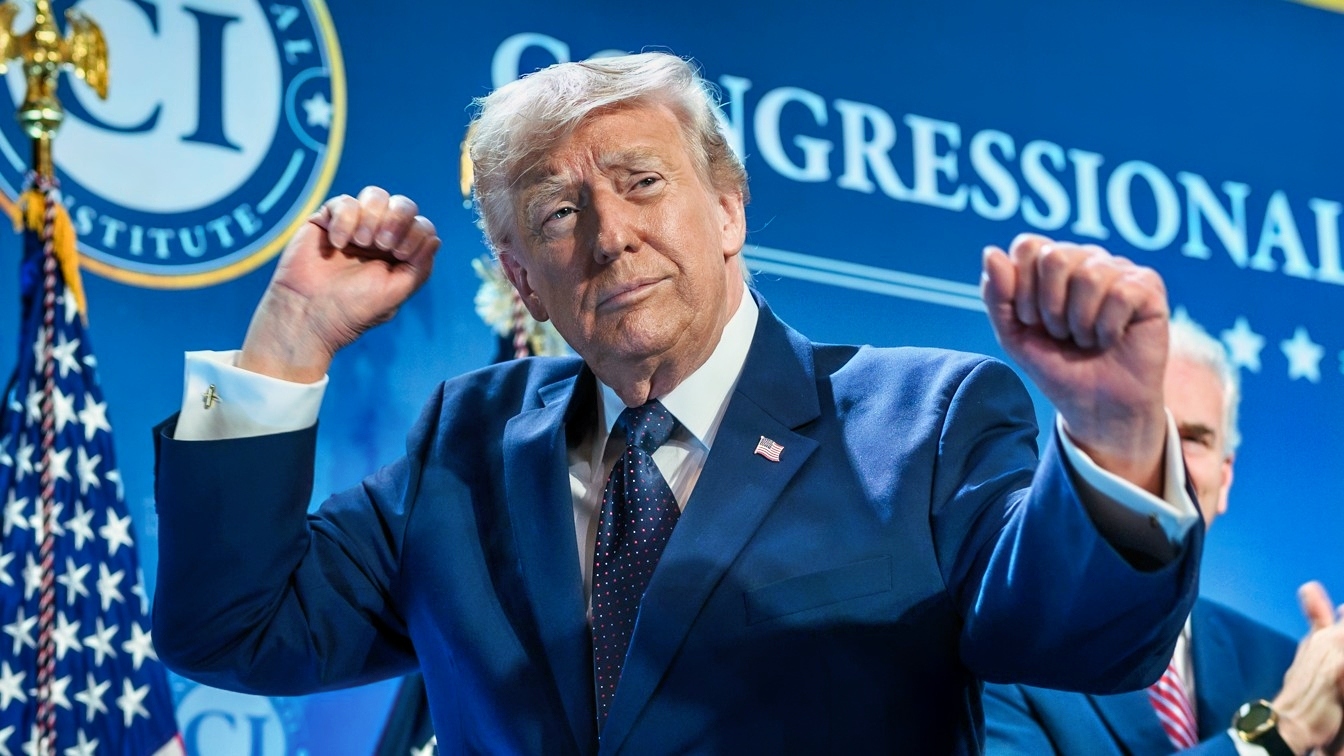
According to Washington Post columnist Max Boot, President Donald Trump’s foreign policy could become a major liability for Republicans in the upcoming midterm elections.
In an October 26 op-ed, titled “Brace yourself, GOP. Trump’s Iran war and tariffs are going to sting,” Boot argues that the administration’s military intervention in Iran and aggressive tariff policies are degrading economic conditions for American voters and that, as a result, foreign policy has become entangled with voters’ concerns about everyday affordability.

Former President of the United States Donald Trump speaking with attendees at the 2022 Student Action Summit at the Tampa Convention Center in Tampa, Florida. By Gage Skidmore.

President Donald J. Trump delivers remarks at the 450th mile of the new border wall Tuesday, Jan. 12, 2021, near the Texas Mexico border. (Official White House Photo by Shealah Craighead)
Boot argues that foreign policy is usually a secondary consideration in congressional elections, but this time it will be front and center, inseparable from things like the price of gas and milk.
With early polls showing widespread economic dissatisfaction, Boot warns Republicans could face a substantial electoral backlash.
Economic Dissatisfaction
Boot’s warning rests partly on the electorate’s negative assessment of economic conditions.
According to recent polling from Washington Post-ABC News-Ipsos, 75 percent of Americans described the economy as either “not so good” or “poor.”
Boot contrasted the poll results and the current political environment with the environment before the 2018 midterms, when about 34 percent of respondents reportedly rated economic conditions negatively.
The result was a Democratic surge; the Democrats gained 40 seats in the House of Representatives.
Boot argues that today’s considerably worse economic perceptions suggest problems for the Republicans.
Of course, economic perception isn’t the only factor in election outcomes.
But Boot sees the economic polling as a stark warning for Republicans, who may be vulnerable to seat flips.
Democrats Gaining Ground
The odd part is that Republicans have usually been perceived more favorably than Democrats on many economic issues.
But now Democrats are gaining an advantage on those issues, like the economy (where Democrats have voter trust over Republicans by 40 percent to 33 percent) and inflation and the cost of living (where Democrats hold a 14-point advantage).
Democrats are also viewed more favorably on the Iran conflict (9-point advantage), where Republicans’ handling of the war has not been well received.
These numbers are not dispositive, but they suggest Republicans are struggling to defend their performance on both domestic and foreign policy.
Boot argues that economic conditions heavily influence voters.
So higher prices for gasoline, groceries, and consumer goods will take precedence over foreign policy decisions; the takeaway from Iran, whatever the geopolitical ambitions, will be higher costs at home.
Driving Affordability
Boot argues that two major Trump administration policies have contributed to the affordability problem. The first is the Iran war.
The conflict has disrupted the global energy market; threats to shipping routes have raised transportation and insurance costs; and higher oil prices have increased gasoline, diesel, and shipping expenses for American consumers.
Boot stated the conflict was unpopular and costly.
Second, tariffs.
Boot argues that Trump’s tariffs are driving higher consumer prices and inflation, which Boot believes have undermined Trump’s promise of economic relief.
Coalition Erosion
Perhaps the most politically significant polling figure concerns dissatisfaction among Trump’s own voters.
According to the Post-ABC-Ipsos survey, 22 percent of registered voters who supported Trump in 2024 now disapprove of his job performance, which Boot reads as evidence of weakness within the president’s electoral coalition.
Still, just because a former Trump voter is dissatisfied with Trump doesn’t mean that voter won’t support Republican congressional candidates.
And Ukraine
Boot also criticized Trump’s treatment of Ukrainian President Volodymyr Zelenskyy and his approach toward Russia.
According to an Economist-YouGov poll, 66 percent of registered voters sympathize more with Ukraine; just three percent sympathize more with Russia.
Boot argues that Trump’s criticism of Zelenskyy risks alienating voters who remain sympathetic to Ukraine, reinforcing Boot’s broader argument that the administration’s foreign-policy positions may now be unusually unpopular.
Still, Trump has a unique ability to wiggle out of perceived political disaster. Pundits have been predicting Trump’s political ruin for more than a decade now, and it just hasn’t happened.
So while the polling is bad and the election may well turn out badly for Republicans, keep in mind Trump’s unique ability to survive.
About the Author: Harrison Kass
Harrison Kass is a writer and attorney focused on national security, technology, and political culture. His work has appeared in Tablet, City Journal, The Hill, The Spectator, and The Cipher Brief. He holds a JD from the University of Oregon and a master’s in Global & Joint Program Studies from NYU—more at harrisonkass.com.


