

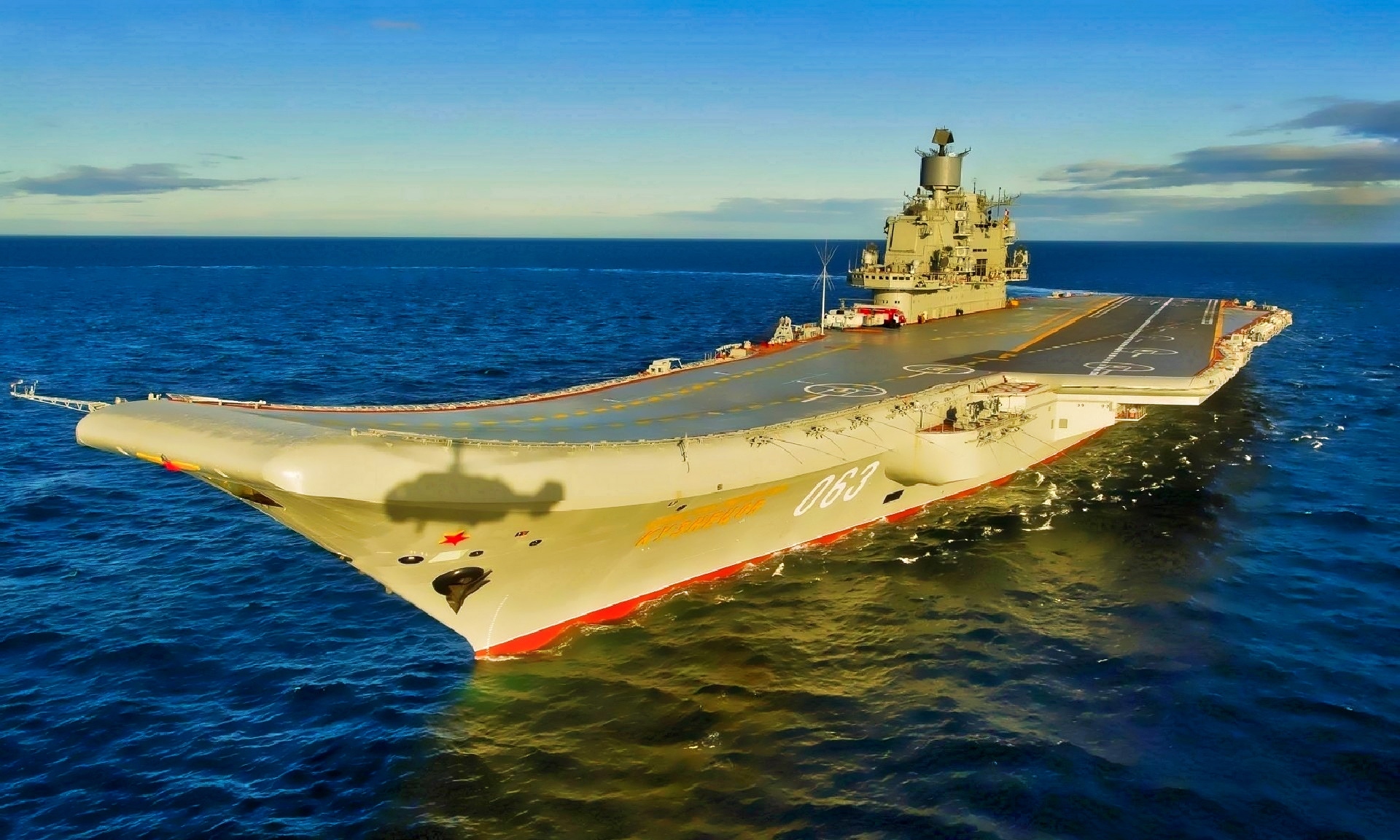
When asked if the Russian Navy’s lone aircraft carrier, the Admiral Kuznetsov, would ever be put to sea again, a colleague in Moscow answered: “If you believe in that possibility, then you probably also believe in the Easter Bunny.”
He was not exaggerating. The ship tied up at its berth in the northern port of Murmansk more than eight years ago and has not been deployed since.
Repairs were supposed to put the carrier back to sea more than two years ago, but an onboard fire that broke out during repairs has indefinitely postponed that action.
Like most ships in Russia’s increasingly decrepit Navy, the carrier is an aging vessel built 39 years ago during the Soviet era. When it deployed to operate off the coast of Syria in 2016, it was widely lampooned for pumping out a plume of black smoke that could be seen for miles as it sailed through the English channel.
Signs of Aging for Admiral Kuznetsov Aircraft Carrier
Russia’s senior naval staff considered decommissioning the ship altogether, either replacing it with a new vessel or abandoning the idea of operating an aircraft carrier altogether. The carrier is in such poor condition that it tows an outsized tugboat behind it when at sea as a safeguard in the event the ship’s engines break down.
When the Admiral Kuznetsov was at sea, a United States Navy ship often shadowed the vessel. This was not because Washington wanted to be in a position to sink the ship in the event of the outbreak of hostilities with Moscow. The US ship was there to be able to rescue the Russian crew as often their ship appeared to be on the verge of foundering.
The Russian carrier’s operational record was also less than stellar. During a 2016 deployment, the ship lost two of its complement of carrier-capable fighters.
In the Kuznetsov’s convalescence, jets based from the ship have been redeployed. The proposal to redeploy the carrier jets to the Hmeimim aerodrome in the Latakia region of Syria to prevent further losses was later followed through on.
Lack of Industrial Capability
The primary reason the Russian Navy has limited options for continuing to operate a carrier or even build a new one is that almost all the facilities where this class of shipbuilding took place in the Soviet years are located in Ukraine.
These shipyards include Nikolayevand and the NITKA carrier pilot training facility in Crimea. Russia regained control of this training center when President Vladimir Putin ordered the invasion and occupation of the peninsula in March 2014.
The shipyards, however, remain under Ukraine’s control, and the ship repair plants Moscow still operates in the north of the country are not adequate to service vessels the size of the Kuznetsov.
Recently, it was revealed that Russia has its Liquid Natural Gas (LNG) tankers serviced at shipyards in the EU due to this limitation.
Russia conducted maintenance on the Admiral Kuznetsov at Severomorsk shipyards on a PD-50 floating dry dock purchased from Sweden. This dock sank in 2018 due to inadequate measures at the port to keep the pumps operating that kept it afloat.
The only way to service the ship after this incident was to rebuild and enlarge two parallel dry docks at the 35th Repair Shipyards.
The carrier entered the new, refurbished shipyard only in May 2022. However, a fire broke out on board the carrier in December 2022 while under repair.
The original forecast was for this refit to be completed in 2024, but this date has not been met either due to the requirement that most of the ship’s electronics require replacement.
Most of the other major sections of the Admiral Kuznetsov also require significant repairs, including resurfacing the flight deck, refitting the ski take-off ramp, and rehabilitating the engine room machinery.
The engines for the ship also need replacement, but the single facility where they are produced is the Ukraine Zorya-Mashproyekt firm co-located with the Nikolayev shipyards.
Irregularities for Admiral Kuznetsov Aircraft Carrier
Whatever path there is for the Admiral Kuznetsov carrier to re-enter service appears to be undermined by funds for its repair being siphoned off by corrupt officials.
Internal investigations and other knowledgeable commentators like former Russian naval officer Vyacheslav Konovalov have stated, “Certain elements of the modernization that cost millions were never actually implemented, and the funds disappeared into someone’s pockets.
Russian military writer Pavel Felgenhauer put it more bluntly when he told Western media outlets, “Each additional day of repair is another million in someone’s pocket.” All things considered, the odds would seem to be against the carrier ever re-entering service again.
About the Author: Reuben F. Johnson
Reuben F. Johnson is a survivor of the February 2022 Russian invasion of Ukraine and is now an Expert on Foreign Military Affairs with the Fundacja im. Kazimierza Pułaskiego in Warsaw and has been a consultant to the Pentagon, several NATO governments and the Australian government in the fields of defence technology and weapon systems design. Over the past 30 years he has resided in and reported from Russia, Ukraine, Poland, Brazil, the People’s Republic of China and Australia.


Pingback: Russia's 'New' Shtorm Nuclear Aircraft Carrier Is a Cruel Joke - National Security Journal
Pingback: The U.S. Navy Feared Russia's Only Aircraft Carrier Might Sink - National Security Journal
Pingback: Russia's Only Aircraft Carrier Should Be 'Scrapped Immediately' - National Security Journal
Pingback: 1,200 Destroyed: Russia's T-72 Tank Is Getting Smashed In Ukraine - National Security Journal
Pingback: Russia's Last Aircraft Carrier Hasn't Sailed For Nearly a Decade - National Security Journal