

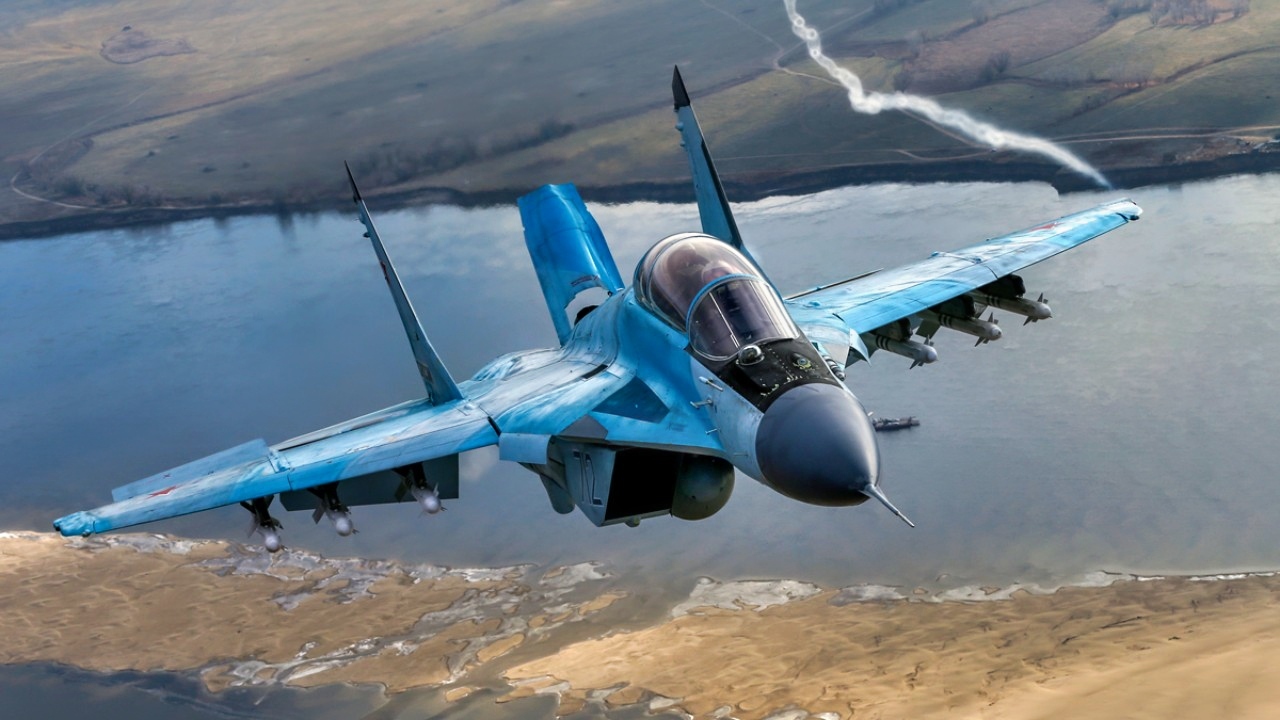
Russia’s MiG-35 in 4 Words – Putin’s New Drone Hunter (Key Points): Russia’s recent deployment of its scarce MiG-35 fighter jets for air defense duties over Moscow, aimed at countering escalating Ukrainian drone attacks, is viewed by analysts as a potential sign of desperation.
-This move suggests a shortage of dedicated air defense systems like S-400s and Pantsirs, likely depleted by the ongoing war in Ukraine.
-The MiG-35, a modernized 4++ generation MiG-29 built in very limited numbers and having failed to secure significant export orders, is not a standard Russian Aerospace Forces inventory item.
-Its current role may also serve as an operational evaluation for the largely untested platform.
Russia’s MiG-35 Fighter Is a Drone Hunter?
According to reports early in May, the Russian Ministry of Defense has deployed its limited number of Mikoyan MiG-35 fighter jets to fly air defense missions in the skies over Moscow. The aircraft has not seen combat in the war in Ukraine, but it is now being dispatched to defend the Russian capital due to the mounting number of drones Kyiv has been firing into the Moscow region.
This deployment is the first known operational use of the MiG-35 in a defensive role near the Russian capital. The aircraft is not part of the regular Russian military inventory and was only built in small numbers to create the false veneer that it was a program of record with the Russian military.
There has even been discussion in Moscow that it is a weapon system with no planned use, prompting articles in the Russian media with titles like “The MiG-35: If Anyone Needs It, Who Is It?”
Moscow’s war planners also never intended to use the aircraft in this war. Therefore, pressing it into service in this manner raises numerous questions about whether Moscow has enough remaining air defense assets.
“This aircraft would never have been put into active service unless the Russian VKS [Aerospace Forces] were desperate for some way to beat back the increasing numbers of Ukraine attack drones,” said a former and retired Russian aircraft designer who spoke to me.
Scrambling: To Intercept Drones as Well as Find Customers
According to posts on the X platform, several of the no more than 15 manufactured MiG-35s have recently been scrambled to intercept aerial drones within the Moscow Military District. Some suggestions have been made that these fighters could be engaged in a test program to create more anti-drone capabilities with tactical aircraft and that those techniques could then be employed across the entire service.
However, the other scramble the MiG-35 is engaged in is to find customers for the program.
During the Cold War, the Soviet Air Force (VVS) operated a “high-low” fighter force, with the Sukhoi Su-27 occupying the upper tier and the MiG-29, the original design that the MiG-35 is based on, on the lower tier. Since the 2000s, the MiG-29s have been phased out, and the majority of the Russian VKS fighter force has been composed of the Su-35 and Su-30SM2.
Since then, the MiG-35 has been promoted as an export program, with the prime target being the second-round tender of the Indian Air Force’s Medium-Multirole Combat Aircraft (M-MRCA) program.
Attempting to Roll Back Ukraine’s Drone Offensive
Some have suggested that bringing the MiG-35 into this air defense role is also part of an operational evaluation program for the aircraft. While the fighter’s MiG-29 is based on has seen untold thousands of hours of combat, the MiG-35 remains largely an untested commodity.
The aircraft is a heavily modernized version of the MiG-29, which was originally produced in the Soviet era. The Mikoyan Design Bureau in Moscow began developing this version of the aircraft in the late 1990s after the MiG-29M program was shut down and put into stasis.
Like the advanced versions of the original Su-27 (e.g., Su-35), the aircraft is categorized as a 4++ generation fighter. Its avionics suite and other onboard systems are very close copies of those installed in the Su-30SM2 models, creating what the design bureau calls a unified configuration between the MiG and Sukhoi models.
The decision to deploy the MiG-35 near Moscow follows a series of high-profile drone attacks that are not confirmed by but believed to be the actions of the Ukrainian military. On March 11, Russian authorities claimed to have intercepted 337 Ukrainian drones across numerous regions of Russia. This includes 91 reported to have been shot down over the Moscow Oblast. That would also be the largest attack of its kind on the Russian capital since the war began.
“Seventy-four drones were shot down on approach to Moscow in the early hours of March 11,” stated Andrey Vorobyov, the Governor of Moscow Oblast, writing on the Telegram messaging platform. The rising number and frequency of attacks and the degree to which those attacks are damaging Russia’s war effort are the chief motivators for bringing the MIG-35s into the conflict.
Russia’s military has tried numerous modifications to its air defenses to protect against these drone assaults. The backbone of that defensive network employs the Almaz-Antei S-400 surface-to-air missile system, which is reportedly linked with the short-range Pantsir-S1 point-air defense units.
However, the number of those systems available is no longer adequate due to battlefield losses, given the frequency of Ukrainian attacks. Using MiG-35 fighter jets is the only option Russia has left to bolster protection around the capital.
About the Author:
Reuben F. Johnson is a survivor of the February 2022 Russian invasion of Ukraine and is an Expert on Foreign Military Affairs with the Fundacja im. Kazimierza Pułaskiego in Warsaw. He has been a consultant to the Pentagon, several NATO governments and the Australian government in the fields of defense technology and weapon systems design. Over the past 30 years he has resided in and reported from Russia, Ukraine, Poland, Brazil, the People’s Republic of China and Australia.
Meet the Best Tanks on Earth


Pingback: Russia's MiG-35 Fighter Jet Is Now Officially a Failure - National Security Journal