


Key Points and Summary – The Soviet November-class (Project 627) submarines were Moscow’s first nuclear-powered attack boats, built to carry massive nuclear torpedoes against U.S. ports.
-On paper, they outperformed USS Nautilus with deeper diving, higher speed and greater buoyancy.

An aerial port quarter view of the nuclear-powered attack submarine ex-USS NAUTILUS (SSN 571). The NAUTILUS was being towed to Groton, Connecticut, where it became a museum. Creative Commons Image.
-In practice, they were loud, mechanically unreliable and dangerously under-shielded, bathing crews in radiation and suffering a string of deadly accidents.
-Their VM-A reactors and crude safety culture led to fires, system failures and tragedies like K-8’s loss in the Bay of Biscay. Yet the USSR kept these “doomsday machines” in service for decades, prioritizing deterrence over the lives of their submariners.
November-Class Submarine: A Radiation Disaster
The Soviet Union’s November-class (Project 627 “Kit”) submarines, the first nuclear-powered boats in the Soviet Navy, were designed to launch nuclear torpedoes at major US cities during the height of the Cold War.
The Soviets’ obsession with “mutually assured destruction” is still a Kremlin strategy today, nearly 70 years later.
However, in their rush to catch the US Navy after the launch of the first nuclear-powered submarine, the USS Nautilus (SSN-571), the Soviets cut corners on crew safety. The workmanship was shoddy, and many critical operational systems didn’t work correctly or at all.
The submarines were noisy and had little radiation shielding for the crew. The K-3, the first of the North Atlantic Treaty Organization (NATO) designated November-class, was launched in 1958.
The K-3 Leninsky Komsomol made its first voyage in July 1958 under the command of Captain Leonid Osipenko, using a reactor design supervised by renowned scientist Anatoly Alexandrov.
Meet The Soviets’ November-Class Attack Submarines
Shortly after the Soviet Union detonated its first atomic bomb, the Soviets were closely following the development of the USS Nautilus, the first nuclear-powered submarine.
At first, the Russians banned any development of nuclear power for submarines for fear that it would slow the development of the atomic bomb. But after the Nautilus was launched, that perception changed dramatically.
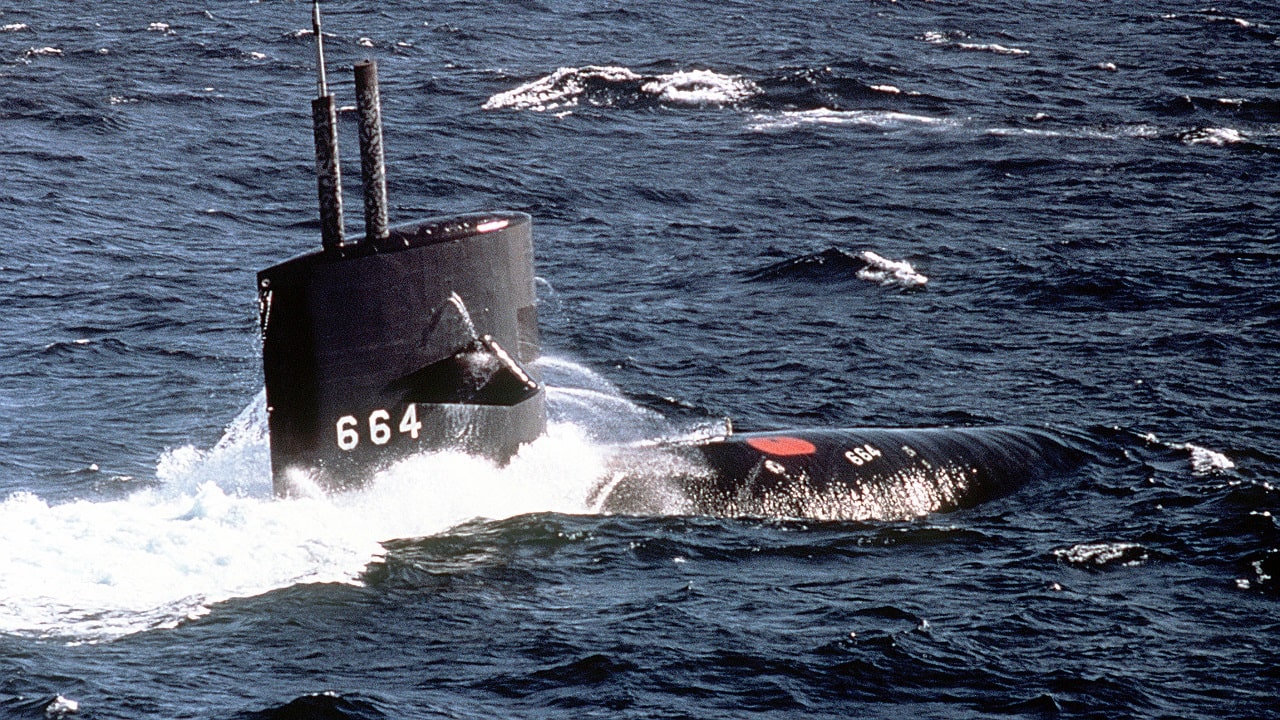
Sturgeon-class U.S. Navy Submarine. Image Credit: Creative Commons.
Nuclear-powered boats had unlimited range, were much faster, and could render anti-submarine weapons ineffective at the time. And once they committed to the project, they set about building a submarine that they intended to be better than the Nautilus.
And in many aspects it was. A cigar-shaped submarine is technically more hydrodynamic, hence the ability to obtain 30 knots, but it could also dive much deeper than other boats, and the 627’s have been as deep as 340 meters, 140 meters deeper than Nautilus.
The 627s also had a double hull, with the pressure hull split into nine watertight compartments. The submarine also had a high reserve buoyancy (31 percent compared to Nautilus’s 16 percent) to ensure survivability should the boat be attacked or run aground.
The Project 627 boats, named Kit or “Whale” in Russian and later codenamed by NATO as the November class, on paper outclassed the Nautilus substantially.
The Novembers were 107.5 meters long, eight meters wide, had a draft of 5.6 meters, and a submerged displacement of 4,750 tons.
The K-3 was the first of the November class to be introduced in 1958, followed by K-5, K-8, K-11, K-14, K-21, K-42 Rostovskiy Komsomolets, K-50, K-52, K-115, K-133, K-159, and K-181.
The November’s Power Plants
The November class (Project 627) submarines were powered by two VM-A pressurized-water-cooled reactors, each producing 70 MW. This system generated steam to drive turbines for propulsion, enabling the submarines to reach submerged speeds of up to 30 knots. Later versions also included diesel generators and auxiliary electric motors for backup power.
In comparison, the Nautilus had a single reactor and a top speed of 23 knots. The 627s were also more heavily armed, using eight 533mm torpedo tubes to Nautilus’ six.
The Soviets’ T-15 Nuclear Torpedoes
The Soviets wanted the 627s to sneak into US harbors and launch the battery-powered T-15 torpedo with a thermonuclear warhead. This would not level US cities but make them uninhabitable due to high doses of radiation.
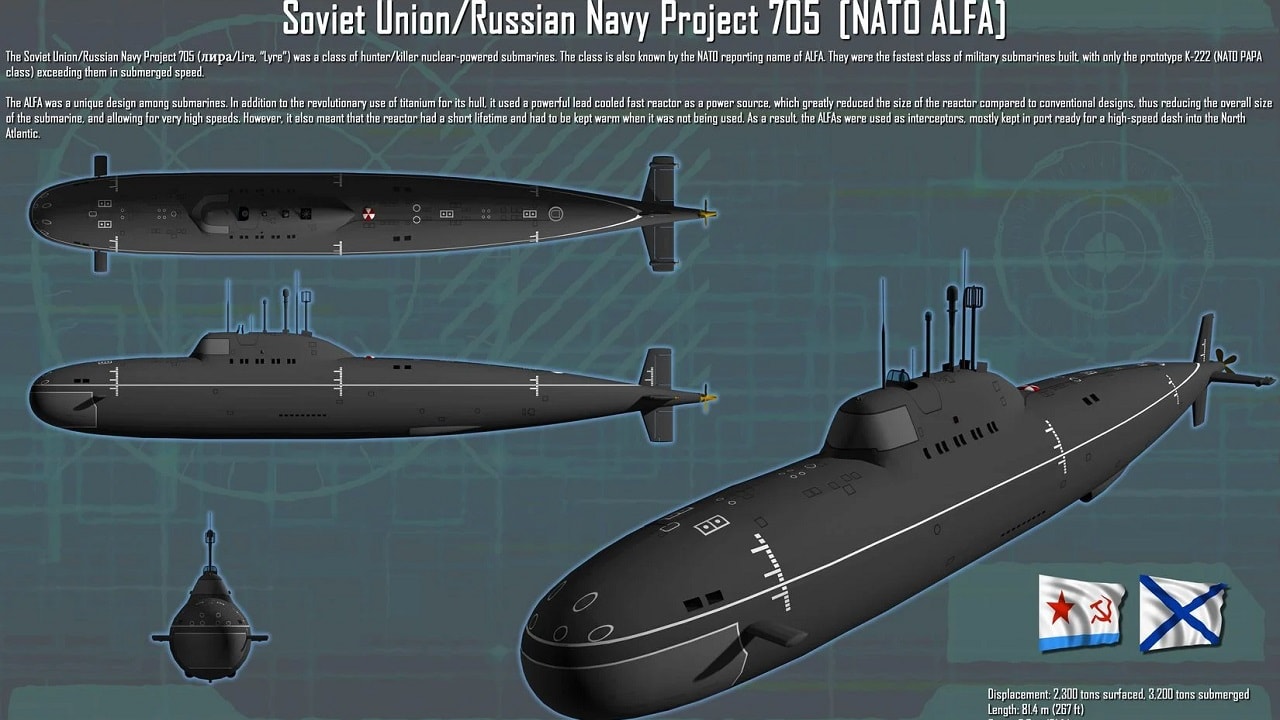
Alfa-Class Submarine. Image Credit: Creative Commons.
The Soviet T-15 was a huge, early nuclear torpedo developed in the 1950s that was intended to carry a hydrogen bomb over a distance of 16 nautical miles.
At over five feet in diameter and weighing 40 tons, it was too large for most submarines; it was to be carried by the 627s. The T-15 was eventually deemed impractical due to its size and slow speed, and the project was abandoned in favor of smaller, more conventional torpedoes.
The 627s were the first of the Soviet/Russian “Doomsday Machines” that they are still obsessed with today.
The November Class Was Unsafe For Its Crews
Despite the advantages the Russians built into the November class design, several drawbacks ultimately proved that the boats were not a match for US submarines.
The powerful reactors were very noisy and thus easily detectable by US submarines underwater, despite the use of stealthy propellers and the first anechoic sonar tiles applied to a nuclear submarine. This reactor noise, combined with its inferior sonar array, made the November class ill-suited for hunting opposing submarines.
The Russians neglected to shield their nuclear reactors on the big boats, resulting in frequent illnesses among the crew, along with multiple accidents that resulted in the deaths of their crews.
The K8’s Deadly Accident
On April 12, 1970, while returning from Okean 70, the biggest exercise the Soviet navy had ever held, K8 got into difficulty in the Bay of Biscay.
The submarine spent 4 days in dire straits on the surface after short circuits in the electrical systems in compartments three and seven, followed by a fire in the air conditioning unit. The submarine surfaced, and smoke and carbon dioxide forced most of the crew onto the deck.

POLARIS POINT, Guam (May 7, 2013) The Los Angeles-class attack submarine USS Albuquerque (SSN 706) arrives in Apra Harbor, Guam, to conduct maintenance and liberty. Albuquerque is conducting operations in the U.S. 7th Fleet area of responsibility. (U.S. Navy photo by Mass Communication Specialist 1st Class Jeffrey Jay Price/Released)
Soon, the ship drifted without power; both reactors were shut down, and the auxiliary diesel generators ran for only 1 hour after a cooling system problem.
Ultimately, the commanding officer and fifty-two members of the crew died, 30 went down with the boat, and 22 died of exposure while waiting to be rescued. The K8 eventually sank to the bottom. This was not the only deadly accident on board the 627s.
Accidents, many of them deadly, continued to haunt the November class. Despite their terrible safety record, the 627s continued to serve in the Soviet Navy for decades.
The last of the November class, the K14, was decommissioned in 1990, ending the first generation of boats and only one year from the collapse of the Soviet Union.
The first of the class, the K3, now serves as a museum boat in Saint Petersburg.
About the Author: Steve Balestrieri
Steve Balestrieri is a National Security Columnist. He served as a US Army Special Forces NCO and Warrant Officer. In addition to writing on defense, he covers the NFL for PatsFans.com and is a member of the Pro Football Writers of America (PFWA). His work was regularly featured in many military publications.
More Military
JASSM: The ‘Stealth’ Cruise Missile That Keeps Russian Generals Up at Night
The Day a B-2 Stealth Bomber Disintegrated on Takeoff
The U.S. Military’s Superpower Muscles Are Getting Old
The Mach 6.7 X-15 ‘Hypersonic Rocket Plane’ Has a Message for the U.S. Air Force


