

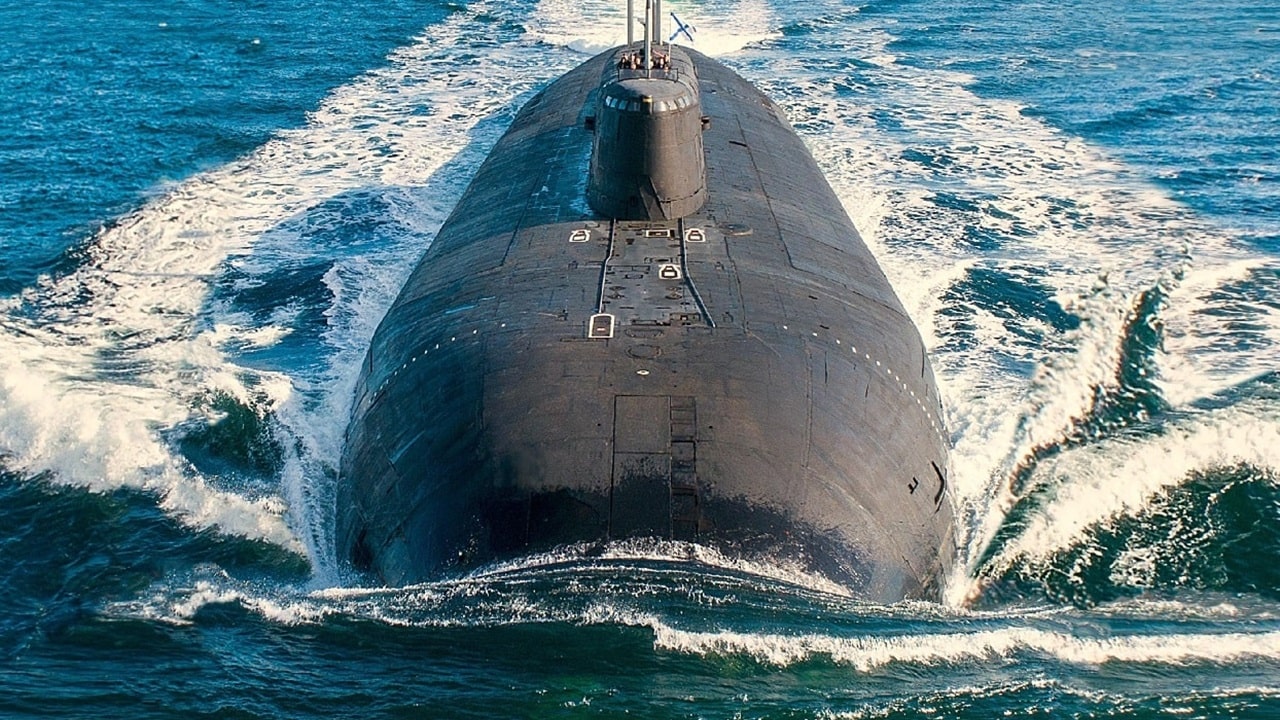
Key Points and Summary – Russia’s Oscar-class nuclear-powered cruise-missile submarines—Project 949 Granit and 949A Antey—were built to kill U.S. carriers with salvos of P-700 Granit missiles.
-In practice, they never fired in anger, but the class is infamous for the 2000 Kursk disaster, when an internal torpedo explosion and Moscow’s botched rescue effort killed all 118 sailors.
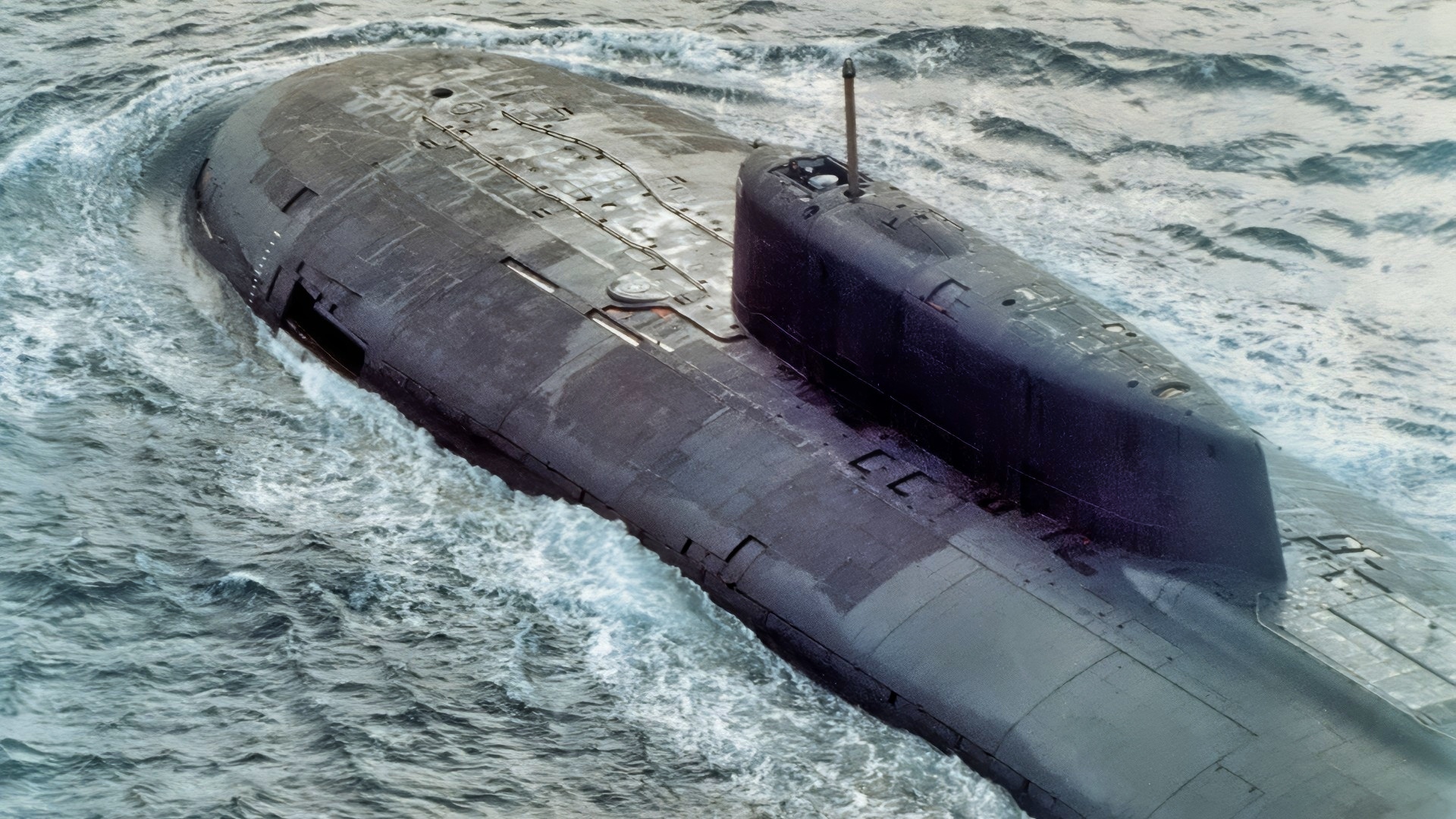
An elevated port side view of the forward section of a Soviet Oscar Class nuclear-powered attack submarine. (Soviet Military Power, 1986)
-Another boat, K-150 Tomsk, nearly burned in a 2013 yard fire. Today only six Oscar IIs remain, with select hulls being upgraded under Project 949AM to carry up to 72 Kalibr or Oniks missiles.
-Their oversized, unmanned successor, Belgorod, now anchors Russia’s next undersea era.
Russia’s Oscar-Class Submarine Is No Joke
The name “Oscar” means different things to different people. In the movie business, it’s the nickname for the coveted statuette presented by the Academy of Motion Picture Arts and Sciences during the annual Academy Awards.
For fans of educational kiddies shows, there’s Oscar the Grouch, the grumpy but still lovable Sesame Street Muppet.
In the military context, “Oscar” indicates the letter O in the NATO phonetic alphabet.
Germane to our current topic at hand, it’s also the NATO reporting name for two classes of Soviet-made nuclear-powered cruise missile submarines (SSGNs) designed during the Cold War to sink U.S. Navy aircraft carriers: the Oscar I and Oscar-II class SSGNs (officially known to the Russians as the Project 949 Granit and Project 949A Antey respectively).
Oscar I and Oscar II-Class (Project 949 Granit and Project 949A Antey) Initial History
These vessels were built by Sevmash (which still exists today as part of the Russian Federation’s United Shipbuilding Corporation JSC, headquartered in Arkhangelsk Region, Severodvinsk).
The lead ship of the class, the K-525 Arkhangelsk, was laid down on 25 July 1975, launched on 3 May 1980, and commissioned on 30 December 1980.
K-525 was followed by the K-206 Murmansk, and then Project 949 was upgraded to Project 949A, increasing the length and power of the subs.
The first of these bigger, better boats was the K-148 Krasnodar, laid down on 22 July 1982, launched on 3 March 1985, and commissioned on 30 September 1986.
A total of 14 hulls were completed out of the 20 originally planned.
Oscar II Tech Specs and Vital Stats
(Courtesy of Deagel.Com)
-Displacement: 24,000 tons submerged; 14,700 tons surfaced
-Hull length: 154 meters
-Beam Width: 18 meters
-Power: 980 shp
-Max Speed (submerged): 32 knots
Maximum Operating Depth: somewhere in excess of 600 meters
-Endurance: 110 days
-Crew Complement: 100 commissioned officers and enlisted seamen
Armament:
24 × launch tubes for P-700 Granit (3M-45; NATO reporting name SS-N-19 “Shipwreck”) long range anti-ship missiles
4 × 533mm and four 650mm torpedo tubes
Operational History In Brief
As far as we can ascertain, none of the Oscars have ever fired their shots in anger and therefore are unable to lay claim to killing a carrier or any other type of enemy warship, for that matter. (
For the record, only two submarines have pulled off a confirmed sinking of enemy vessels since World War II ended: (1) the Pakistani Navy Daphne-class submarine PNS Hangor during the 1971 Indo-Pakistani War; and (2) Britain’s Royal Navy Churchill-class submarine HMS Conqueror [Pennant No. S48] during the Falklands War against Argentina in 1982.)
However, one Oscar II-class boat infamously sank herself with one of her own torpedoes in what’s arguably the worst submarine disaster of the post-Cold War era.
This was the tragedy of the K-141 Kursk (named after the Russian city that was the site of an epic tank battle in July 1943), which had been commissioned in 1994, making her of the first Russian naval vessels to be completed after the collapse of the USSR. The incident took place on 15 August 2000, and it claimed the lives of all 118 crewmen, including the skipper, Capt. First Rank Gennady Petrovich Lyachin.
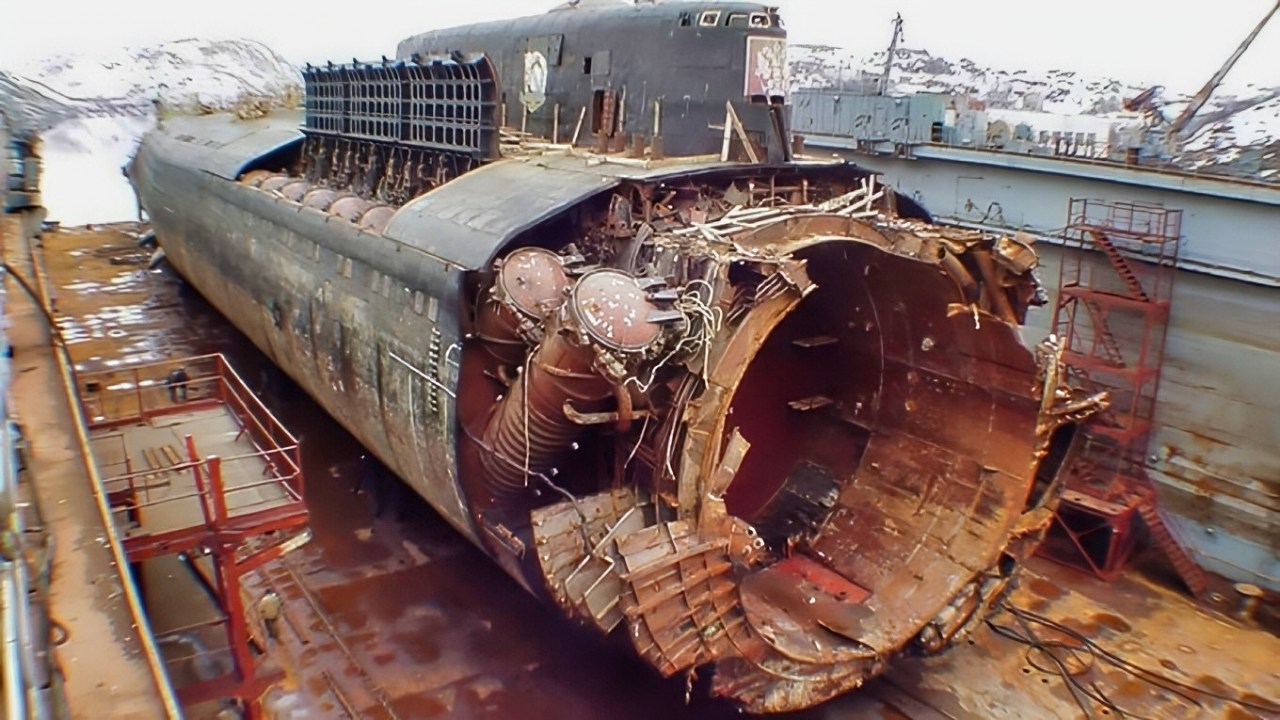
Kursk Submarine Accident. Image Credit: Creative Commons.
What compounds the tragedy and adds insult to injury is the fact that Vladimir Putin’s dithering and intransigence on rescue operations led to the loss of all hands despite the initial possibility of saving the lives of at least some of the crew.
Another Oscar II came dangerously close to sinking so in a far less publicized incident on 16 September 2013.
This was the K-150 Tomsk, which suffered a major onboard fire whilst at the Zvezda Shipyard in Vladivostok due to a welding accident igniting insulation materials. Luckily, no lives were lost this time, but 15 crew members were injured, raising serious questions about Russian maintenance protocols.
Remarkably, the Tomsk was repaired and returned to service by June 2014. In 2023, she conducted a successful test launch of one of her Granit missiles.
Where Are They Now? The Way Forward for the Oscars
Six Oscar II subs remain in service, including the aforementioned Tomsk.
In 2011, the Rubin Design Bureau (which is also part of the United Shipbuilding Corporation) began work on the Project 949AM program, which entails at least three Oscar-class submarines will undergo repair and modernization to extend their service life by 20 years.
A major aspect of the modernization will be the replacement of the Granit missiles replaced with up to 72 newer 3M-54 Kalibr or P-800 Oniks (SS-N-26 Strobile)anti-ship cruise missiles. Conveniently, the upgrades don’t necessitate design changes to the hull as the new weapons can fit into the existing launchers outside the pressure hull.
Meanwhile, there’s yet another generation of Oscars underway, that being the fifth-generation K-329 Belgorod, under Project 09852. Two particular aspects of the Belgorod stand out: (1) its sheer size (184 meters in length and 30,000 tons in submerged displacement), making it Russia’s largest submarine (yes, even larger than the Typhoon class immortalized in “The Hunt for Red October”); and (2) the fact that it is unmanned.
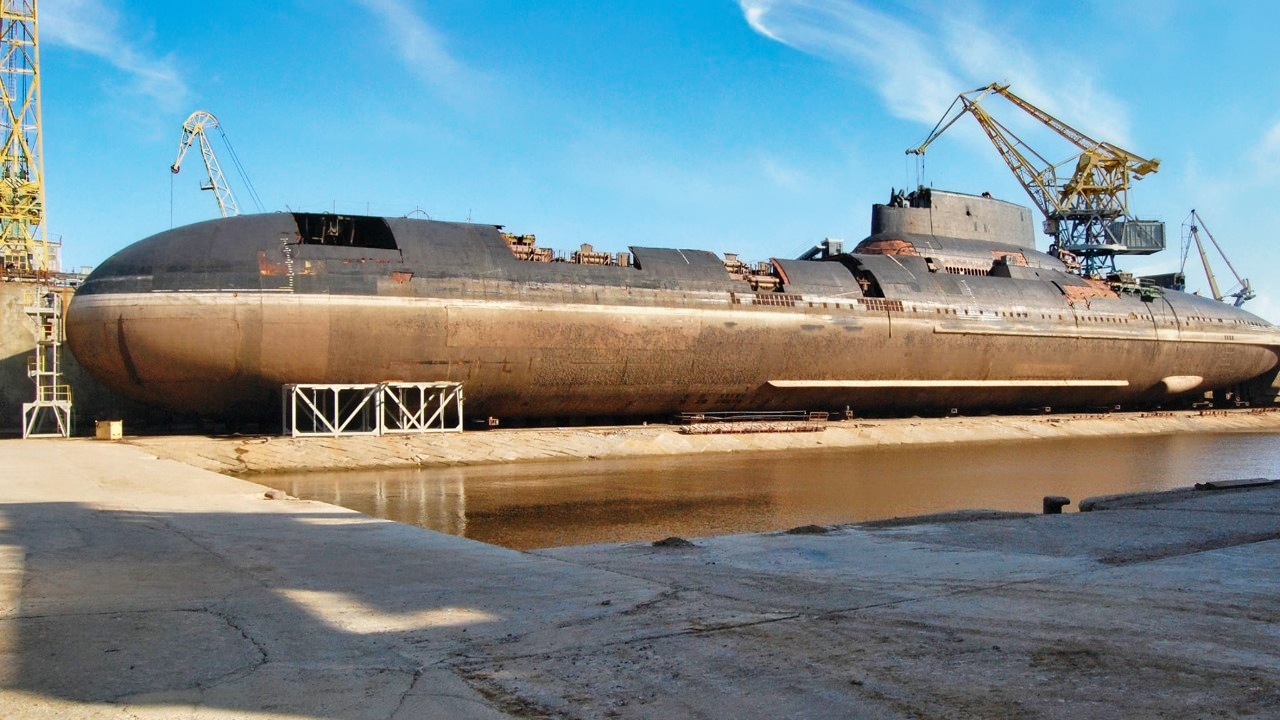
Typhoon-Class Submarine. Image Credit: Creative Commons.
This newest Oscar was commissioned in July 2022 and is expected to come into operation in Kamchatka within the submarine forces of the Russian Pacific Fleet before the current year comes to an end.
About the Author: Christian D. Orr, Defense Expert
Christian D. Orr is a Senior Defense Editor. He is a former Air Force Security Forces officer, Federal law enforcement officer, and private military contractor (with assignments worked in Iraq, the United Arab Emirates, Kosovo, Japan, Germany, and the Pentagon). Chris holds a B.A. in International Relations from the University of Southern California (USC) and an M.A. in Intelligence Studies (concentration in Terrorism Studies) from American Military University (AMU). He is also the author of the newly published book “Five Decades of a Fabulous Firearm: Celebrating the 50th Anniversary of the Beretta 92 Pistol Series.”
More Military
Who Has the Fastest Hypersonic Missile? Russia, China, or the US?


