

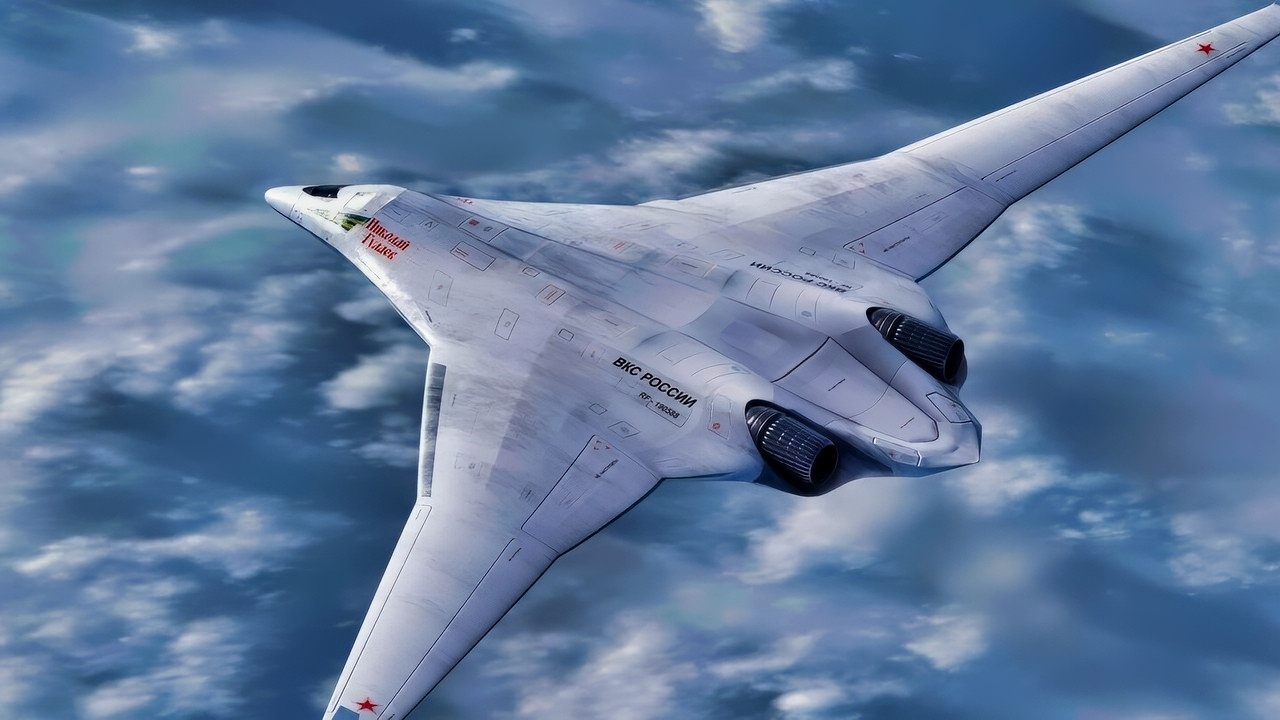
PUBLISHED on August 14, 2025, 08:43 AM EDT – Key Points and Summary – Russia’s next-generation PAK DA stealth bomber program is in deep trouble, plagued by severe delays that have pushed its potential service date into the 2030s.
-Despite the uncertainty, Moscow desperately needs the new bomber for three key reasons: to maintain strategic prestige against the American B-21 and Chinese H-20, to replace its dangerously aging Cold War-era bomber fleet, and to compensate for significant combat losses inflicted by Ukrainian drone strikes.
-The program’s struggles, exacerbated by sanctions and the war, highlight a critical vulnerability in Russia’s long-range strike capabilities.
PAK DA Stealth Bomber: Why Does Russia Still Need It?
The Tupolev PAK DA, codenamed Poslannik (“Envoy”) by the Russians and dubbed “Flatback” by NATO, is the Russian Federation’s prospective sixth-generation stealth bomber.
For now, it exists only on paper. In practice, it is not certain such a plane ever will fly. The “Flatback” was originally supposed to make its maiden flight in 2019, but funding reallocations and changes in engine development schedules scrapped that plan. Current projections are for a prototype to fly by 2026, with serial production expected to commence around 2030–2032.
But even that revised schedule may be overly optimistic, as production is being held up by a lack of available parts – a result of sanctions related to the Ukraine war. So why does Russia even bother with the PAK DA at this point? Because, regardless of all the hurdles, the Russian Aerospace Forces (VKS) need it pretty badly, for several reasons.
REASON #1 FOR PAK DA: “KEEPING UP WITH THE JONESES”
Military technology development is a never-ending quest to keep pace with one’s adversaries. In the case of fifth-generation stealth fighters, to take one example, Russia’s arms industry has been quite embarrassed by the way its Sukhoi Su-57 “Felon” lagged behind both the United States (with the Lockheed Martin F-22 Raptor and F-35 Lightning II) and China (with the Chengdu J-20).
Now, the PAK DA trails America’s Northrop Grumman B-21 Raider, which made its maiden flight on Nov. 10, 2023. It also likely lags the Chinese Xi’an H-20, which, according to intel, may have made its first test flight sometime within the last 12 months.
As embarrassing as it would be for Russia to come in third place once again, it would be an even bigger blow to that country’s prestige if it were to quit its project to develop a next-generation stealth bomber.
REASON #2: RUSSIA’S CURRENT BOMBER FLEET IS GETTING OLD
The strategic heavy bombers in the VKS fleet are no spring chickens. Indeed, these warbirds are getting rather long in the beak. They date back mostly to the Cold War:
–The Tupolev Tu-95 “Bear” entered service way back in 1956.
–The Tu-22M “Backfire” was officially introduced in 1972.
–The Tu-160 “Blackjack” made its operational debut in 1987.
All told, they debuted from 38 to 69 years ago.
In the case of the Blackjack in particular, there is also the concern of low numbers. According to the World Directory of Modern Military Aircraft (WDMMA), Russia has a mere 15 Tu-160s in its fleet. Meanwhile, WDMMA assesses the numerical strength of the Tu-22M and Tu-95 at 58 and 47, respectively, bringing the VKS’s total strategic bomber fleet to number 120 aircraft.
REASON #3: REPLACING BATTLEFIELD LOSSES
Russia’s bomber shortages went from bad to worse thanks to a daring drone strike by Ukraine on Russian airbases in June 2025. Reportedly, Ukraine used a total of 117 drones to strike four fields deep inside Russia.
According to a Reuters report:
“‘I can see the destruction of several aircraft,’ said John Ford, a research associate at the California-based James Martin Center for Nonproliferation Studies.
“Ford said that SAR imagery provided to him by Reuters showed what appeared to be the remnants of two destroyed Tu-22 Backfires – long-range, supersonic strategic bombers that have been used to launch missile strikes against Ukraine.
“The SAR image, as well as drone footage of the strikes posted on social media, also indicated that four strategic Tu-95 heavy bombers had been destroyed or severely damaged, he added.
“Brady Africk, an open source intelligence analyst, agreed that the SAR imagery of Irkutsk air base showed several Tu-95s and Tu-22s had been destroyed and damaged, although more imagery was needed to properly assess the impact.”
WDMMA does not indicate whether its aforementioned assessment of Russian bomber numbers takes these losses into account.
About the Author: Christian D. Orr, Defense Expert
Christian D. Orr is a Senior Defense Editor for 19FortyFive. He is a former Air Force Security Forces officer, Federal law enforcement officer, and private military contractor (with assignments worked in Iraq, the United Arab Emirates, Kosovo, Japan, Germany, and the Pentagon). Chris holds a B.A. in International Relations from the University of Southern California (USC) and an M.A. in Intelligence Studies (concentration in Terrorism Studies) from American Military University (AMU).
Military Matters
The F-22 Raptor Just Keeps Getting Better


