

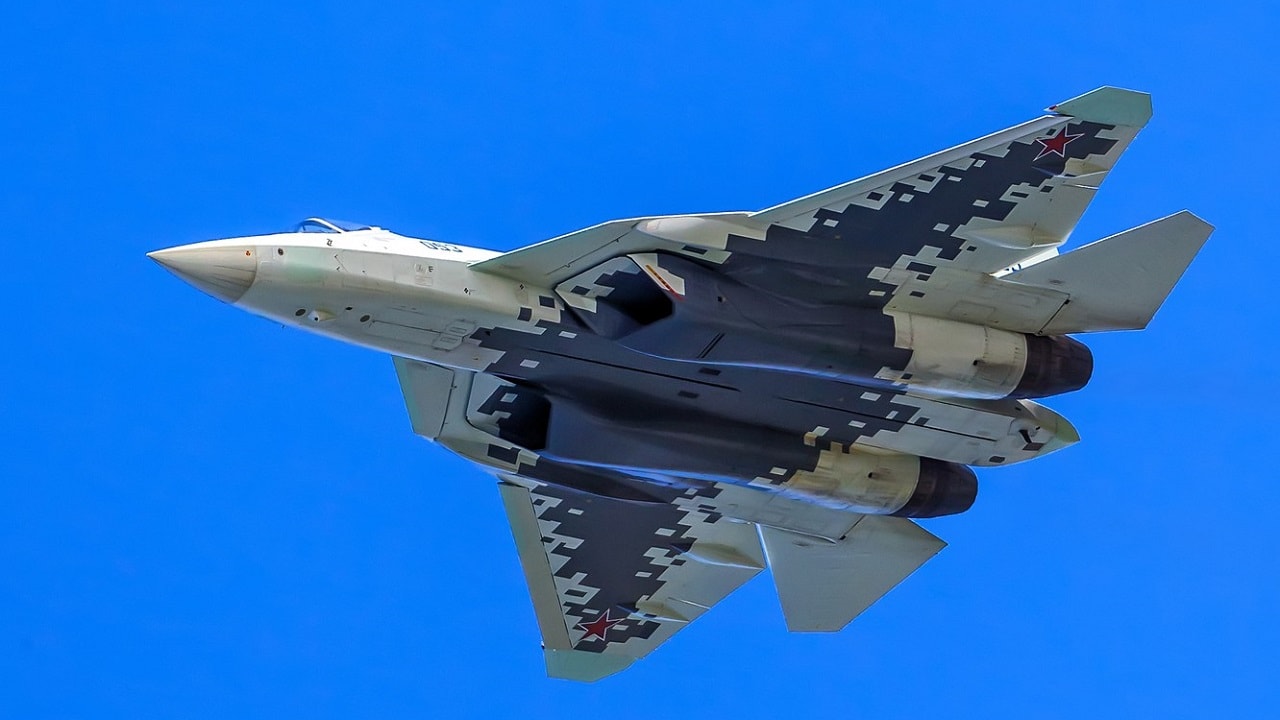
Why The Su-57 Is The Worst Stealth Fighter In The World Today
Key Points and Summary
-Russia’s Sukhoi Su-57 is widely considered the worst-performing fifth-generation stealth fighter, plagued by a host of critical flaws.
-Its stealth capabilities are significantly inferior to its American and Chinese counterparts, with a radar cross-section potentially a thousand times larger than an F-35’s.
-The program has been crippled by a painfully slow production rate, with only a handful of combat-ready jets delivered.
-Compounded by a history of failed international partnerships, like with India, and embarrassing public displays of poor workmanship, the Su-57 fails to live up to its “stealth fighter” designation.
Russia’s Su-57 Felon Keeps on Failing
There are three countries currently that claim to have produced 5th-generation stealth fighters: the United States (the Lockheed Martin F-22 Raptor and F-35 Lightning II), the People’s Republic of China (the Chengdu J-20 Mighty Dragon and Shenyang J-35), and Russia (the Sukhoi Su-57 [NATO reporting name Felon]). Meanwhile, India is working on its Advanced Medium Combat Aircraft (AMCA), but it isn’t expected to be fully operational until 2035.
The Sukhoi Su-57 is widely considered by many experts to be the worst-performing stealth fighter, particularly compared to its American and Chinese counterparts like the F-22 Raptor and J-20, due to significantly inferior stealth capabilities, limited production, and issues with technology and workmanship.
Su-57 History
The Felon is capable of aerial combat, ground attack, and maritime strikes. The Su-57 incorporates stealthy characteristics, supermaneuverability, supercruise, integrated avionics, and large payload capacity.

Su-75 Checkmate and Su-57. Image Credit: Creative Commons.

Su-57 Fighter From Russia. Image Credit: Creative Commons.
Russia and India signed a contract in 2010 for Sukhoi and Hindustan Aeronautics Limited (HAL) to develop a derivative of the PAK FA jointly called the Fifth Generation Fighter Aircraft (FGFA). Each country was to pay $6 billion, and the development was expected to take 8-10 years.
However, by 2014, the partnership fell apart. The Indian Air Force started voicing concerns over performance, especially the stealth feature, cost, and workshare. India found that the aircraft did not meet its requirements and left the partnership in 2018.
The Su-57 is powered by two Saturn AL-41F1 afterburning turbofan engines that power the aircraft to Mach 2.45. A new engine has been in the works for a decade, but has not materialized.
The armament for the aircraft includes a 30 mm autocannon under the nose, various anti-ship, anti-aircraft, and anti-armor missile configurations, and eight hard points in the storage bays.
According to Air Force Technology, the Russian aircraft is also equipped with 3D thrust vector jets, enabling higher maneuverability and the capability to develop a supersonic cruising speed.
Stealth? Radar Cross-Section Is Enormous
While it offers improvements over previous Russian aircraft, its radar cross-section is significantly larger than that of other fifth-generation fighters, and delays, budget issues, and reliance on older engines have plagued its development.
The F-35 has a frontal radar cross-section of 0.0001 m², thanks to its advanced fiber-matte radar absorbent material. In comparison, the SU-57 has a radar cross-section ranging from 0.1 to 1 m². This means the Su-57 has a 1000x bigger radar cross-section than an F-35, which is more akin to a fourth-generation fighter.
That may be an exaggeration. Alex Hollings says the Felon’s radar signature is more likely to be 20 to 30 times that of an F-22 Raptor, which is still a massive difference in stealth.

U.S. Air Force maintainers assigned to the 3rd Air Expeditionary Wing prepare F-22 Raptors for take-off on the flightline during exercise Resolute Force Pacific 2025 in Tinian, Northern Mariana Islands, July 19, 2025. The REFORPAC exercise is part of a first-in-a-generation Department-Level Exercise series, employing more than 400 Joint and coalition aircraft and more than 12,000 members at more than 50 locations across 3,000 miles. (U.S. Air Force photo by Airman 1st Class Tala Hunt)
Manufacturing Is Years Behind Schedule
Despite heavy marketing of the Su-57E (export version), Algeria appears to be the only taker. The two countries reportedly agreed on a deal for 14 Su-57s in late 2019, but it wasn’t confirmed by Algeria publicly until this year. Why?
Sukhoi is years behind in delivering Su-57s to the Russian military. The Russian Air Force currently only has about 15 Su-57s. Russia will likely struggle to meet the 2025 deadline for Algeria. Another reason is that Algerian law requires imported military aircraft first to be flight-tested in the country, which, according to Tom Cooper, an expert on Russian military aircraft, is something the Russians would never allow.
Russia’s Wild Claims About The Su-57 Being 6th-Generation Soon
Tass, the government-controlled news service, reported that an upgraded and even more advanced model of the Su-57 could be in development, and that it would be the world’s first in-service “sixth-generation” aircraft.
Tass quoted Russian Aerospace Force ex-commander and Chairman of the Federation Council Defense and Security Committee Viktor Bondarev, who made an outlandish claim.

Su-57 Felon Stealth Fighter Taking Off. Image Credit: Creative Commons.
“This is actually a splendid plane and it can embrace both fifth-and sixth-generation features. It has huge modernization potential. Importantly, it is the best among the existing versions of its stealth characteristics. It incorporates all the best that is available in modern aviation science, both in Russia and in the world.”
Russia’s Debacle In China
Russia sent a Su-57 to China in November for the 15th China International Aviation and Aerospace Exhibition, which was a disaster from a public relations standpoint.
Chinese social media, which is very pro-China and anti-West, was quick to point out the flaws of the Russian design, despite the fact that the two countries have a publicly stated “no limits partnership.”
Russia made the mistake of sending a prototype Felon instead of a production model. Meanwhile, the Chinese are trying to drum up business for their own exports. Several aviation enthusiasts were quick to point out numerous design issues and other perceived flaws. That included the numerous bolts on the fuselage and poorly aligned sections.
Is the Su-57 a good fighter jet? Yes absolutely. While it may barely be a 5th-generation stealth fighter, it is more than a match for the F-16s and F-15s in the inventory. And it would give an F-22 or F-35 a good battle. However, the F-35’s stealth capability and high-speed, AI-enabled computing are far superior. And the Felon would be detected and targeted long before it could ever see its opposition.
And numbers-wise? Even if Russia builds its 76 Felons as planned, Algeria would have no production, and it would face over 1,000 US and allied F-35s and 187 F-22s.
So, yes, it is by far the worst of the world’s stealth fighters if it is one at all.
About the Author: Steve Balestrieri
Steve Balestrieri is a National Security Columnist. He served as a US Army Special Forces NCO and Warrant Officer. In addition to writing on defense, he covers the NFL for PatsFans.com and is a member of the Pro Football Writers of America (PFWA). His work was regularly featured in many military publications.
More Military
The U.S.-Venezuela War of 2025?
The F-15EX Eagle II Doesn’t Need Your Stealth Pity


