


Why the F-15EX Matters—And Why It’s Controversial
Key Points and Summary
-The F-15EX Eagle II replaces aging F-15C/Ds with a modern, high-capacity fighter built for speed, range, and payload.
-It brings an AESA radar, the EPAWSS electronic-warfare suite, an open-architecture digital backbone, and a validated 12-missile air-to-air loadout.
-It isn’t stealthy, but that’s not the point: the EX is designed to complement fifth-gen aircraft as a standoff shooter, interceptor magazine, and airborne controller, especially for homeland and maritime air-defense missions.
-The program is controversial—critics prefer more stealth jets—but the 20,000-hour airframe life, fast fielding via an existing production line, and growing planned buy argue for a pragmatic, capacity-first answer.
Why the Original F-15 Eagle Was Great
Start with the scoreboard and work backward. The F-15 earned an air-to-air reputation few jets can touch, pairing blistering speed with a big radar, long legs, and a pilot-centric cockpit that made complex tasks feel intuitive.
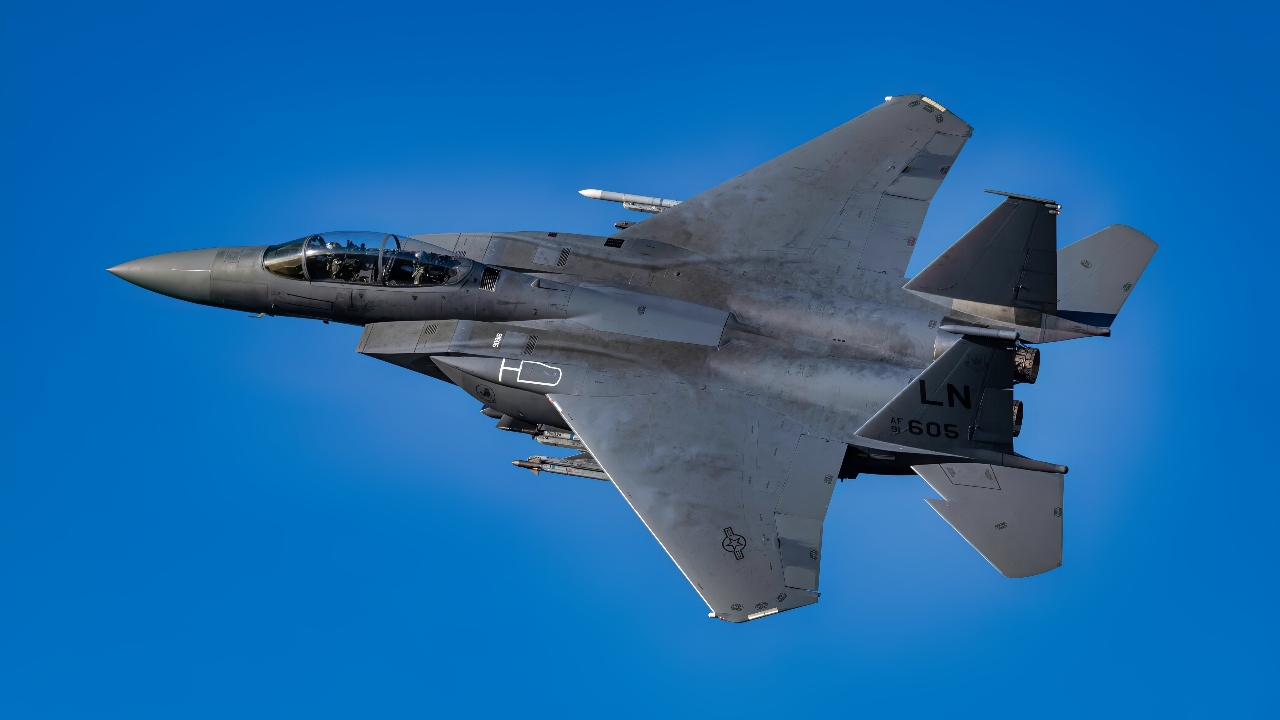
An F-15E Strike Eagle pulls out of a low approach and prepares to land at Royal Air Force Lakenheath, Jan. 5, 2022. The Strike Eagle is currently the second largest fighter aircraft in the U.S. Air Force’s inventory behind the new F-15EX. (U.S. Air Force photo by Senior Airman John Ennis)
The design brief after Vietnam was simple but ruthless: dominate the sky. The resulting aircraft had what mattered in the real world—power, persistence, and weapons you could actually use at range. It could sprint, climb like a rocket, and still carry a deep magazine.
But the Eagle’s “secret sauce” wasn’t only performance. It was systems integration and human factors. A powerful radar (and later AESA upgrades), excellent visibility, and a cockpit flow that minimized the friction between sensing and shooting gave pilots the ability to fight their plan, not the jet. Add twin-engine reliability and a generous fuel fraction, and you get the kind of sortie endurance that wins campaigns, not just dogfights.
The aircraft also adapted—growing from a pure air-to-air F-15A/C into the F-15E Strike Eagle, a two-seat, night-and-weather strike fighter that could kick in doors while still defending itself.
The Problem the Air Force Faced by the Late 2010s
Fast-forward four decades. The F-15C/D fleet was aging hard—fatigue, structural hotspots like the notorious longerons, and the simple arithmetic of airframe hours were catching up. Air National Guard units on 24/7 alert still needed a fast, high-endurance interceptor to defend the homeland and backfill capacity for deterrence missions.
Meanwhile, the F-22 line had closed early, the F-35 was still maturing and expensive to sustain at scale, and the service needed a near-term solution that could be fielded quickly, slot into existing F-15 bases and maintenance pipelines, and swing between air defense and long-range standoff carriage.
Enter the F-15EX Eagle II. It isn’t a museum piece polished for air shows. It’s a production-line descendant of the export “Advanced Eagle” (think Saudi F-15SA, Qatari F-15QA), adapted to U.S. needs with a digital backbone and open-architecture software so the jet can absorb new sensors and weapons as fast as budgets and software teams can deliver.
What the Eagle II Actually Brings
Three buckets define the upgrade:
1) Sensors and processing. The Eagle II carries a modern AESA radar with serious track/engage capacity and better reliability than the old mechanically scanned arrays. Pair that with a digital backbone and the latest mission computer suite, and you get a fighter that can fuse more data with less pilot workload. Drop a passive IRST pod on a station and you add silent detection and long-range cueing against low-observable threats. In a mixed package with stealth jets, the F-15EX can be the loud, obvious shooter taking targeting data from quieter friends.
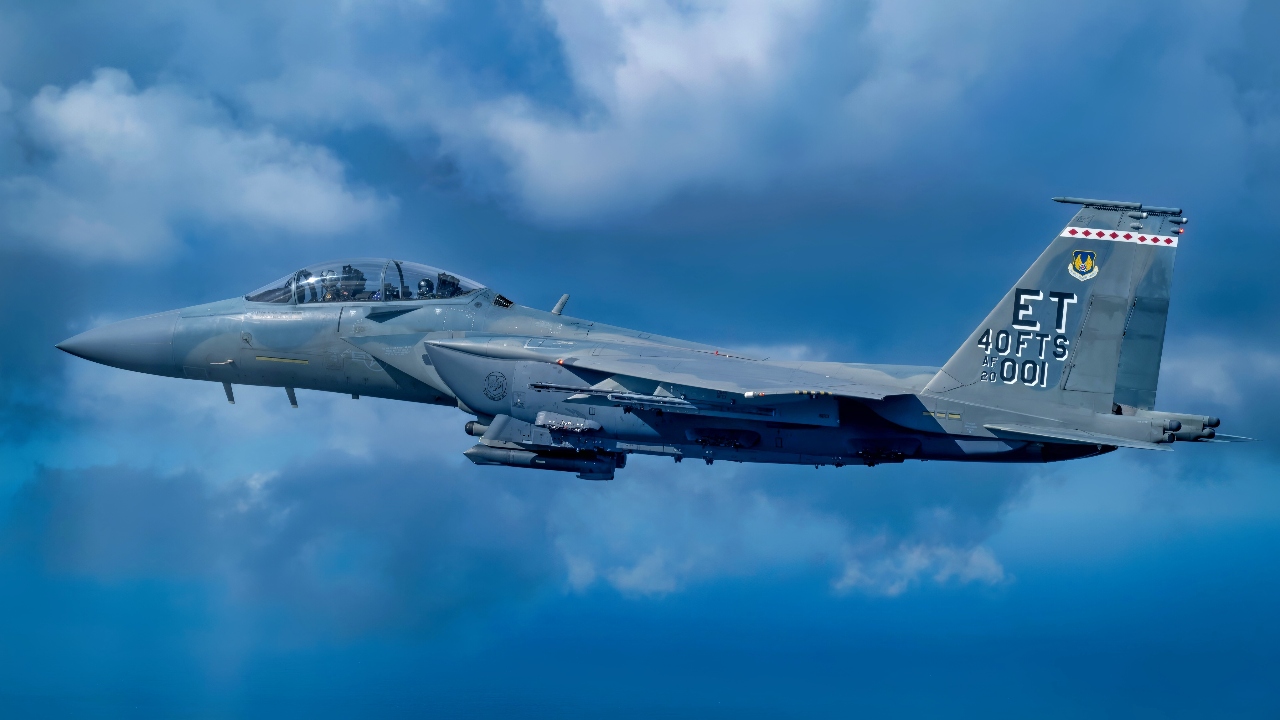
A U.S. Air Force F-15EX Eagle II fighter jet assigned to Eglin Air Force Base, Florida, flies near Jacksonville, Florida, Nov. 2, 2024. Airmen from the 40th Flight Test Squadron and 96th Aircraft Maintenance Unit supported a flyover for the annual Florida-Georgia college football game. (U.S. Air Force photo by Staff Sgt. Blake Wiles)

An F-15EX Eagle II, assigned to the 142nd Wing, taxis on the flightline before take-off during the official Unveiling Ceremony for the new fighter jet at the Portland Air National Guard Base, Oregon on July 12, 2024. The 142nd Wing will be replacing the F-15 C/D model Eagles with the new F-15EX Eagle II models. (National Guard photo by John Hughel, Oregon Military Department Public Affairs)
2) Survivability and EW. The EPAWSS electronic-warfare suite is a generational leap over legacy boxes—think automated threat detection, geo-location, and jamming options that make standoff employment more resilient and pushback against modern SAMs more credible.
No, the EX isn’t stealth. But it’s far harder to surprise—and far better at not being predictable—than the Eagles you grew up with.
3) Payload and growth. The headline is a 12-missile air-to-air loadout validated in test, with plenty of flexibility for standoff strike stores. In practice, that translates into an air-defense “magazine” that can sanitize a corridor or anchor a layered patrol, and a strike fit that lets the jet lug big weapons at useful ranges. The other number that matters is airframe life: the Eagle II is built for 20,000 flight hours. In a world where sustainment costs and depot throughput drive availability, that matters more than brochure performance.
Why the F-15EX Was Needed—In Plain English
The Air Force didn’t need a theoretical solution. It needed fighters on ramps quickly to replace F-15C/Ds at units that perform alert and air-defense missions every day.
It needed a platform that legacy F-15 squadrons could absorb with minimal disruption, leveraging existing infrastructure, maintainers, training pipelines, and weapons.
And it needed a complement, not a competitor, to stealth fighters: something that could carry more missiles, stay up longer, and shoot farther using targeting from stealthy partners.
You can argue philosophy all day, but the operational logic is straightforward:
-For homeland defense and maritime air defense where ranges are huge and tanker time is precious, endurance and weapons count weigh heavily.
-In peer conflict, a non-stealth fighter’s survivability is a function of distance and employment—launching long-range missiles from outside dense SAM rings while stealth assets work the edge.
-For weapons integration, the EX’s open systems let the Air Force field new missiles and pods faster—turning the jet into a rolling testbed that converts to real combat capability without waiting for a brand-new airframe.

F-15EX Eagle II’s from the 40th Flight Test Squadron, 96th Test Wing, and the 85th Test and Evaluation Squadron, 53rd Wing, both out of Eglin Air Force Base, Florida, fly in formation during aerial refueling operations with a KC-135 Stratotanker from the 370th Flight Test Squadron out of Edwards Air Force Base, California, May 14. The Eagle II’s participated in the Northern Edge 21 exercise in Alaska earlier in May. (Air Force photo by Ethan Wagner)

An F-15EX Eagle II, assigned to the 142nd Wing, taxis on the flightline before take-off during the official Unveiling Ceremony for the new fighter jet at the Portland Air National Guard Base, Oregon on July 12, 2024. The 142nd Wing will be replacing the F-15 C/D model Eagles with the new F-15EX Eagle II models. (National Guard photo by John Hughel, Oregon Military Department Public Affairs)
The Controversy: Why Critics Push Back
No surprise: buying a non-stealth fighter in the 2020s drew fire.
The main critiques come in four flavors:
“It’s not survivable in a high-end war.” True if you try to fly it like a stealth bomber. Not true if you employ it as intended: standoff shooter, magazine in the sky, and airborne controller in a mixed force. Survivability shifts from signature to tactics, range, and EW.
“It siphons money from stealth and NGAD.” Budget tradeoffs are real. Every dollar on EX isn’t going to NGAD or more F-35s. The counter-argument is that the EX saves time and risk by filling a critical gap now and preserving industrial capacity while NGAD matures.
“Conformal fuel tanks and other promised options weren’t there on Day 1.” Also true. Early operational jets arrived with a phased capability approach. But a crawl-walk-run spin-up is normal when you’re trying to field quickly—and it’s easier when the airframe is familiar and the production line already knows how to build the hard bits.
“Just buy more F-35s.” If the Air Force could instantly field fully supported F-35 capacity everywhere it needs it, this debate would be quieter. But sustainment realities, software increments, and training throughput have been pacing items. The F-15EX Eagle II gives commanders a near-term capacity boost with a very long service life and a skill set (speed, altitude, magazine) that pairs well with stealth.
Why the Two-Seat Cockpit Still Matters
A lot of alert missions are flown single-seat, and the Eagle II can do that. But the second cockpit is real futureproofing. As collaborative combat aircraft and other unmanned teammates mature, the back seat becomes a human mission manager—someone who can run the mixed-fleet playbook, manage sensors, and orchestrate weapons and wingmen while the pilot flies the jet. That is not Star Trek; it’s practical workload management when the information firehose gets too wide for one brain in a high-threat environment.
Where It’s Going and Who’s Flying It
The first operational Eagle IIs went to the Air National Guard, replacing tired F-15C/Ds in the homeland defense role and building toward a steady-state force. More squadrons will transition as production ramps and modernized jets roll off the line.
The planned buy has increased compared to early budgets, in part to maintain readiness and ensure the Air Force has sufficient assets to fulfill both air defense and deterrent strike roles.
Operationally, the EX will spend a lot of time doing the unsexy, essential stuff: defensive counter-air, NORAD alert, maritime intercepts, Arctic and Pacific patrols, and exercise work that cements joint tactics with stealth fighters, tankers, and AWACS replacements. But as new weapons mature—long-range air-to-air missiles, hypersonic cruise missiles, smarter decoys, improved anti-ship options—the same jet becomes a missile truck that adds real weight to a campaign without asking for a new basing plan.
How It Fights in a Peer Scenario
Picture a Pacific night with weather building and tankers scarce. Two F-15EX Eagle IIs launch to relieve a mixed patrol. Each carries a deep AAM load and a podded IRST. A stealth pair works forward, quietly detecting and sorting targets at long range. The EXs hold at the edge, receiving cues and pushing missiles into threat corridors while their EW suites complicate the enemy’s picture. If an anti-ship strike package is inbound, the EXs might act as interceptor magazines; if the task is strike support, they carry standoff weapons whose range keeps the jets outside dense SAM envelopes. It’s not glamorous. It is how you build a nightly air plan that holds up for months.
The Risks and Realities
Let’s be honest about the weak spots:
-No stealth means employment will always be constrained by distance, altitude, and EW. The EX is not your tip-in platform for first-night SEAD against a peer.
-Sustainment discipline matters. The jet’s long design life is only an asset if depots, software teams, and EW reprogramming stay on pace.
-Industrial throughput must hold. If production cadence slips, you end up with a boutique fleet that can’t absorb attrition or cover rotations.
-Budget gravity is relentless. If the Air Force is forced to choose between NGAD, F-35 block upgrades, and EX, the EX will always have to prove it is adding unique value.
The Case for the Eagle II
The pro-EX argument is pragmatic:
-Capability now. It replaces airframes that have simply run out of life, letting units maintain alert and air-defense missions without a gap.
-Complement, not replacement. It amplifies stealth—acting as a shooter, magazine, and controller that lets fifth-gen fighters conserve weapons and focus on the jobs only they can do.
-Adaptable hardware. Open architecture and a big power/cooling margin let the Air Force plug in new weapons and sensors without waiting on a new aircraft program.
-Longevity. A 20,000-hour airframe life spreads acquisition cost over decades and gives planners a dependable block of sortie capacity in an era when jets are hard to buy and harder to field.
Bottom Line on F-15EX Eagle II
The F-15EX Eagle II is not an argument against stealth, and it isn’t nostalgia.
It is a force-structure hedge with teeth—a fast, long-legged, high-capacity fighter that replaces worn-out Eagles and buys time while stealth fleets grow, sustainment stabilizes, and next-gen programs come online.
The controversy is healthy; it forces the Air Force to define where and how the EX fights. But judged by what it’s meant to do—defend the homeland, add magazine depth, integrate new weapons quickly, and complement fifth-gen fighters—the Eagle II makes strategic sense.
The real test isn’t a brochure spec. It’s delivery, training, and integration: getting enough jets to the right units, proving readiness rates are where they should be, and showing—exercise by exercise—that the EX raises the floor on daily airpower while freeing stealth assets to raise the ceiling.
About the Author: Harry J. Kazianis
Harry J. Kazianis (@Grecianformula) is Editor-In-Chief and President of National Security Journal. He was the former Senior Director of National Security Affairs at the Center for the National Interest (CFTNI), a foreign policy think tank founded by Richard Nixon based in Washington, DC. Harry has over a decade of experience in think tanks and national security publishing. His ideas have been published in the NY Times, The Washington Post, The Wall Street Journal, CNN, and many other outlets worldwide. He has held positions at CSIS, the Heritage Foundation, the University of Nottingham, and several other institutions related to national security research and studies. He is the former Executive Editor of the National Interest and the Diplomat. He holds a Master’s degree focusing on international affairs from Harvard University.
More Military
The F/A-18 Super Hornet Fighter Has Reached the End of the Line
The Ferrari F-35 Could Be a Sky Monster
F-22 Super: The ‘New’ Stealth Fighter Is Coming


Shawn Anger
September 8, 2025 at 3:47 am
I think you forgot the political piece. Boeing/MD needed a shot in the arm and LM needed the competition to meet schedule and cost. True?