


Key Points and Summary – The Caribbean has become a “powder keg” as U.S. warships steam off the coast of Venezuela, sparking a tense standoff.
-While Washington frames the deployment as a counter-narcotics operation, it’s a clear strategic signal to President Maduro, whose own provocations against Guyana and alignment with China and Russia have raised alarms.
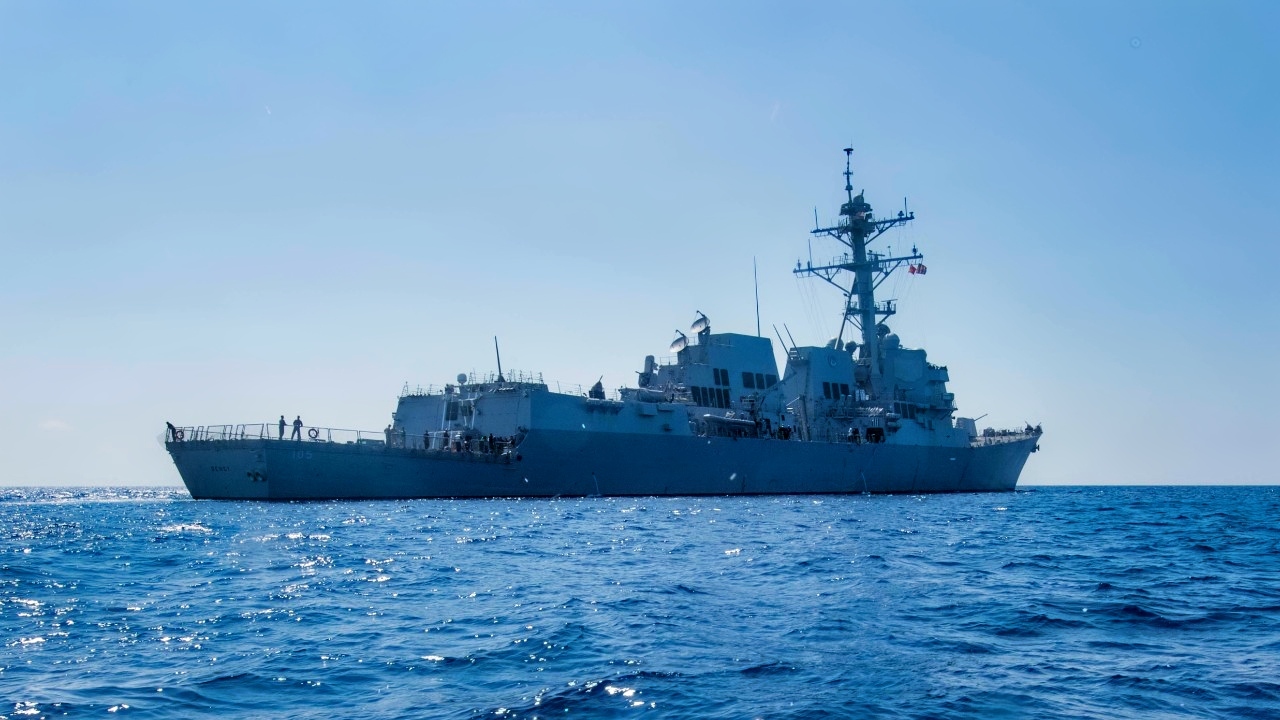
Arleigh Burke-class guided-missile destroyer USS Dewey (DDG 105) transits the South China Sea. Dewey is part of the Sterett-Dewey Surface Action Group and is the third deploying group operating under the command and control construct called 3rd Fleet Forward. The U.S. 3rd Fleet operating forward offers additional options to the Pacific Fleet commander by leveraging the capabilities of 3rd and 7th Fleets. (U.S. Navy Photo By Mass Communication Specialist 3rd Class Kryzentia Weiermann/ Released)
-Maduro has responded with defiant militia drills, creating a dangerous situation where a single miscalculation could ignite a conflict neither side truly wants.
-This is a classic case of coercive diplomacy, where the line between signaling and all-out war is perilously thin.
A ‘Powder Keg’ in the Caribbean: Are the U.S. and Venezuela on the Brink of War?
The Caribbean tonight is a powder keg.
U.S. warships are steaming off the Venezuelan coast. Venezuelan government militias are marching through Caracas in a series of televised protests of defiance. Washington says its deployment is routine and focused on drug interdiction. Venezuelan President Nicolás Maduro calls it a precursor to an invasion.
The truth is somewhere in between.
Neither side wants a war, but both have staked their national prestige on a series of deployments that, if either side misreads or misunderstands the signals, could lead them into an armed conflict that neither side seeks. This is the tragic logic classical realists from Thucydides to Morgenthau warned about: wars born not of ambition but of honor, fear, and interest colliding in an inherently anarchic world.
Could a War with Venezuela Start Soon?
So, what is happening?
To begin with, the U.S. has surged naval assets into the southern Caribbean at a high tempo over the past two weeks. A mix of guided-missile destroyers, a cruiser, and even a fast-attack submarine have arrived, billed officially as counter-narcotics operations. On its face, that explanation doesn’t pass the laugh test. You do not need sophisticated surface combatants to hunt down smugglers, and certainly not in these numbers.
The better explanation is not deception, but strategic signaling: aircraft, hulls, and flags deliberately placed where they will be seen—and read—by every audience that matters. This is coercive diplomacy with classical realist undertones: the projection of power to manage and mitigate perceived threats, not to indulge in conquest or regime change.
In response, Maduro has seized on the opportunity to present the American deployments as confirmation of a story he has long told his people: Washington is committed to overthrowing his government by force.
Maduro and his officials have claimed the activation of more than 4.5 million militia, staged televised “resistance” drills, vowed to declare a “republic in arms,” and broadcast defiant public speeches insisting there is “no way” the United States can successfully invade Venezuela.
Bluster? Partly. But the enlistment drives and highly public mobilization are real enough to raise the temperature and thus increase the odds of an ugly incident at sea or along the coastline, leading to an escalation that neither side originally intended.
Here the lesson of defensive realism is clear: states, especially weaker ones, often provoke not to conquer but to survive.
If the official counter-narcotics justification is a straw man, what are Washington’s real motives? Start with geopolitics. Deploying a muscular naval presence to the southern Caribbean is a message to three audiences at once.
To Caracas: your border provocations against Guyana, your alignment with Russia and China, and your defiance of U.S. legal and financial pressure have costs. To neighbors—especially Guyana—it is reassurance: the guarantor of hemisphere security still shows up. And to rivals further afield, it is a broadcast that American power can be flexed regionally, even while the Pentagon juggles priorities in Europe, the Middle East, and the Indo-Pacific.
Oil and credibility are also at stake. Guyana’s offshore reserves have become strategically significant almost overnight, with U.S. companies heavily invested and Georgetown now a symbol of resistance to territorial revisionism in the Western Hemisphere.
Venezuela’s revived claims over Essequibo fuse a long-standing sovereignty dispute with this new energy map. If Caracas were allowed to intimidate Guyana into concessions, it would look—fairly or not—like an American failure to defend its own neighborhood. The U.S. deployments, then, are a hedge: deterring a Venezuelan fait accompli while stopping short of outright war.
Domestic politics matter too. Trump continues to consolidate his political base by going after regimes he brands as criminal cartels and stemming South American migrant flows at the source. A highly visible military posture scratches that itch—projecting resolve without committing to the costs and risks of an actual invasion.
The same logic explains the escalatory legal theater: sharply increased bounties for Maduro; fresh rhetorical designations drawing bright lines between Venezuela’s leadership and the ordinary people of Venezuela. It is lawfare in service of deterrence, calibrated to an audience that equates toughness with ships on station and rewards on offer.
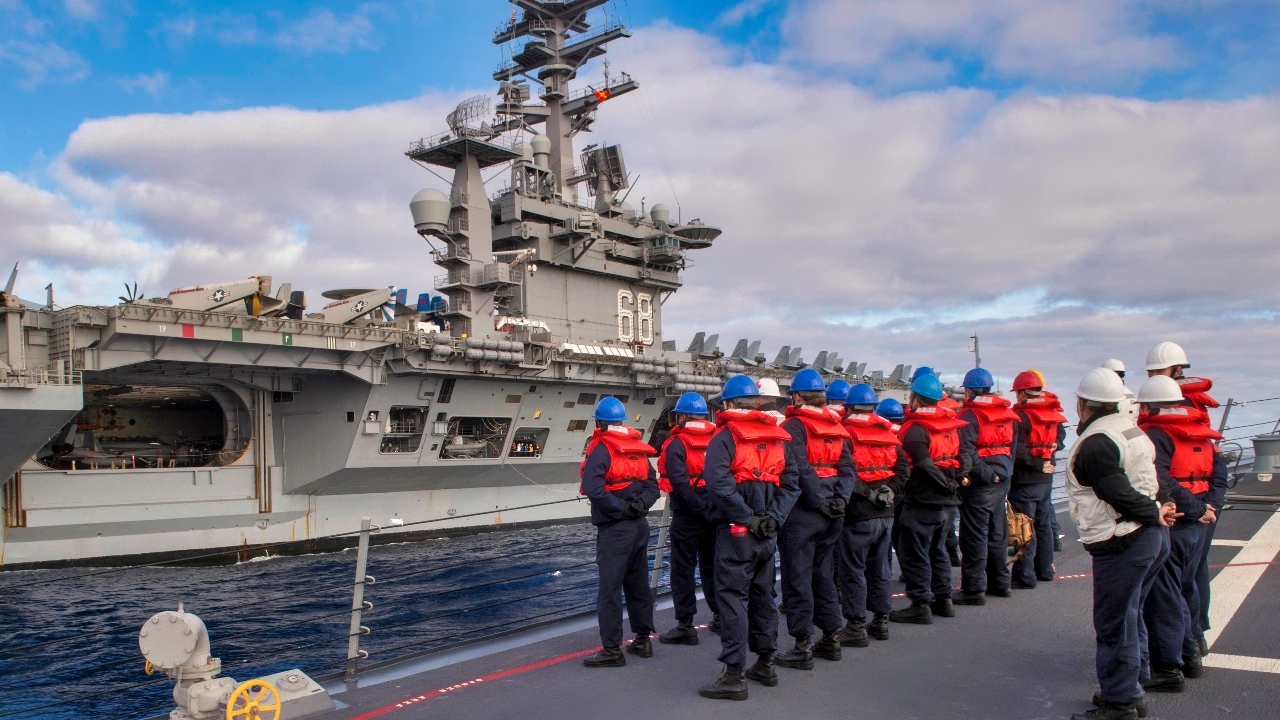
(June 11, 2017) Sailors aboard the Arleigh Burke-class guided-missile destroyer USS Pinckney (DDG 91) stand in formation as the ship pulls alongside the aircraft carrier USS Nimitz (CVN 68) to conduct a replenishment-at-sea. The Pinckney is currently underway as part of the Nimitz Carrier Strike Group on a regularly scheduled deployment to the Western Pacific and Indian Oceans. (U.S. Navy photo by Mass Communication Specialist 2nd Class Craig Z. Rodarte/Released)
Add it all up, and you have a pattern: coercive diplomacy wrapped in naval spectacle—pressure calibrated to intimidate, not invade. The ships and assets on station are meant to unsettle, to remind Maduro he is vulnerable, and to show friends and adversaries alike that the United States can still project combat power in its near abroad.
At the same time, the posture is carefully measured. The assets visible today are formidable enough to impose costs but insufficient for a full-scale amphibious assault on a populous country with loyalist militias and complex terrain. That asymmetry is the point: enough to intimidate but not enough to trip the wire to war—unless, of course, someone panics, or misreads a signal, or miscalculates a response.
And it is this element of what Clausewitz referred to as “chance” that makes the current situation in the Caribbean so dangerous. The more forces the U.S. and Venezuela concentrate in contested space, the higher the probability that an unintentional misstep could light a fuse.
In an atmosphere supercharged by nationalist rhetoric and domestic political incentives—in both countries—even a minor clash could be seized upon by hardliners as proof the other side fired first.
As classical realists have long taught, that is how wars often begin: not with a deliberate “go” order but with a sequence of escalatory moves that leave little space for either side to climb down or reach an accommodation.
The regional context only exacerbates the danger. Venezuela’s military is not able to project force in a significant way far from its shores, but at sea it can still pose significant threats, and on land it can still make use of asymmetric weapons.
At the same time, however, Guyana’s newfound oil wealth and the long-standing dispute over Essequibo mean that now every action and reaction counts more than before. Even Trinidad and Tobago has gotten pulled into the action, with its prime minister offering an opening salvo by saying that U.S. forces could use Trinidadian and Tobagonian soil against Venezuela in the event of an attack against Guyana – only to later backpedal on his statement. Here, though, is where the tragic dynamics classical realists warn of come into play: local disputes, when combined with new resources and larger alliances, can begin to develop a momentum of their own, one that is difficult for the original initiators to control as it spirals out into unintended crises.
None of this means that war is imminent. The Pentagon is acutely aware of its global commitments and the geopolitical liabilities of a costly intervention. Trump relishes displays of strength but dislikes quagmires. Maduro thrives on confrontation but knows a direct clash with U.S. forces could end his regime. Both sides have strong incentives to stop short of open conflict. The problem is that incentives do not always govern outcomes when militaries are operating in close proximity and domestic pressures reward escalating symbolism.
What Happens Next?
Taken together, then, here is where we actually are: on a narrowing ledge. The United States is not on a predetermined path to war with Venezuela. But it is skating close to a line that could be crossed inadvertently—an over-eager pilot, a jittery militia commander, a political need to look unblinking on television. The prudent course is obvious: maintain pressure while widening off-ramps, keep the military messaging proportional to achievable political ends, and separate domestic theater from real strategy.
History punishes leaders who mistake performance for policy. Classical and defensive realists alike remind us that the tragedy of international politics is that wars often emerge not from ambition but from insecurity and miscalculation. Yet they also insist that tragedy is not fate.
Prudence, restraint, and clear signaling can keep fear, honor, and interest from driving states over the edge. In the Caribbean tonight, the difference between coercion and catastrophe may be nothing more than the discipline to resist the tragic pull of events.
About the Author: Dr. Andrew Latham
Andrew Latham is a non-resident fellow at Defense Priorities and a professor of international relations and political theory at Macalester College in Saint Paul, MN. You can follow him on X: @aakatham. He writes a daily column for National Security Journal.
More Military
‘They Are Learning’: North Korean Troops Are Adapting to Drone Wars in Ukraine


waco
September 2, 2025 at 12:27 pm
Western countries, especially those belonging to the ‘DEFENSIVE’ organization called NATO🤤, like US and Canada and EU, are eager to apply war and similar violent acts like invasion, NFZ and sanctions and sabotage to change govt in all far flung corners of foreign lands.
Iraq, Libya, Grenada, panama, somalia, Syria, Chad, niger and now Venezuela.
Those western countries will continue with their very wicked ways until….
Until somebody whacks one of them right on the head with a thermonuclear sledgehammer.
Putin the effiminate can start the ball rolling by doing it against the nazist state of Kyiv.
It’s useless for Putin to appeal to xi jinping for help, as xi is no Kim jong-un.
Do it on your own.
Commentar
September 2, 2025 at 2:10 pm
Trump is targeting Nicolas Maduro, while macron, starmer, netanyahu and merz are targeting Iran.
Who the hell do those guys think they’re.
They’re merely servants of Asmodeus. Nothing more.
The best way to handle those demons is to build a giant ship and secretly install it with VLS rocket tubes.
The ship could be fully co-owned by Venezuela and Iran.
Inside each tube within the ship is a live RS-28 rocket with the live rocket carrying ten to twenty warheads.
Park the vessel in north Korean waters and let’s see what trump, macron, starmer, netanyahu dare to do.
Today, trump, macron, starmer, netanyahu and merz have become part of the Pantheon of asmodeus-influenced global conquerors like Adolf, Hirohito and Genghis.
A most very mostest bloody bloodthirsty bunch that have walked the planet.