

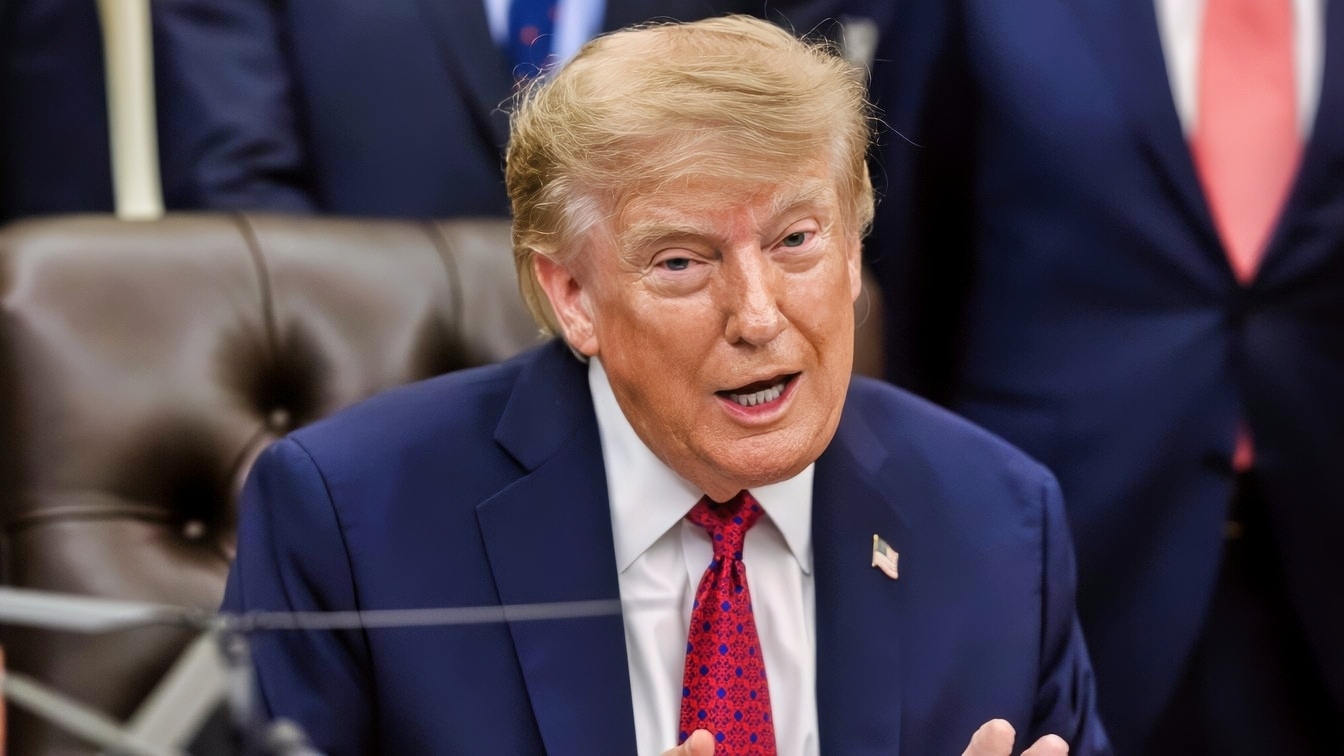
President Donald Trump has promised $5,000 checks to every adult American citizen should the Republicans win the midterm elections next month.
The proposal has been described as everything from a pay-in-the-sky campaign promise to an attempted bribe, and most political observers agree it will join the “DOGE Dividend” and tariff rebates as proposals from Trump’s second term that are unlikely ever to become reality.

Donald Trump Speaking at CPAC. Image Credit: Creative Commons.

Donald Trump Giving a Speech. Image Credit: Gage Skidmore.
However, Trump has presided over recent government check distributions that have actually gone out, though they’re for much less money and are far less universal than the $5,000 check proposal.
$90 a Pop
Trump had announced last Friday on Truth Social that the administration would begin sending “Checks,” in his words, to seniors to help pay for their Medicare payments.
According to USA Today, 20 million senior citizens enrolled in Medicare Part B this month will receive the $90 checks.
The checks will go to 1.52 million seniors in California, 1.43 million in Texas, 1.4 million in Florida, and just over 1 million in New York.
Seniors will receive their payments via direct deposit in October, although Medicare recipients without direct deposit set up will receive checks at their home address instead.
The payments, per the report, will be diverted from the $2 billion Medicare Improvement Fund, which Trump described in the Truth Social post as a “slush fund” that Democrats had used in the past to pay for “the Waste, Fraud, and Abuse for their Special Interest friends.”
In that post, he also touted his proposal for $5,000 checks, which he reiterated are contingent on Republicans winning control of Congress in November.
The Obamacare “Refunds”
The Trump Administration has also begun distributing a different one-time payment to a specific subset of Americans.
According to CNBC, these checks are described as $500 “refunds” for more than 950,000 Obamacare enrollees, whom the White House claims were “overcharged” their fees during the Biden years.
The checks will go to Americans in 30 states.
In September, the White House announced the payments and described them as “Working Families Obamacare Refunds.” The claim was that the Biden Administration had overcharged the Obamacare enrollees in the 30 states that used the federal exchange.
The other 20 states, most of which were governed by Democrats at the time have their own state-level exchanges.
Per the CNBC report, the Affordable Care Act’s passage in 2010 included enhanced premium subsidies, which the Republican Congress declined to renew when they expired at the end of 2025.
This resulted in increased premiums. Jonathan Oberlander, a professor of health policy and political science at the University of North Carolina at Chapel Hill, told CNBC that the refunds were likely “damage control” in response to those higher premiums.
Other experts told CNBC that the refunds are unlikely to significantly offset the higher premiums.
The Affordable Care Act payments were also not authorized by any congressional act.
Brad Woodhouse, of the activist group Protect Our Care, called the refunds an “absolute joke” and predicted that the “$500 gimmick won’t even begin to dig them out of the hole that Trump and Republicans created,” in comments to the Associated Press after the payments were first announced in September.
Is It Legal?
Some Democrats have raised questions about the legality of such payments, since Congress did not appropriate the money by any act, although no legal challenge has been raised yet.
“If you want to BUY midterm votes, maybe start by not gutting everyone’s health care in the first place,” Sen. Ron Wyden (D-OR) said on social media this week in response to the Obamacare refunds.
It’s one of a few midterm election moves by Trump that are out of the ordinary and possibly not legal. Another is the campaign ads, featuring the president, which are “paid for by the U.S. government.”
The advocacy group Public Citizens says the ads are prohibited by federal law and has called on the Federal Communications Commission (FCC) and the Federal Trade Commission (FTC) to block further airings.
The White House has described the ads as “public service announcements” and vowed to continue airing them, along with other future ads.
About the Author: Stephen Silver
Stephen Silver is an award-winning journalist, essayist, and film critic, and contributor to the Philadelphia Inquirer, the Jewish Telegraphic Agency, Broad Street Review, and Splice Today. The co-founder of the Philadelphia Film Critics Circle, Stephen lives in suburban Philadelphia with his wife and two sons. For over a decade, Stephen has written thousands of articles on politics, national security, technology, and the economy. Follow him on X (formerly Twitter) at @StephenSilver, and subscribe to his Substack newsletter.


