

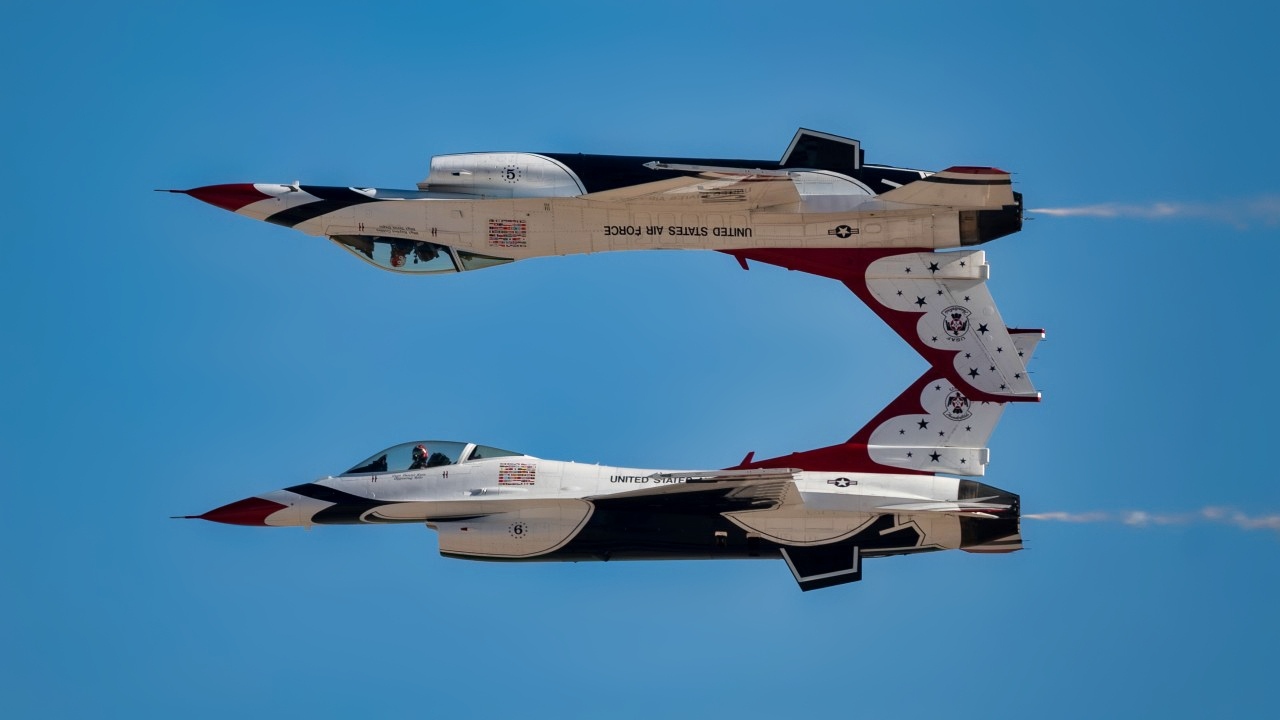
Russia has continued to bombard Ukraine in the past weeks, with one of the largest ballistic-missile barrages of the entire war occurring two weeks ago.
These attacks are typically opportunistic acts by Russian President Vladimir Putin.
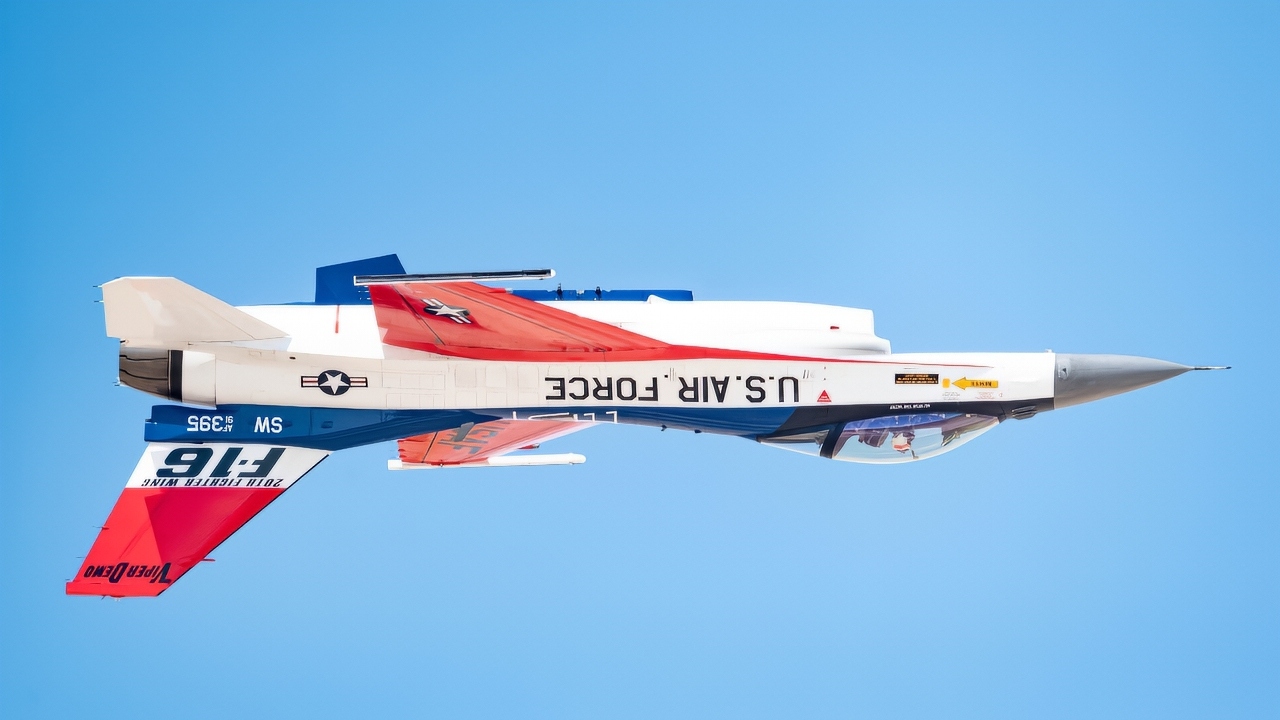
U.S. Air Force Maj. Taylor “FEMA” Hiester, F-16 Viper Demonstration Team commander and pilot, performs aerial maneuvers in an F-16C Fighting Falcon during an air show at Marine Corps Air Station Yuma, Ariz., March 15, 2025. The flight demonstration highlights the versatility of the F-16, a multi-role fighter aircraft proficient in both air-to-air and air-to-ground combat. (U.S. Air Force photo by Senior Airman Steven Cardo)

A U.S. Air Force F-16 Fighting Falcon flies over the U.S. Central Command area of responsibility Oct. 14, 2020. The F-16 Fighting Falcon is a compact, multirole fighter aircraft that has proven itself in both air-to-air combat and air-to-surface attack. (U.S. Air Force photo by Senior Airman Duncan C. Bevan)
Ukraine has run out of US-made Patriot missiles, which are the only defensive weapons that are effective against Russia’s ballistic missiles, which travel at beyond supersonic speeds in terminal phase descent.
Putin knows of this deficiency, which is why the attacks have intensified.
Despite a plethora of historical evidence proving that bombing Ukraine into submission will not work, the former KGB Lt. Col. who has ruled Russia for 26 years is attempting to bomb Ukraine into granting him territorial concessions they have no intention of signing up to.
But the problem of not having enough interceptor missiles for the Patriot still is a cause for massive destruction in the city of Kyiv and a weekly loss of life – caused when Russian missiles land on top of Ukrainian apartment buildings.
“Protection against ballistic missiles is our constant and top priority,” Ukrainian President Volodymyr Zelensky declared after one of these recent attacks. But Ukraine’s problem in defending against these Russian attacks is that even if it had enough missiles to fill its current inventory of Patriot launchers, there would still be too many “holes” in coverage over major cities and strategic targets.
Shoot The Archers
What needs to happen in Ukraine, writes retired US Navy Admiral Mark Montgomery, who is now a Director at the Foundation for the Defense of Democracies (FDD), in a recent edition of the Washington Post.
Ukraine must be able not only to take down incoming missiles “to deflect Russian arrows,” but also must be capable of “shooting the archers,” he advocates.
Due to Ukraine’s vulnerability to attack, Russia has invested heavily in increased production of Iskander, RM-48U, and Zirkon ballistic missiles.
What is anticipated for the coming months is that as winter approaches, Putin’s air and missile forces will renew their perennial efforts to destroy Ukraine’s energy infrastructure.
Again, the goal is to try and break the will to put up resistance by the Ukrainians – in this instance, by damaging so many power grids that people will be frozen into submission during the sub-zero months.
What Adm. Montgomery and others are calling for is for Ukraine to switch away from a defensive posture.
He also specifically points to Ukraine’s intention to work with its European allies on a new air and missile defense system called Freyja. The US has also offered Ukraine the opportunity to produce its own Patriot missiles under a license-production agreement.
These initiatives, as well as other efforts, are, as he comments, “positive. But they will all take time — likely years — to bear fruit.” What Montgomery and others who have spoken to NSJ are now advising is an immediate, faster solution that falls into the category of “shooting the archers.”
This approach would not require Ukraine to construct massive factories or production lines that will not produce a single missile anytime soon.
Instead, his proposal is for Ukraine to utilize the assets – specifically, air-launched weapons – that it already has in inventory.
Freeing Up The ERAM
Ukraine has a fleet of US-made F-16 fighter jets. These are older-model fighters, many of which were built in the F-16A/B era and were subsequently upgraded. But even in this configuration, they are not capable of performing the missions they are desperately needed for now.
These F-16s need to be employed on strike packages to destroy the Russian mobile ballistic missile launchers – so that they are put out of action before they can fire any missiles at all.
The F-16 is capable of performing this task, but it is not configured to use the weapon that would make this possible.
The US has already approved the sale of 3,350 Extended Range Attack Munitions (ERAMs) to Ukraine.
The ERAM is a 500-pound, air-launched, highly accurate standoff missile with a maximum range of about 300 miles. It is also designed with a high degree of jamming immunity.
At present, however, these US jets are not equipped to use the ERAM.
The missile is only integrated into older Russian-designed fighter aircraft such as the Mikoyan MiG-29 and Sukhoi Su-27.
These older aircraft lack the electronic infrastructure for pilots to re-target the ERAM weapon guidance system and update the target list while in flight. They can only be programmed while on the ground.
Integrating the weapon onto the F-16 would give the pilot assigned such a “search and destroy” mission far more flexibility.
Making these modifications to the F-16s would take only a few weeks, rather than the years it would take to establish Patriot missile production lines.
“Stop the missiles at the launcher,” says Montgomery. “The technology exists, the platform exists, and the weapon is already approved for sale. A small change in US policy would make a big difference in Ukraine’s fight for survival.”
About the Author: Reuben F. Johnson
Reuben F. Johnson has thirty-six years of experience analyzing and reporting on foreign weapons systems, defense technologies, and international arms export policy. Johnson is the Director of Research at the Casimir Pulaski Foundation. He is also a survivor of the Russian invasion of Ukraine in February 2022. He worked for years in the American defense industry as a foreign technology analyst and later as a consultant for the U.S. Department of Defense, the Departments of the Navy and Air Force, and the governments of the United Kingdom and Australia. In 2022-2023, he won two awards in a row for his defense reporting. He holds a bachelor’s degree from DePauw University and a master’s degree from Miami University in Ohio, specializing in Soviet and Russian studies. He lives in Warsaw.


