


Key Points and Summary – In 2009, the Los Angeles-class attack submarine USS Hartford collided with the amphibious ship USS New Orleans in the Strait of Hormuz, causing more than $100 million in damage and injuring 15 sailors.
-A Navy investigation found Hartford’s crew at fault, citing “dozens of errors” and a lax command climate that tolerated sleeping on watch, slouching at the controls, casual chatter in sonar, and even an officer navigating while listening to an iPod.
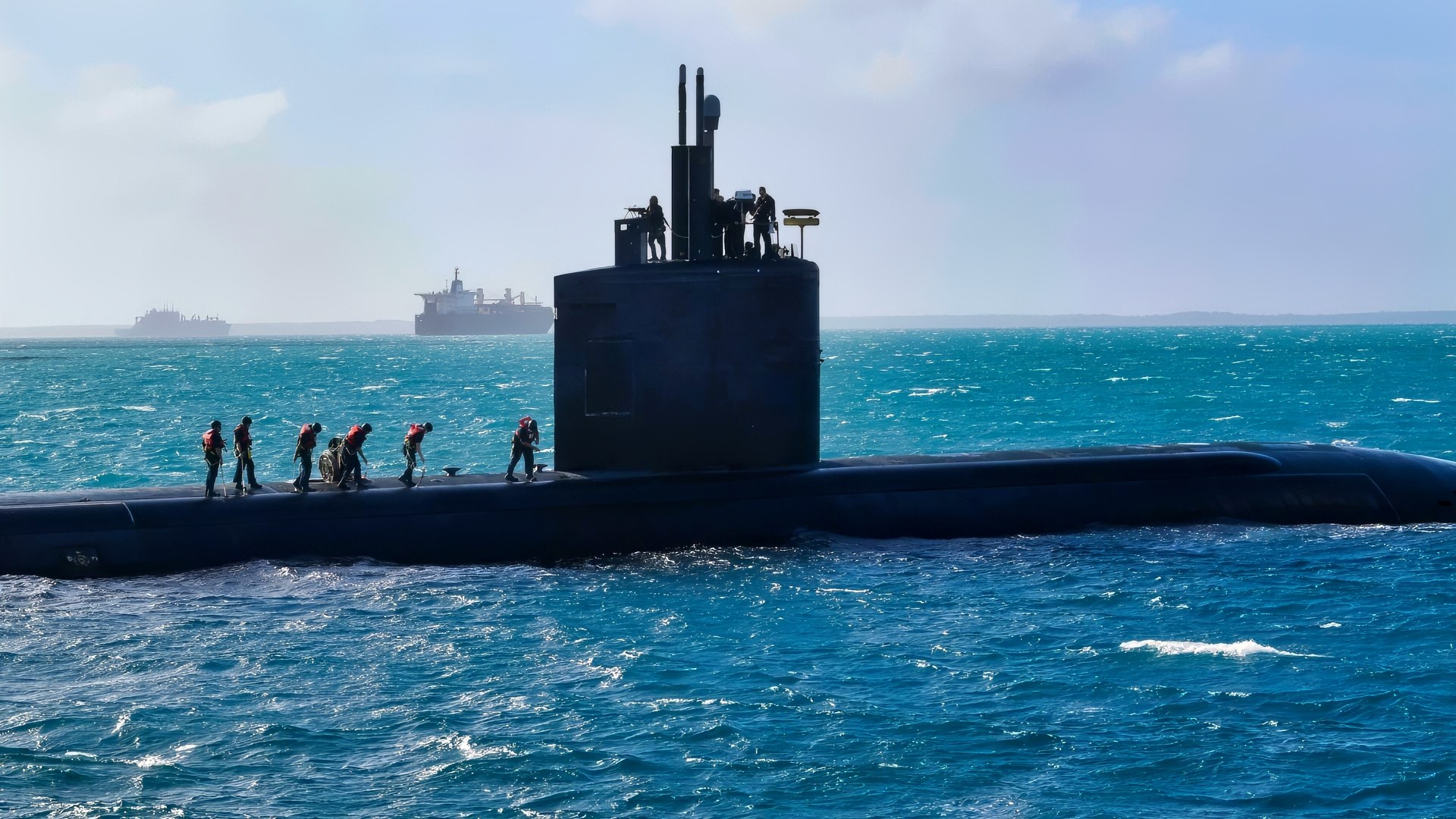
DIEGO GARCIA, British Indian Ocean Territory (Aug. 21, 2020) – USS Greeneville (SSN 772) enters Diego Garcia’s harbor Aug. 21, 2020. Sailors assigned to U.S. Navy Support Facility (NSF) Diego Garcia provided mail delivery and trash disposal for Greeneville. NSF Diego Garcia provides logistic, service, recreational and administrative support to U.S. and Allied Forces forward deployed to the Indian Ocean and Arabian Gulf. U.S. Navy Photos by Mass Communication Specialist Seaman Michael T. Porterfield. (Released)
-Investigators concluded that correcting any one of nearly 30 mistakes could have prevented the crash, turning the incident into a case study in failed leadership and standards.
Inside the $100 Million Navy Submarine Crash That Should Have Never Occured
In 2009, the Los Angeles-class attack submarine USS Hartford collided with the amphibious ship USS New Orleans in the Strait of Hormuz, causing more than $100 million in damage and injuring 15 sailors.
A Navy investigation found Hartford’s crew at fault, citing “dozens of errors” and a lax command climate that tolerated sleeping on watch, slouching at the controls, casual chatter in sonar, and even an officer navigating while listening to an iPod.
Investigators concluded that correcting any one of nearly 30 mistakes could have prevented the crash, turning the incident into a case study in failed leadership and standards.
Submarine Crash Happened for Reasons You Won’t Believe
There are grazing incidents and other close calls between vessels, but sometimes more serious collisions occur, with a comedy of errors as the cause.
That’s what happened in 2009.
The US Navy’s Los Angeles-class submarine USS Hartford and the Navy’s San Antonio-class amphibious transport dock USS New Orleans collided. This happened in the Strait of Hormuz near the United Arab Emirates, Iran, and Oman on March 20.

POLARIS POINT, Guam (May 7, 2013) The Los Angeles-class attack submarine USS Albuquerque (SSN 706) arrives in Apra Harbor, Guam, to conduct maintenance and liberty. Albuquerque is conducting operations in the U.S. 7th Fleet area of responsibility. (U.S. Navy photo by Mass Communication Specialist 1st Class Jeffrey Jay Price/Released)
The damage was extensive and cost more than $100 million in repairs, with extended refit periods and other transformations to make the vessels sea-worthy again. After an investigation, the USS Hartford was considered responsible for the wreck.
What Were These Sailors Doing?
The Los Angeles-class fast attack submarine made “dozens of errors,” according to NBC News.
This accident was a doozy, a result of incompetence and a lack of military bearing and professionalism. This was “an accident that exposed lax leaders who tolerated sleeping, slouching, and a radio room rigged with music speakers,” the Navy investigation found, NBC noted.
The command team on the USS Hartford was found to be negligent. There were clearly violations of undersea warfare regulations, a lack of standards, and a failure to take seriously the crossing of the critical and dangerous Strait of Hously.
This Was a Hazardous Incident That Could Have Been Tragic
New Orleans had $2.3 million in damage, while Hartford tallied over $100 million. To make matters worse, 15 sailors on the Hartford had non-life-threatening injuries.
The chief of the sub was ordered to take another job, and many of the officers conducted themselves poorly, failing to meet Navy expectations.
The investigation revealed that New Orleans had no part in the wreck, and its officers and crew were not admonished. However, the officers of the Hartford were blamed for command errors leading up to the crash.
“Correction of any one of nearly 30 tactical and watch-stander errors, or adherence to standard procedures, could have prevented this collision,” Admiral John Harvey Jr., leader of US Fleet Forces Command, wrote in the investigatory report.
You Have Got to Be Getting About This Incompetence
It gets worse. The report said some sailors were sleeping on duty. At least five personnel would catch a nap during operations, and the sailors took turns while nodding off. The others kept a watch out so as not to be caught by superiors.
Amazingly, officers later found out these sleep habits were taking place, but did nothing about them. No disciplinary action was taken.
A Cascade of Problematic Behavior
More details of incompetence emerged. “During the hour before the collision, sonar operators in charge of monitoring nearby ships were chatting informally; the supervisor left his station; the navigator was taking an exam while listening to his iPod; and the officer in command did not check the periscope,” the report said.
One responsibility of an officer for any branch of service is never to ignore deficiencies. But this was just what the command team on the Hartford did, even while crossing the Strait of Hormuz, where combat can always arise. No iPod should be seen on duty.
Checking the periscope should be automatic. And no chit chat by sonar operators should be allowed.
The ship drivers were relaxed at the controls – often “slouching” and removing their shoes for more comfortable seating. Sonar operators would just leave their duty stations and return to quarters or meander around the sub.
One Big Command Failure
“This appearance of a lack of standards, and of a general reticence to hold personnel accountable to standards, did not inspire either the questioning attitude or the forceful watch team backup that could have helped avoid the collision,” the report said.
I have written about various US Navy accidents before, and this is the worst after-action report I have ever seen. Subs can run aground, and it is usually because of poor communication, not loose standards or terrible crew habits.
Should the Skipper Have Been Court-Martialed?
Commander Ryan Brookhart was fired, and he was lucky the Navy did not court-martial him for dereliction of duty. This was a severe incident that could have resulted in a loss of life. The Silent Service has high standards for its officers and enlisted personnel, and these activities should never have been allowed on board.
This cascade of incidents started with sailors taking cat naps. No chief petty officer should have allowed this to happen. When sailors found out that their shipmates could take such luxuries, they figured that if my friend didn’t get caught, I wouldn’t either. So the iPods appeared, and lax duty activities commenced.
The Navy should have relieved more people, including the squadron commander. The investigation was heavily redacted in the final report, indicating that the service branch did not want the details to reach the media. But sometimes making an incident public shows that more oversight is needed on duty.
I never served in the Navy, so I do not know what long sea deployments are like. I do not want to sound like a scold or armchair admiral, not having been on a sub for months like these sailors. But all current and former officers and non-commissioned officers would be aghast at the funny business that occurred on this submarine. It all could have been prevented.
About the Author: Brent M. Eastwood
Author of now over 3,000 articles on defense issues, Brent M. Eastwood, PhD is the author of Don’t Turn Your Back On the World: a Conservative Foreign Policy and Humans, Machines, and Data: Future Trends in Warfare plus two other books. Brent was the founder and CEO of a tech firm that predicted world events using artificial intelligence. He served as a legislative fellow for US Senator Tim Scott and advised the senator on defense and foreign policy issues. He has taught at American University, George Washington University, and George Mason University. Brent is a former US Army Infantry officer. He can be followed on X @BMEastwood.


