


Key Points and Summary – Aging CF-18s leave Canada at a crossroads. Ottawa is reviewing its F-35 purchase, with results expected Sept 20–22, a decision that will shape NORAD interoperability, NATO commitments, and Arctic defense for decades.
-Proponents argue the fifth-gen F-35’s stealth, sensors, and networked ops are essential against Russian activity in the High North.
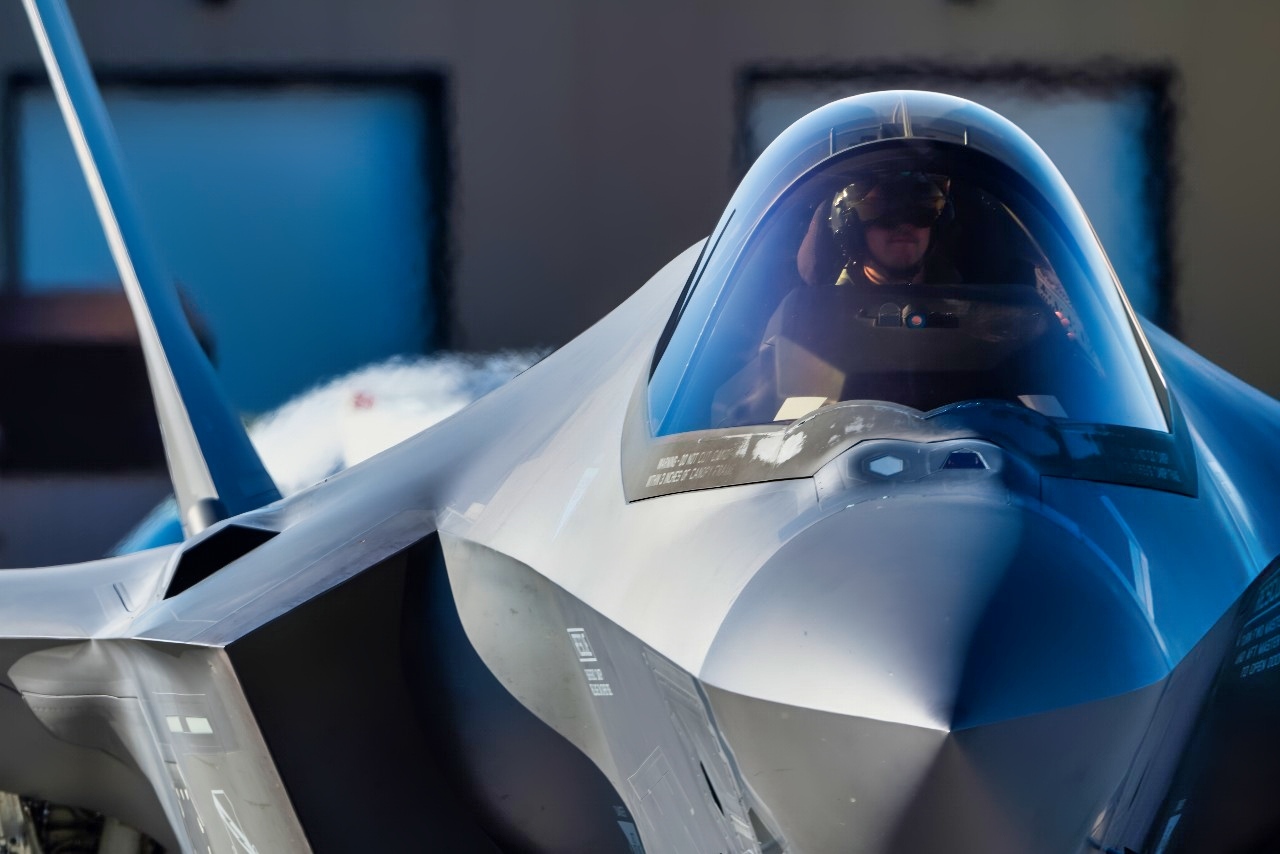
An F-35A Lightning II fighter jet, a single seat, single engine, all-weather stealth multirole fighter aircraft, assigned to the 466 fighter squadron prepares to taxi across the flightline at Hill Air Force Base, Utah, Oct. 5, 2024.
-Critics want cheaper 4.5-gen options—Saab JAS 39 Gripen E, Dassault Rafale, or Boeing Super Hornet—that promise lower costs and industrial offsets but less stealth and integration.
-Our explainer breaks down the stakes, timelines, and trade-offs so you can see what Canada gains—or risks—if it cancels the F-35 and chooses an alternative.
What Will Canada Do on the F-35 Stealth Fighter?
For decades now, Canada has relied on an increasingly aging fleet of CF-18 fighters to defend its airspace. While this fighter is capable on its own, it is growing increasingly outdated and no longer sufficient to deter contemporary threats.
Originally, Canada had planned to procure several batches of F-35 stealth fighters to modernize its air force. However, after tensions with the Trump administration have increased, Canada is now reconsidering its decision to purchase the advanced fifth-generation fighters.
The Canadian Military is currently conducting a review of the purchase, the results of which are expected around Sep 20-Sep 22.
The results will likely determine whether the government will proceed with the order.
Why Canada Needs the F-35
Canada’s defense strategy is shaped by its vast geography, its commitments to international alliances like NORAD and NATO, and the increasing importance of Arctic sovereignty. The F-35 is uniquely suited to meet these demands.
As a fifth-generation multirole stealth fighter, it offers capabilities that no other aircraft currently in production can match. Its stealth profile, advanced sensors, and ability to operate in a networked battlespace make it a force multiplier in both defensive and offensive operations.
One of the most compelling reasons for Canada to adopt the F-35 is its interoperability with the United States. As a founding member of NORAD, Canada and the U.S. are required to fly the same kind of planes for interoperability.
Pete Hoekstra, the U.S. ambassador to Canada, warned that the NORAD alliance could be threatened should Canada decide to back out of the F-35 deal. “If Canadians are flying one airplane, we’re flying another airplane, it’s no longer interchangeable,” Hoekstra explained. “And so, that might even threaten NORAD.” The F-35 is the only fighter jet that offers full-spectrum interoperability with U.S. forces, including secure data sharing, joint mission planning, and real-time battlefield awareness.
Maintaining Deterrence
Canada’s NATO commitments also require a modern, capable fighter that can operate alongside allied forces in high-threat environments.
The F-35’s stealth and sensor fusion capabilities allow it to penetrate contested airspace, conduct precision strikes, and provide real-time intelligence to coalition partners. In an era where peer adversaries are deploying sophisticated air defense systems and electronic warfare tools, the F-35’s survivability and adaptability are essential.
Another major factor is Canada’s need to defend its Arctic territory. As climate change opens new shipping routes and increases access to natural resources, the Arctic is becoming a region of strategic competition.
Russia has significantly expanded its military presence in the Arctic, and China has declared itself a “near-Arctic” power. Canada must be able to monitor and respond to incursions in this vast and remote region.
The F-35’s long range, advanced sensors, and ability to operate in harsh environments make it well-suited for Arctic patrol and defense missions.
What if Canada Cancels the F-35? Top 3 Alternatives
If the government does decide to terminate the F-35 deal, either due to cost overruns, political shifts, or technical issues, Canada would need to consider alternative fighter jets.
No other aircraft matches the F-35’s full suite of capabilities, but several strong contenders could fulfill many of Canada’s defense requirements.
The JAS 39 Gripen
The first and most frequently discussed alternative is the Saab JAS 39 Gripen E. This Swedish-built fighter is a 4.5-generation aircraft known for its cost-effectiveness, agility, and advanced avionics.
It features an active electronically scanned array (AESA) radar, electronic warfare systems, and a modern cockpit.

The Saab JAS 39E Gripen is Sweden’s modern multi-role fighter, built specifically for versatility and resilience against Russian threats. Image Credit: Creative Commons.
The Gripen is designed for ease of maintenance and high sortie rates, making it attractive for countries with limited defense budgets. Saab has also expressed willingness to allow local assembly and technology transfer, which could benefit Canada’s aerospace industry.
However, the Gripen lacks the stealth capabilities of the F-35 and is less integrated with U.S. and NATO systems, which could limit its effectiveness in joint operations. Its performance in Arctic conditions, while promising, is less proven than that of the F-35.
The Dassault Rafale
Another potential alternative is the Dassault Rafale, a French multirole fighter that has seen combat in Libya, Mali, and Syria.
The Rafale is known for its versatility, capable of performing air superiority, ground attack, reconnaissance, and nuclear deterrence missions. It features advanced systems such as the SPECTRA electronic warfare suite and a powerful AESA radar.
The Rafale is a mature, combat-proven platform with a strong track record. However, it is expensive, comparable in cost to the F-35, and lacks stealth.

Dassault Rafale Fighter in India. Image Credit: Creative Commons.
Its integration with NORAD systems would also be more complex, and France’s independent defense posture may complicate long-term interoperability with North American forces.
The F/A-18E/F Super Hornet
The third major alternative is the Boeing F/A-18E/F Super Hornet. This would be a more practical choice since the aircraft shares a lineage with Canada’s current CF-18s, which could simplify pilot training and maintenance.
This option would also work within the NORAD framework and allow interoperability with the U.S. The Super Hornet is a reliable, multirole platform used extensively by the U.S. Navy. It offers a good range, payload, and survivability, and has been upgraded with modern avionics and sensors.
However, the Super Hornet is based on an older design and lacks stealth capabilities. It is also nearing the end of its production lifecycle, raising concerns about long-term support and upgrade potential. Additionally, if Canada is hesitant to procure the F-35, it is less likely that it would be willing to buy 4th-generation American fighters.

A Sailor directs an F/A-18E Super Hornet from the “Kestrels” of Strike Fighter Squadron (VFA) 137 on the flight deck of the aircraft carrier USS Nimitz (CVN 68) in the South China Sea, May 12, 2025. Nimitz is underway in the U.S. 7th Fleet area of operations on a scheduled deployment, demonstrating the U.S. Navy’s unwavering commitment to a free and open Indo-Pacific. (U.S. Navy Photo by Mass Communication Specialist Seaman Apprentice Franklyn M. Guage)
Canada Destined to Go F-35?
Ultimately, it is up to the Canadians to decide how they wish to defend themselves. Whether they stick with the F-35 or pursue a European model for their defensive needs is ultimately Canada’s problem.
However, many practical factors must be considered before the government makes any rash decisions. Canada is a member of NORAD and is thus responsible for maintaining treaty obligations. Canada also has a vast amount of territory to defend, and with Russia pushing further into the Arctic, the need for an advanced fighter is even more critical.
About the Author: Isaac Seitz
Isaac Seitz, a Defense Columnist, graduated from Patrick Henry College’s Strategic Intelligence and National Security program. He has also studied Russian at Middlebury Language Schools and has worked as an intelligence Analyst in the private sector.
More Military
F-35I Adir: Israel Has a Custom Stealth Fighter
Russia Might Never Have Another Aircraft Carrier
J-50: China Has A New Stealth Fighter Flying


Brent Dawson
September 17, 2025 at 5:54 pm
“ability to operate in harsh environments make it well-suited for Arctic patrol and defense missions.”
???
I know the plane was grounded from flying near lightning for four years rumors are that is fixed …
But
Didn’t an F35 recently crash because it iced up?
Yeeaah we don’t “need” that.
Ron Fischer
September 17, 2025 at 6:25 pm
I lost respect for this author as soon as he stated the F-35 has proven arctic capabilities. What a joke this thing needs to be kept in a heated hanger to ensure takeoff and has had many issues adapting to service in Alaska. The Gripen on the other hand is northern born and northern bred. This fighter lives in the arctic and subarctic. The F-35 is a finicky primadona and is not a good aircraft for a country that needs a really good multi role fighter. We should buy 32-36 F-35’S and focus them on NORAD deployment, and buy an additional 120 Gripens for sovereign defence, this will get us near cold war level numbers.
Canuck
September 20, 2025 at 11:56 pm
The Gripen is a great plane, but for long-range arctic combat air patrol, we should really be looking at twin-engine fighters.
If you have an engine malfunction 800 km into the middle of white nowhere, you’ll be real glad you had a spare. That’s the reason we bought F-18s back in the day instead of F-16s.
Shawn
September 18, 2025 at 1:27 am
F35 is no any using for Canada. There is no possibility for Russian plane to fly Arctic to challenge Canada,except Russian missile.
Pragmatic Thinker
September 21, 2025 at 12:13 am
Gripen E and Rafale can fly armed supersonic without afterburner “supercruise”. Neither the F-35 nor the F-18E can do this. Gripen E flies for much less then the other options less then one third the flight hour cost of an F-35. Gripen E is already testing with AI piloted options and other 6th gen. technologies as Gripen E is much better suited for rapid upgrades compared to the other choice. The massive protection of aerospace systems and jobs makes it a very difficult option to consider. F-35 is continuing to fail with availability and servicing not to mention costs. The block 4 upgrade F-35 Canada is to buy is five years behind schedule and $6 billion overbudget now to be ready in 2030 with less improvements.
preston
October 5, 2025 at 8:18 pm
We cant really switch from the f35 now. we have pilots, mechanics and instructors already and they would take 5 years to confirm.
preston
October 5, 2025 at 8:20 pm
The thing is saab that is holding canada back from the gripen