


The US Air Force’s Accidental Masterpiece: How the F-16 Conquered 50 Years of Change – When the YF-16 first flew in January 1974, it was revolutionary. It introduced digital fly-by-wire controls, relaxed static stability, a side-stick controller, and the famous bubble canopy. Those were generational leaps in fighter design.
And because the basic aerodynamic design was so good, engineers never had to replace the aircraft. Instead, they kept upgrading everything around the airframe.

F-16 Fighting Falcons from the 35th and 80th Fighter Squadrons of the 8th Fighter Wing, Kunsan Air Base, Republic of Korea; the 421st Expeditionary Fighter Squadron of the 388th FW at Hill Air Force Base, Utah; the 55th EFS from the 20th FW at Shaw Air Force Base, S.C.; and from the 38th Fighter Group of the ROK Air Force, demonstrate an “Elephant Walk” as they taxi down a runway, during an exercise at Kunsan Air Base, Republic of Korea, March 2, 2012. The exercise showcased Kunsan Air Base aircrews’ capability to quickly and safely prepare an aircraft for a wartime mission. Image Credit: Creative Commons.

F-16 Fighting Falcons from both the 35th and 80th Fighter Squadrons of the 8th Fighter Wing, as well as from the 466th Fighter Squadron of the 419th Fighter Wing at Hill Air Force Base, Utah, demonstrate an elephant walk formation as they taxi down a runway during an exercise at Kunsan Air Base, Republic of Korea Dec. 2, 2011. The exercise showcased Kunsan AB aircrews’ capability to quickly and safely prepare an aircraft for a wartime mission. (U.S. Air Force photo by Staff Sgt. Rasheen Douglas/Released)
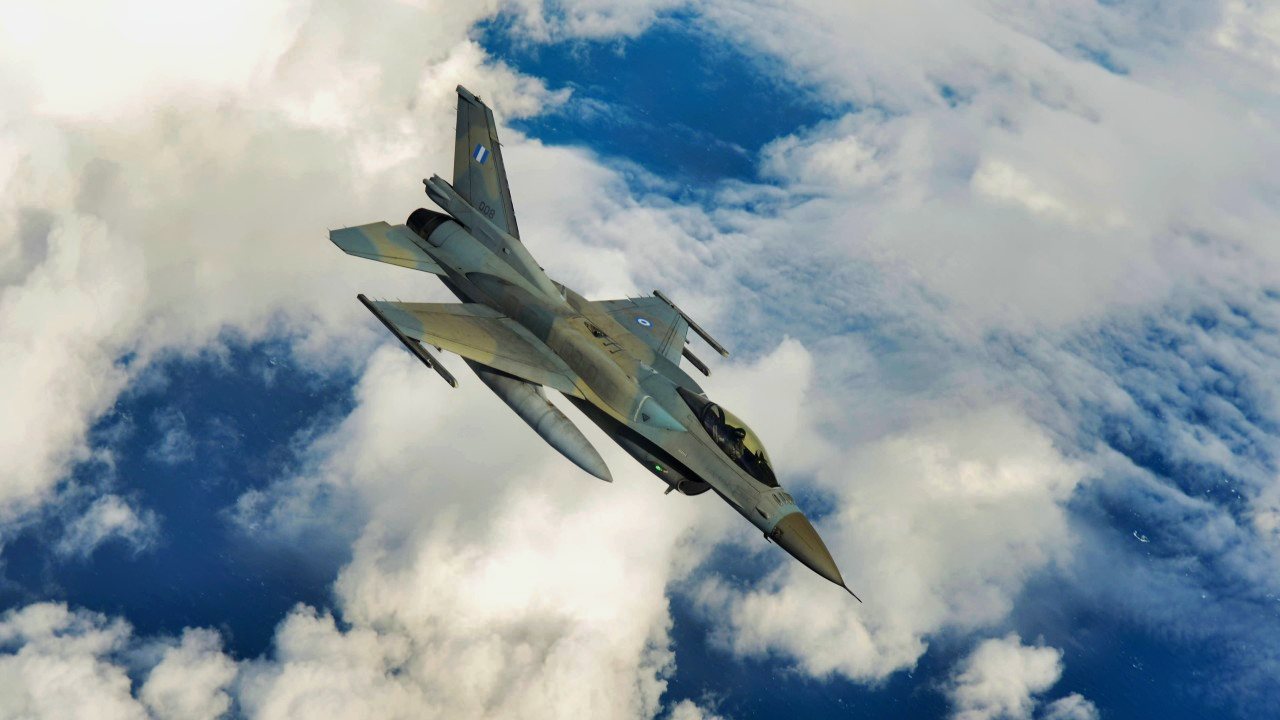
Hellenic air force F-16C Fighting Falcons fly alongside a U.S. Air Force KC-135 Stratotanker from the 100th Air Refueling Wing Oct. 26, 2017, over the Mediterranean Sea. During this flight, the KC-135 participated in aerial refueling training with 22 F-16s. (U.S. Air Force photo by Senior Airman Tenley Long)
The “Block” Upgrade Philosophy
One of the most important reasons for the F-16’s longevity was the Air Force’s decision to modernize the aircraft in stages.
Rather than waiting for a completely new fighter, the Air Force continually introduced new “Block” variants with better radars, avionics, weapons, software, engines, and mission systems. All this occurred under the Multinational Staged Improvement Program (MSIP) in the 1980s. Once MSIP became institutionalized back then, the F-16 was ensured true, lasting longevity.
An F-16A from the late 1970s and an F-16V Block 70 from today are almost entirely different aircraft. They share the same basic body shape. And that’s about it. That’s why the Air Force could rely upon the F-16 for as long as it has.
The Mission Kept Expanding
The original F-16 was envisioned primarily as a lightweight day fighter. Over time, however, that mission set evolved alongside its overall capabilities. It became a great fighter with great air superiority. Then it evolved into a precision-strike aircraft. It conducted close air support (CAS) missions, too.
Next up, the Air Force imbued this iconic craft with enhanced suppression of enemy air defenses (SEAD) capabilities (the “Wild Weasel” mission set). Air Force planners weren’t done, though. They pushed the F-16 into becoming a maritime strike platform. Once NATO was sold on the need for this plane, it became a nuclear-capable warplane.

U.S. Air Force Capt. Aimee “Rebel” Fiedler, F-16 Viper Demonstration Team commander and pilot, flies at the Stuart Air Show, FL, Nov 11, 2023. The F-16 Fighting Falcon is capable of speeds of up to mach 2 or twice the speed of sound. (U.S. Air Force photo by Staff Sgt. Dallin Wrye)

A U.S. Air Force F-16 Fighting Falcon piloted by Maj. Josiah “Sirius” Gaffney, Pacific Air Forces’ (PACAF) Demonstration (Demo) Team commander, sits on the tarmac shortly after landing during the PACAF F-16 Demo Team Practice Flight at Misawa Air Base, Japan, April 21, 2021. Although COVID-19 has postponed air shows, the demo team continues training to make sure they are ready to showcase the F-16 capabilities. (U.S. Air Force photo by Airman 1st Class Leon Redfern)
Over time, the F-16 mutated again into a networked sensor node, presaging the rise of fifth-generation warplanes. So, rather than becoming obsolete as new needs arose, the F-16 simply accumulated missions that older aircraft once performed separately. It was a sort of Swiss Army knife of warplanes.
The Aircraft Was Stronger Than Anyone Expected
One of the biggest surprises has been the durability of the F-16’s structure itself. Originally designed for roughly 8,000 flight hours, the aircraft underwent extensive Service Life Extension Programs that strengthened the wing skins, bulkheads, fittings, and fuselage structures. Modernized F-16s are now being pushed toward an astonishing 12,000 flight hours–a 50 percent increase in their originally designed lifespan!
In other words, the F-16 will be plying the unfriendly skies well into the 2040s.
The F-16 Got “F-35 Brains”
What keeps modern F-16s relevant is not their impressive aerodynamics alone. The newest F-16V Viper incorporates a bevy of technologies that undergird the Lockheed Martin F-35 Lightning II fifth-generation multirole fighter program. Vipers possess AN/APG-83 AESA radars, next-generation mission computers, massive digital cockpit displays, modern data links, the Viper Shield EW suite, and improved automation and sensor fusion.
So, the newest F-16s have become fourth-generation-plus warplanes, merging their original designs and mission sets with key components of the F-35, thereby significantly augmenting their lethality.
The Global Market Saved the F-16
Since its first flight 50 years ago, more than 4,600 F-16s have been built. It has become one of the most successful fighter programs in history. Today, roughly two dozen foreign countries operate this aircraft, creating a huge ecosystem for maintenance, training, logistics, and upgrades. Production remains active, with new aircraft still being built.

U.S. Air Force Capt. Ethan “Bantam” Smith, Pacific Air Forces F-16 Demonstration Team commander, flies in preparation for an upcoming air show at Misawa Air Base, Japan, Aug. 9, 2024. The team’s performances underscore the importance of air superiority and project the U.S. Air Force’s ability to support allied operations in critical areas worldwide. (U.S. Air Force photo by Airman 1st Class Andre Medina)
That impressive scale lowers costs and makes modernization economically viable. The wide international user base ensured that the F-16 remained the Air Force’s primary warplane far longer than the Air Force had originally planned for.
The Real Secret
Yes, the F-16 must enjoy continuous upgrades. But the aspect of the F-16 that few defense nerds like me appreciate is the actual aerospace engineering that went into designing this bird. You see, the F-16’s unique aerodynamic design imbued it with impressive structural strength, enabling continuous internal growth.
These features ensured that the F-16 could absorb 50 years of technological advances without ever missing a beat.
Indeed, systems that often try to do so many mission sets ultimately collapse under the ambitions of their designers. Not the F-16. In each new mission it was given, the F-16 more than met the demand.
It’s too bad that this unique experience imbued Air Force planners with the notion that they could replicate this at will with other programs, such as the costly F-35, which today suffers through a readiness rating of just 25 percent–after the Pentagon spent nearly $2 trillion on the program over 20 years.
But for the F-16, each new radar, computer, or weapon system it received merely augmented its capabilities rather than complicated its ability to conduct the mission it was originally planned to complete.
That’s why an aircraft that first flew when Richard Nixon was president will still be flying combat missions when a member of the Millennial or Gen Z generation is sitting in the White House. There will likely never be another fighter program in the US Air Force that’s as successful as the F-16 has been.
About the Author: Brandon J. Weichert
Brandon J. Weichert is National Security Editor. He also manages The Weichert Brief on Substack. Weichert also hosts “National Security Talk” on Rumble. He is the author of four bestselling national security books, the most recent of which is A Disaster of Our Own Making: How the West Lost Ukraine (Encounter Books). Follow him via Twitter/X @WeTheBrandon.


Fred Adams
June 13, 2026 at 2:12 pm
An interesting article. Extended into the near edge of stealth technology, after 50 years of proven combat capability, this aircraft seems a marvel. The B-52 is still flying and performing useful war missions after 70 years of flight.
These laudable accomplishments must be viewed against the competition, Russian and Chinese Gen 5/6 planes and the theaters in which they might be implemented. We haven’t met these head-to-head but their existence seems to dictate development of air capabilities beyond today’s F-16. Some authors question the reality of “existence” when applied to “Chinese/Russian Gen 5/6.”
US/Israel advanced air capabilities have shown very well against the Russian and Chinese defensive systems in play in the regional warfare we’ve seen. Do Chinese/Russian Gen5/6 play as well against our best defense systems? Russia’s hesitation to fully deploy her advanced aircraft against the Ukraine may reflect on that question. and may tend to downgrade the pressing necessity of our development efforts.