

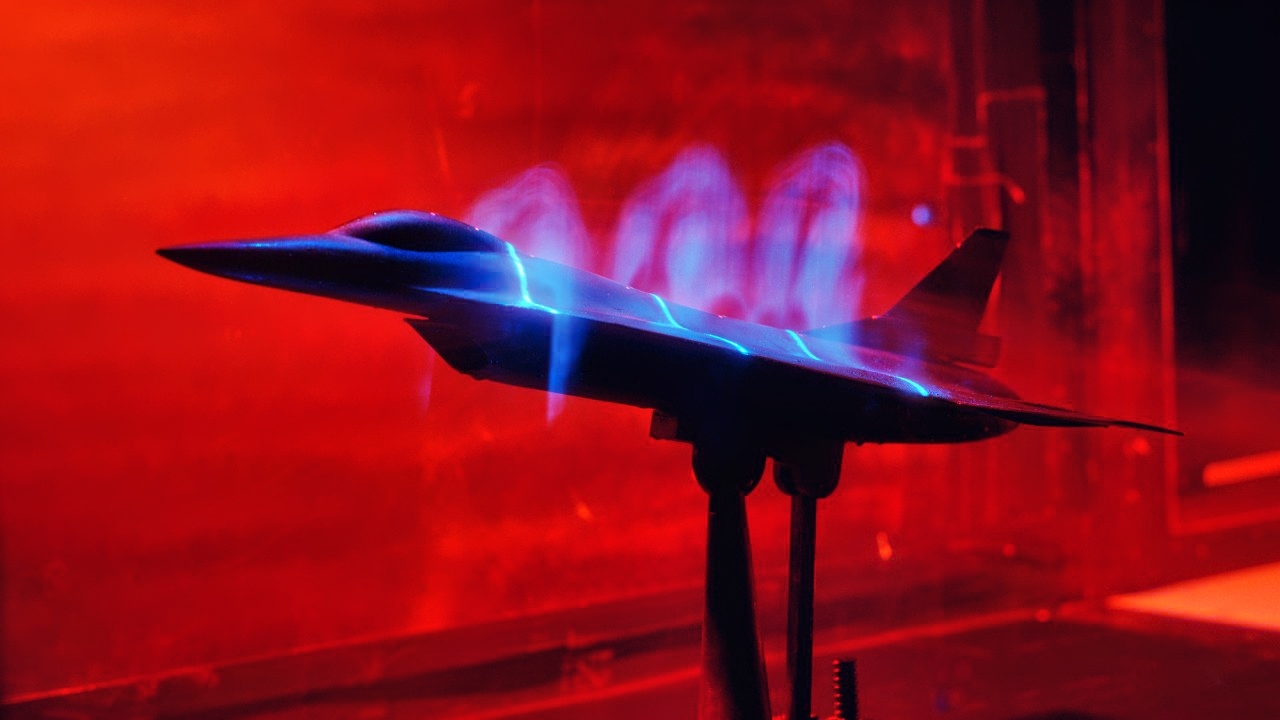
Key Points and Summary – The F-16XL was a radical, experimental variant of the iconic F-16, featuring a massive “cranked-arrow” delta wing.
-This innovative design gave it double the wing area, allowing it to carry twice the weapons and fly 50% farther than a standard F-16, with incredible maneuverability.

F-16XL. Image Credit: Creative Commons.
-Despite its impressive performance, the F-16XL lost the Air Force’s Enhanced Tactical Fighter competition in the 1980s to what would become the legendary F-15E Strike Eagle.
-The only two prototypes ever built were later transferred to NASA, where they served for years as valuable research aircraft.
The F-16XL, Oh What Could Have Been
The F-16 is one of the Air Force’s most iconic aircraft. They have been in service for nearly 47 years, and the US has built more than 4,600 of them. About 2,600 of them remain in service for the US Air Force.
This, more than anything else, speaks to what a superb aircraft it has been. It is used by 25 allied air forces, including the United States Air Force. There have been many variants over the nearly 50 years. And all of them were good.
But the F-16XL was different. And only two of those were ever built.
Meet The F-16XL
Only two F-16XLs were ever made. In 1981, the fighter entered the Air Force’s Enhanced Tactical Fighter (ETF) competition to select a replacement for the F-111 Aardvark. The F-16XL lost the bid, and the F-15 Eagle ultimately won the ETF competition, was adopted by the US Air Force, and has been mass-produced to become one of the most successful fighter aircraft in Air Force history.
The F-15 Eagle was the gold standard for fighter aircraft until the F-22 Raptor entered service with the USAF.
LTG Lawrence A. Skantze spoke when the first F-16XL rolled out on July 2, 1982. At the time, his role was the Commander of the Aeronautical Systems Division. He characterized ASD’s perspective as having “one foot in the present and one foot in the future.” And he was spot on.
General Skantze said that “somewhere out there is a new and advanced technology fighter,” and that sometime soon, the USAF’s present exploratory work would lead to the definition of that new aircraft.
Meantime, he said, it’s “our responsibility to take the fighter craft we have today and evolve those into higher performers, better performers, and improve their margin and hone the edge of their cutting abilities as the future goes before us.”
The F-16XL could attain a 5G turn in 0.8 seconds, half the time of an F-16A. A 9G turn takes just a tad longer. The XL design incorporates a “cranked-arrow” wing to a fifty-six-inch-longer fuselage.
The cranked-arrow design retains the advantages of delta wings for high-speed flight. Still, the usual disadvantages of delta wings were rectified by having the aft portion less highly swept than the forward section. It thus retains excellent low-speed characteristics and minimizes the trim drag penalties of a tailless delta.
The larger delta-wing design has a wing area that is more than double that of the standard F-16 (633 square feet vs. 300 square feet), resulting in reduced drag.
However, the longer-winged F-16XL was able to carry more fuel and a greater number of weapons. The enlarged wing allowed the new F-16 to store 65 percent more fuel, resulting in a 50 percent increase in range.
The massive delta wing allowed for more external hardpoints and, consequently, a larger weapons payload. The result was a jet that could deploy more weapons than its predecessors and could go further to deploy said weapons. And that marked a significant practical improvement over the F-16.
The XL had 17 hardpoints with a capacity of up to 15,000 pounds of payload (stations 2–5 and 13–16 were split into groups, similar to the F-15E). It carried double the armaments of an F-16. It had a 20 mm M61 Vulcan rotary cannon.
The XL was powered by the General Electric F110-GE-100 turbofan, producing 17,100 lbf of thrust dry and 28,900 lbf with afterburner. Top speed was Mach 2.0, or 1,534 mph. It had a climb rate of 62,000 feet per minute.
The F-16XL Could Have Been A Special Aircraft
Although the USAF could have opted to build more of the F-16XLs, as they would have made great fighter/attack aircraft, it was not to be. General Dynamics donated the two F-16XLs to NASA. However, judging by the success of the F-15 (which, coincidentally, is still in service), it is hard to argue with the decision.
The F-16XLs were used at Edwards Air Force Base in California in 1988. The idea was to study airflow around the wings, leading them to research how the F-16XL could accelerate to its top speed.
One of the tests included a 1995 sonic boom study, in which F-16XL #849 flew 200 feet behind a NASA SR-71 to probe the boundary of the SR-71’s supersonic shock wave. These tests measured and recorded the shape and intensity of the shock waves.
Those studies helped NASA’s High-Speed Civil Transport (HSCT) program engineers better understand supersonic shock waves, enabling them to reduce sonic boom intensity near populated areas.
Now the two F-16 XL aircraft are museum pieces; they were outstanding aircraft.
About the Author: Steve Balestrieri
Steve Balestrieri is a National Security Columnist. He served as a US Army Special Forces NCO and Warrant Officer. In addition to writing on defense, he covers the NFL for PatsFans.com and is a member of the Pro Football Writers of America (PFWA). His work was regularly featured in many military publications.
More Military
We Almost Touched the F-117 Stealth Fighter


Thomas A Mills
July 30, 2025 at 3:04 pm
Got to checkout the XL at Holoman AFB while they were there for RCS testing. They were parked on the ramp next to us. We were there with a couple of F4-G Wild Weasles beating the snot out of the Army’s Patriot System. The XL guys (Bernie Walker) gave us nice showing. The one thing I remember most were all the hard points and stub pylons.