

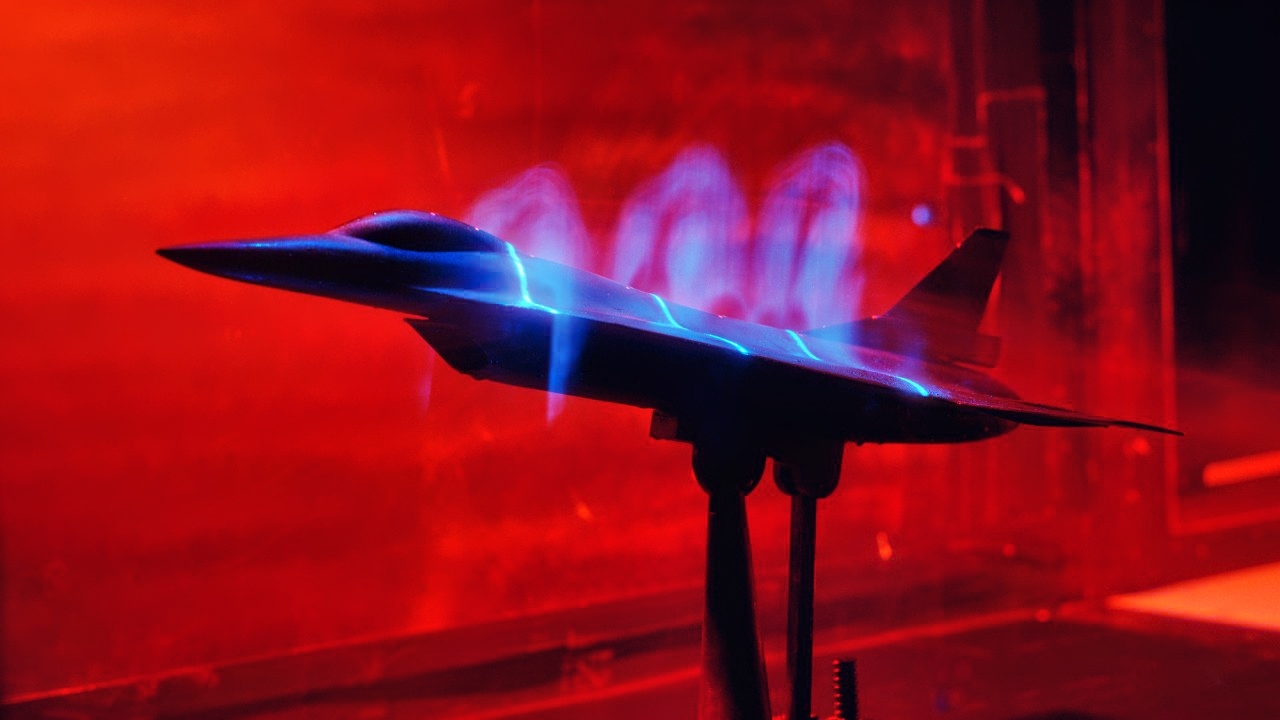
Key Points – The F-16XL was an experimental variant of the Fighting Falcon, extensively re-engineered in the late 1970s with a unique “cranked-arrow” delta wing.
-This design more than doubled the wing’s surface area, significantly increasing internal fuel capacity, weapons payload (up to 27 hardpoints), and supersonic performance.
-Despite its innovative design and impressive capabilities, the F-16XL lost the Air Force’s Dual-Role Fighter competition in 1984 to the F-15E Strike Eagle, which was seen as a lower-risk, twin-engine option.
-The two prototypes were later transferred to NASA for aeronautical research before being retired in 2009.
F-16XL in 4 Words: Air Force Said No
The F-16XL was an experimental variant of the F-16 Fighting Falcon. Designed to explore the potential of advanced aerodynamics, the F-16XL featured a radically different design from any other F-16 models. Rather than simply changing the internal electronics or upgrading the engine, the designers changed the F-16’s layout completely to maximize the jet’s speed and performance. The aircraft never entered production, losing to the F-15E Strike Eagle, and only two prototypes were ever produced.
The Supersonic Cruise and Maneuvering Program
The origins of the F-16XL go back to the late 1970s, when the U.S. invested heavily in supersonic capabilities.
The U.S. Air Force launched the Supersonic Cruise and Maneuvering Program (SCAMP), which aimed to develop technologies that would allow aircraft to sustain supersonic speeds without relying on afterburners, a capability known as supercruising.
General Dynamics, the manufacturer of the F-16, proposed a highly modified version of the F-16 to meet these goals. Initially funded internally, the project was designated the F-16 SCAMP. As the Air Force became more involved, the aircraft was redesigned as the F-16XL.
Two prototypes were built: a single-seat version (serial number 75-749) and a two-seat version (serial number 75-747).
These aircraft were not simple upgrades of the existing F-16A/B models. In fact, they were extensively re-engineered, with only about 40 percent of their structure shared with the original F-16.
The most dramatic change was the introduction of a cranked-arrow delta wing, which fundamentally altered the aircraft’s aerodynamic profile and performance characteristics.
Redesigning the Standard F-16
The unique looking cranked-delta wing was the centerpiece of the F-16XL’s design. This wing configuration significantly increased the aircraft’s surface area, more than doubling that of the standard F-16. This allowed for a much larger internal fuel capacity and the addition of numerous weapon hardpoints (up to 27), compared to the 9 hardpoints on a typical F-16.
The new wing also improved the aircraft’s lift-to-drag ratio, especially at supersonic speeds, which enhanced both range and speed.
Additionally, the wing provided better stability and control at high angles of attack, improving maneuverability.
To accommodate the new wing and increased fuel load, the fuselage was lengthened by 56 inches. The landing gear was also redesigned to fit into the thinner wing structure.
The aircraft was powered by a single Pratt & Whitney F100-PW-200 engine, the same engine used in the F-15 Eagle, which provided greater thrust than the engine used in the standard F-16.
In terms of performance, the F-16XL was impressive. It could reach speeds of Mach 2.05 and had a combat radius of approximately 1,100 miles, significantly greater than that of the standard F-16. Its service ceiling exceeded 50,000 feet, and it could carry up to 15,000 pounds of ordnance.
These capabilities made it a strong candidate for long-range strike missions and deep interdiction roles.
The F-16XL vs the F-15E
The F-16XL was entered into the U.S. Air Force’s Dual-Role Fighter (DRF) competition in the early 1980s. This competition sought a replacement for the aging F-111 Aardvark, with a focus on aircraft that could perform both air-to-air and air-to-ground missions.
The F-16XL competed against the F-15E Strike Eagle, a modified version of the F-15 air superiority fighter.
Despite the F-16XL’s innovative design and strong performance, the Air Force ultimately selected the F-15E in 1984.
Several factors influenced this decision. The F-15E was considered a lower-risk option because it was based on an existing, proven airframe. It also offered greater payload and range capabilities, thanks to its twin-engine configuration. Additionally, the F-15E could be developed and fielded more quickly than the F-16XL, which would have required more extensive testing and development.
The F-16XL at NASA
Although the F-16XL did not win the competition, the aircraft was not done for just yet. Both prototypes were transferred to NASA in the late 1980s, where they were used extensively for aeronautical research. NASA employed the F-16XL in a variety of experimental programs, including studies on laminar flow control, which aimed to reduce drag by maintaining smooth airflow over the wings.
The aircraft was also used in research related to commercial supersonic transport technologies and advanced flight control systems.
Although the data gained from NASA’s experiments was immensely useful, the F-16XL did not quite provide the results that the researchers intended.
The two F-16XLs were placed in storage and upgraded with new technology from the USAF’s F-16 block 40. In 2009, however, both aircraft were finally retired for good and stored at Edwards AFB.
These studies ultimately ended in failure, but they provided valuable data that contributed to the development of future aircraft, including the F-22 Raptor and the F-35 Lightning II.
The legacy of the F-16XL is significant, despite its limited production. Its innovative wing design has influenced other aircraft, particularly in the realm of unmanned aerial vehicles and conceptual supersonic transports.
The aircraft also demonstrated the feasibility of transforming a lightweight fighter into a long-range strike platform, a concept that has become increasingly relevant in modern multirole fighter design. Furthermore, the data gathered from NASA’s research flights helped shape the next generation of military and civilian aircraft.
About the Author:
Isaac Seitz, a Defense Columnist, graduated from Patrick Henry College’s Strategic Intelligence and National Security program. He has also studied Russian at Middlebury Language Schools and has worked as an intelligence Analyst in the private sector.
Aircraft Carrier Drama
The Navy’s Ford-Class Aircraft Carrier Is Obsolete


